1640–1713 · 17th century
Jansenism: Jansen's Augustinus, Arnauld, Pascal and the Condemnations from In eminenti to Unigenitus
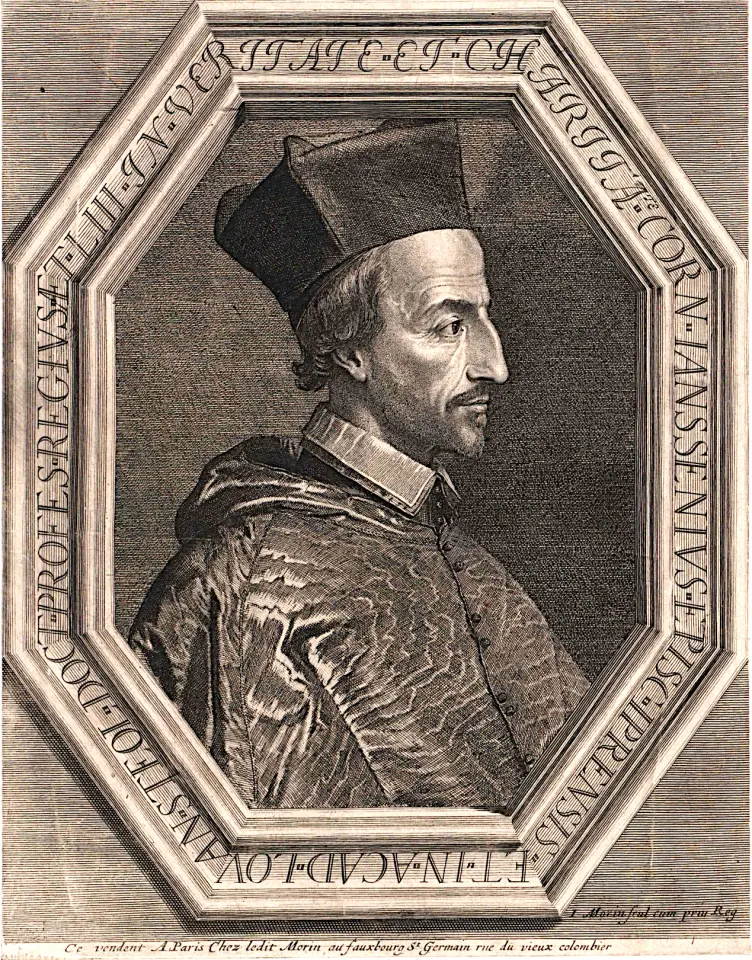
Cornelius Jansen (1585–1638), bishop of Ypres, troubled by moral decline and by the church's departure from Augustine's teaching on grace, left the Augustinus, published posthumously in Louvain (1640) – according to González, a defense of the most radical interpretation of Augustine, directed against Molinism. After the fall the will is enslaved and capable only of evil; what is needed is "healing grace", irresistible and infallible, yet acting so gently that the will does not know it is being led; predestination is absolute and double. Antoine Arnauld carried these principles over into piety and church discipline, and the movement took on the character of resistance to church authority. Condemnations followed – from the bull In eminenti (1643) and the five propositions (1653) to the bull Unigenitus (1713); Pascal defended Arnauld in the Provincial Letters.
Positions
- Molina
- Freedom excludes necessity as well; the support of grace is sufficient for the will
- Jansen and the Jansenists
- Every voluntary act is free, even one done out of inner necessity; healing grace is irresistible; the will is enslaved by concupiscence; a return to Augustine's teaching on grace and to moral strictness
- The Jesuits
- According to Lane, the fiercest opponents of Augustine's teaching; they secured the condemnation of the five propositions; Pascal ridiculed their doctrine of "probability" (Provincial Letters 5)
- Rome and Louis XIV
- The five propositions are contained in Jansen and are justly condemned
Key points
- Before the fall Adam had a freedom of "indifference"; original sin destroyed it; humanity is a "mass of damnation"; Jansen denied any similarity to Calvin
- The three volumes of the Augustinus: Pelagianism, Augustine's teaching on grace, freedom and predestination, the similarity of Molinism to Pelagius
- The Jansenists acknowledged the five propositions to be heretical but denied that Jansen had taught them; many French priests refused to sign the formulary
- Pascal (Provincial Letters 18, 1657): Jansen's doctrine of grace is not the sense of Calvin but "the divine principles of St. Augustine and St. Thomas" (the Thomists)
- The movement became politicized and by the eighteenth century had become an ally of Gallicanism; the last Jansenists were Jacobins
- Shelley: Jansen, defending Catholicism against Calvinists, returned to Augustine: election before the world’s foundation, no salvation without grace. After Trent the weight of good works grew so that Jansen felt it diminished Christ’s work; the Jesuits relied on reason
Outcome
Jansenism was condemned; the abbey of Port-Royal refused to submit; a permanent schism arose in the Netherlands; in France, according to González (HCT), Jansenism merged into the forces that led to the Revolution.
People
- Cornelius Jansen
- Antoine Arnauld
- Blaise Pascal
- Urban VIII
- Innocent X
- Clement XI
- Henri Grégoire
Terms
- healing grace
- For Jansen, the grace that determines the will toward God and leads it infallibly and irresistibly.
- doctrine of probability
- Jesuit casuistry according to which an action approved by any authority cannot be considered a sin (as Lane describes it).
Place
Louvain, Paris, Port-Royal, Rome
Sources disagree
The Augustinus – 1640 (González); the Inquisition's ban – 1641; In eminenti – 1643; the five propositions – 1653 (all books); Arnauld's trial – 1655 (Lane); the Provincial Letters – 1656–1657 (the first is dated 23 January 1656); Unigenitus – 1713; Lane does not give the year the Augustinus appeared.
Sources
Primary sources
- Pascal – The Provincial Letters, letters 1, 5, 18
Textbooks
- Justo L. González – A History of Christian Thought in One Volume (Abingdon, 2014), p. 346–347
- Justo L. González – A History of Christian Thought, vol. III: From the Protestant Reformation to the Twentieth Century (Abingdon, rev. ed. 1987), p. 236–239
- Tony Lane – Christian Thinkers (Russian edition), p. 223–224
- Bruce L. Shelley – Church History in Plain Language (Russian edition), Ch. 33, sec. «Воззвания к «дешевой благодати»»
Related entries
- Response to: Catholic Controversies on Grace after Trent: Baius, Báñez, Molina and the De Auxiliis Controversy (1567–1606)
- Develops: Augustine, "Doctor of Grace": Efficacious Grace and Predestination (397–430)
In church history
- The Jansenist Controversy (1640–1713)
Data compiled: 2026-11-17