431–433 · 5th century
Cyril of Alexandria, the Council of Ephesus (431) and the Formula of Union (433)
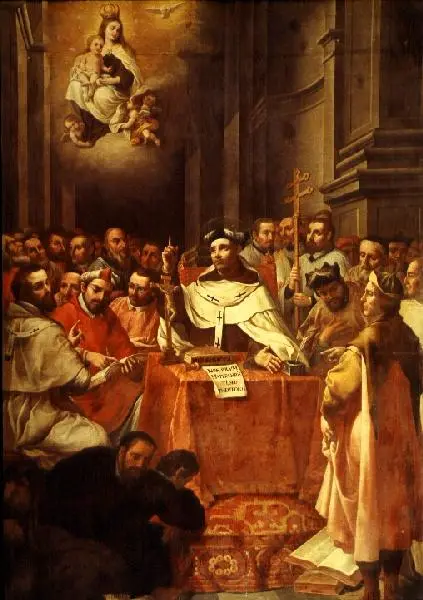
Against the "dividing" christology of Nestorius, Cyril taught that Christ is not a man in whom God dwelt but God the Word become flesh: the divine and the human are united "hypostatically", the Lord's humanity has no hypostasis of its own and exists in the Word, and therefore Mary is Theotokos. In the Second Letter (early 430) he asks Nestorius to hold to the teaching of the fathers and the Nicene Creed (pars. 2–3), and in the Third Letter he demands that Nestorius accept twelve anathemas (par. 12: the letter has set forth what Nestorius must anathematize); Nestorius refused. In 431 Theodosius II convened a council at Ephesus; Cyril opened it before the Antiochenes arrived, Nestorius was condemned and deposed, the Second Letter was approved as a document of the ecumenical faith, and Mary was proclaimed Theotokos. The Antiochenes, arriving under John of Antioch, held their own council and deposed Cyril, while the Roman legates supported Cyril. In 433 the sides were reconciled: Cyril accepted a moderate Antiochene document – the Formula of Union (Christ is perfect God and perfect man, consubstantial with the Father in Godhead and with us in humanity, a "union of two natures", Mary is Theotokos), and the Antiochenes agreed to the deposition of Nestorius.
Positions
- Cyril and his side (over 200 bishops)
- One Christ, hypostatic union; Mary is Theotokos; the flesh suffers, not the divinity; Nestorius is deposed
- Antiochenes (John of Antioch, about 30 bishops)
- Deposed Cyril and Memnon; accused the council of the Apollinarian, Arian and Eunomian heresies
- Hall
- The fourth anathema (the ban on dividing the sayings about Christ between "two persons, i.e. two hypostases") curses an entire tradition
- Theodoret (mature)
- One hypostasis (person), two natures; the doctrines of the Gospel lie between division into two sons and one nature
Key points
- Lane: Cyril wrote (Second Letter to Nestorius 3): "the difference of the natures is not taken away by the union"; Lane considers the differences between the Formula and Cyril’s teaching an illusion
- Berkhof: by applying "nature" only to the Logos and as a synonym of "hypostasis", Cyril gave Eutyches and the Monophysites grounds to appeal to him
- Hall: the council affirmed the Nicene Creed as the sole standard of orthodoxy (canon 7) and condemned Pelagianism. Hall sees in the Formula the teaching of Nestorius later adopted by Chalcedon; in the Eranistes Theodoret set out the Word’s immutability, unmixed natures and divine impassibility, two of which became key at Chalcedon.
- In 433 Cyril allowed biblical expressions to be shared between the natures, retreating from the fourth anathema, but kept “one nature of God the Word incarnate”
- Theodoret of Cyrrhus, at first a supporter of Nestorius, came to distinguish one hypostasis and two natures
- Lebedev: the council at Ephesus composed no doctrinal definitions in the proper sense and read only Alexandrian and Western fathers. The true end of the council is the union of 433, where John of Antioch’s confession combined the Antiochene formulas (“temple”, “unconfused union”) and the Alexandrian (“Theotokos”, “union”).
- Daley: Theodoret of Cyrus, defender of Nestorius yet the most moderate Antiochene, argues in Eranistes that a literal John 1:14 implies change in the Word: the man, not ‘the divine nature’, suffered on the Cross, and the two sets of properties unite only in the prosopon of Word and Jesus. For Cyril the subject of the saving acts is God the Word; he teaches “union according to hypostasis” and the Word’s appropriation of the flesh, and deliberately uses “shocking” exchange of properties: the Word suffered in the flesh, “suffered impassibly,” the Eucharist is the Word’s flesh. Cyril allowed Christ’s divinity and humanity to be distinguished only ‘in thought’: ‘the two are no longer two but one living being’ (To Succensus 5). He preferred ‘suffering in the flesh’ to ‘in human nature’: the Word makes his flesh’s suffering his own, remaining impassible by nature.
- Russell: Cyril distinguished three models of recapitulation: moral, physical (overcoming death) and spiritual (making believers children of God). He distinguished natural from relative, moral participation; in the latter we become through Christ ‘partakers of the divine nature’ (2 Pet. 1:4). Participation is begun by baptism and sustained by the Eucharist, which transforms the body as well.
Outcome
Nestorius was deposed and exiled; the council was recognized as the third Ecumenical Council; the schism between Alexandria and Antioch lasted until the agreement of 433, and the Formula of Union later entered the Chalcedonian Definition; the hypostatic union, according to González, became a mark of orthodoxy.
People
- Cyril of Alexandria
- Nestorius
- John of Antioch
- Memnon of Ephesus
- Celestine I
- Theodosius II
- Theodoret of Cyrrhus
- Sixtus III
Terms
- hypostatic union – καθ᾽ ὑπόστασιν
- Christ's humanity belongs not to another person but to the Word himself; according to Pelikan, the formula was not a philosophical definition.
- one incarnate nature of the Word
- A formula Cyril took from texts attributed to Athanasius but, according to González and Lane, belonging to Apollinaris.
- natural union – ἕνωσις φυσική
- The formula of the third anathema; according to Hall, highly vulnerable.
- consubstantial – homoousios
- Of one essence: with the Father according to the Godhead, with us according to the humanity. The most disputed, non-biblical word of the creed.
Place
Ephesus
Sources disagree
Hall: the council was set for Pentecost 431; Lane: June 431; Berkhof does not give the year. The Second Letter – early 430 (Hall); Cyril died in 444 (Lane). The Formula of Union – 433 (Hall, Lane). Lebedev: the union – 433, coming "into full force" in 438; he dates the adherence of the whole Patriarchate of Antioch to 437.
Sources
Primary sources
- Cyril of Alexandria – Second Letter to Nestorius, para. 2–7
- Cyril of Alexandria – Third Letter to Nestorius (with the Twelve Anathemas), para. 12; anathema 4
Textbooks
- Stuart G. Hall – Doctrine and Practice in the Early Church (Russian edition), p. 139–144, 147
- A. P. Lebedev – History of the Ecumenical Councils, part I, p. 133–134, 138, 149–165, 187, 196–197, 209
- Jaroslav Pelikan – The Christian Tradition: A History of the Development of Doctrine, vol. 1 (Russian edition), p. 277–279
- Louis Berkhof – History of Christian Doctrines (Russian edition), p. 71–72
- Justo L. González – A History of Christian Thought in One Volume (Abingdon, 2014), p. 155–159
- Tony Lane – Christian Thinkers (Russian edition), p. 59–62
- The Oxford Handbook of Christology, ed. Francesca Aran Murphy (2015), p. 173, 173–175, 175–177, 176, 178, 203; 210–211
Related entries
- Response to: Nestorius and the dispute over the title "Theotokos" (428–431)
- Rejects: The Pelagian Controversy over Grace and the Condemnation of Pelagianism (409–431)
- Developed in: The Chalcedonian Definition: one person in two natures (451)
In church history
- The Nestorian controversy and the Third Ecumenical Council of Ephesus (431); the Union of 433 (428–431 (council – June 431); union of 433 (established by 437–438))
Data compiled: 2026-11-17