451 · 5th century
The Chalcedonian Definition: one person in two natures
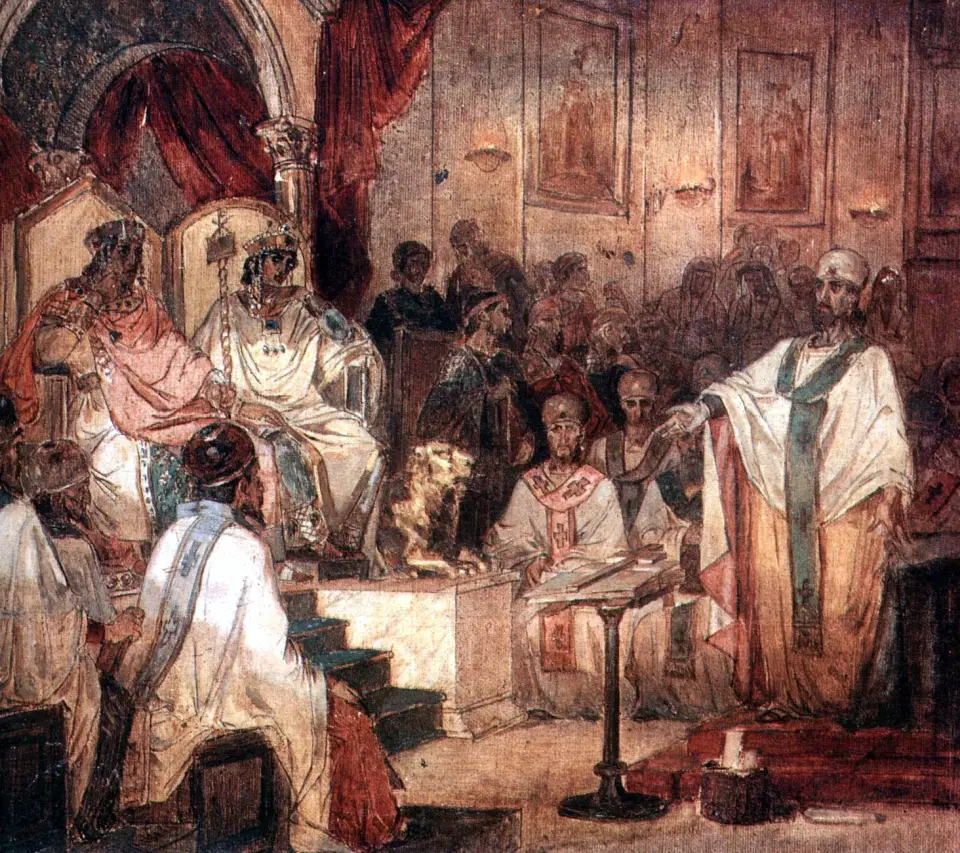
The council convened by Emperor Marcian at Chalcedon in 451 deposed Dioscorus and Eutyches, restored the Antiochenes condemned in 449 and approved Cyril's letters and Leo's Tome. The Definition confesses one and the same Christ, perfect in Godhead and in humanity, of a rational soul and body, consubstantial with the Father in Godhead and with us in humanity, like us in all things except sin; born of Mary the Theotokos, acknowledged "in two natures without confusion, without change, without division, without separation", the properties of each being preserved and coming together in one Person and one Hypostasis. At Rome's insistence it says "in two natures" rather than "from two natures". According to Pelikan, the Definition was composed of ready-made elements: Cyril's letters, the formula of 433, Leo's Tome and an expression of Theodoret.
Positions
- Eutyches (according to the Definition)
- Mixing of the natures
- Nestorius (according to the Definition)
- Division into two persons (a "double Son")
- The Eastern majority
- Preferred the wording "from two natures"
- Opponents of a new definition
- The seventh canon of Ephesus (431) forbids composing another faith
Key points
- Lane: the Definition is summed up in the phrase "One person in two natures" and guards against four heresies – Arius, Apollinaris, Nestorius, Eutyches; Chalcedon drew boundaries – "a restraining fence rather than a straitjacket". The Athanasian Creed (c. 500, southern Gaul) sets out in Western terms a doctrine similar to Chalcedon’s and rejects all four heresies condemned by Chalcedon
- Hall: Cyril's formula "one nature of God the Word incarnate" did not enter the text
- González: the formula "from two natures" was not explicitly condemned
- Pelikan: the Definition left unresolved the question of the subject of suffering and the soteriology of deification; an "agreement to disagree"
- Lebedev: the draft “from two natures” provoked the Roman legates’ protest; after “Leo or Dioscorus?” “in two natures” was adopted. At some fathers’ demand “Theotokos” was added; the definition is close in letter to John of Antioch’s confession, to Leo’s letter only in spirit
- Louth: the Chalcedonian Definition is not only a concluding formula: it endorses the creeds, Cyril’s letters and Leo’s Tome, and only then gives its own.
- Shelley: the Chalcedonian formula may need more accessible explanation today, but one cannot say less than the Church said. The creeds left the mystery untouched; per J. Whale, praise is the safest way to approach it: ‘The living Church is the singing Church’. Following C. Williams, he calls revolt against the creeds of Nicaea and Chalcedon a revolt of ‘immature sensibility’.
- Gunton: the Chalcedonian Definition (451) brought christology to a kind of closure and stood unquestioned in most of the church until the modern era.
Outcome
The Definition became the ecumenical standard of orthodoxy and was accepted at once in the West; Egypt and other regions did not accept it, dissident groups arose, and the christological controversies continued. Pelikan calls Chalcedon the second watershed alongside Nicaea. Lebedev holds that by its address to Marcian on the legitimacy of unfolding dogmas against heresies the council "blessed theological science forever".
People
- Marcian
- Pulcheria
- Leo the Great
- Cyril of Alexandria
- Theodoret of Cyrrhus
- Dioscorus of Alexandria
- Eutyches
- Flavian of Constantinople
Terms
- without confusion, without change, without division, without separation – ἀσυγχύτως, ἀτρέπτως, ἀδιαιρέτως, ἀχωρίστως
- Four negative qualifications of the union of the natures; according to Hall, the first two were taken from Theodoret, and the last two added to avoid charges of Nestorianism.
- in two natures / from two natures – ἐν δύο φύσεσιν / ἐκ δύο φύσεων
- The traditional formula "from two" became suspect because of the phrase of Dioscorus and Eutyches "from two, one".
- hypostasis, person – hypostasis, prosopon
- One hypostasis and one person into which both natures come together.
Place
Chalcedon
Sources disagree
All books: 451; Lane specifies October 451. Lebedev: the first session – 8 October, the deposition of Dioscorus – 13 October, the acceptance of Leo's letter – 17 October; he dates the session on the definition to 21 October (part II) and to 22 October (part I); the solemn confirmation in Marcian's presence – 25 October 451.
Sources
- Stuart G. Hall – Doctrine and Practice in the Early Church (Russian edition), p. 152
- A. P. Lebedev – History of the Ecumenical Councils, part I, p. 198–208, 210–236, 241–243, 338
- A. P. Lebedev – History of the Ecumenical Councils, part II, p. 272–286, 289–298, 319–320
- Jaroslav Pelikan – The Christian Tradition: A History of the Development of Doctrine, vol. 1 (Russian edition), p. 279–284
- Jaroslav Pelikan – The Christian Tradition, vol. 2: The Spirit of Eastern Christendom (600–1700) (Russian edition), p. 118–120
- Louis Berkhof – History of Christian Doctrines (Russian edition), p. 72–73
- Justo L. González – A History of Christian Thought in One Volume (Abingdon, 2014), p. 162–163
- Tony Lane – Christian Thinkers (Russian edition), p. 47, 65–67, 93–94
- The Oxford Handbook of Christology, ed. Francesca Aran Murphy (2015), p. 183–184
- Bruce L. Shelley – Church History in Plain Language (Russian edition), Ch. 11, sec. «И Слово стало плотью», «Пределы истины»
- The Cambridge Companion to Christian Doctrine, ed. Colin E. Gunton (1997), p. 28
Related entries
- Develops: Eutyches, the Tome of Leo the Great and the "Robber Synod" of 449 (448–449)
- Develops: Cyril of Alexandria, the Council of Ephesus (431) and the Formula of Union (433) (431–433)
- Answered by: The Monophysites after Chalcedon, the Henoticon and the Fifth Council (553) (451–553)
- Developed in: Monoenergism, Monothelitism and the Sixth Ecumenical Council: two wills in Christ (638–681)
In church history
- The Fourth Ecumenical Council (Chalcedon) (8 October – 10 November 451)
Data compiled: 2026-11-17