1859 and 1871 · 19th century
Darwin's Origin of Species and theologians' response
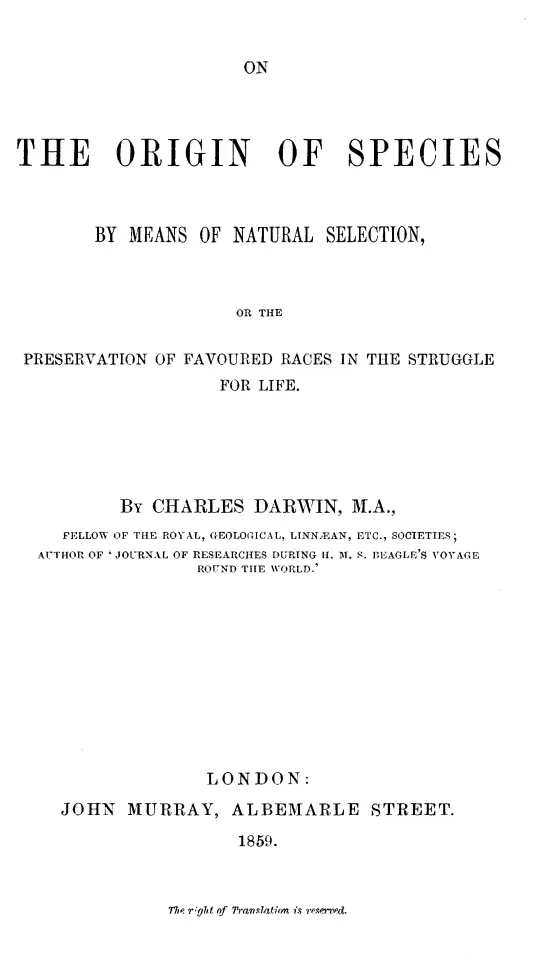
In 1859 Charles Darwin published On the Origin of Species by Means of Natural Selection, and in 1871 The Descent of Man. The theory conflicted with a literal reading of the biblical creation account. This sparked a long-running conflict between science and religion.
Theologians split into three camps. A minority rejected the theory outright. A majority tried to accommodate it within traditional theology. And some, like Pierre Teilhard de Chardin later, sought to rethink theology itself in light of evolution.
Key points
- Origin of Species (1859) and The Descent of Man (1871)
- Conflict with a literal reading of the book of Genesis
- Three theological responses: rejection, accommodation, and rethinking (Teilhard de Chardin)
- Shelley: after the Civil War ‘Christian America’ took three blows: first Darwin’s Origin of Species (1859), raising the question of the Creator and Genesis; then industrialization, urban growth and immigrants from Germany, Norway and Italy with other religious views; finally criticism of the Bible ‘from above’: professors with European degrees taught that Moses did not write the Pentateuch, and evangelicals split. The geology of Hutton and Lyell prepared the ground for Darwin; some rejected evolution, liberals reconciled with it.
People
- Charles Darwin
Place
England
Sources
- J. North – A History of the Church (Russian edition), p. 316
- Tony Lane – Christian Thinkers (Russian edition), p. 305
- Bruce L. Shelley – Church History in Plain Language (Russian edition), Ch. 39, sec. «Культурный шок христианской Америки»; Ch. 40, sec. «Милости просим, Чарлз Дарвин!»
More on the doctrine
- Creation, Science and Evolution: from the Scientific Revolution to Tennant, Teilhard de Chardin and Ramm (16th–20th centuries)
Data compiled: 2026-11-09