1571–1577 · 16th century
Lutheran christology: the communication of properties and the ubiquity of Christ's humanity
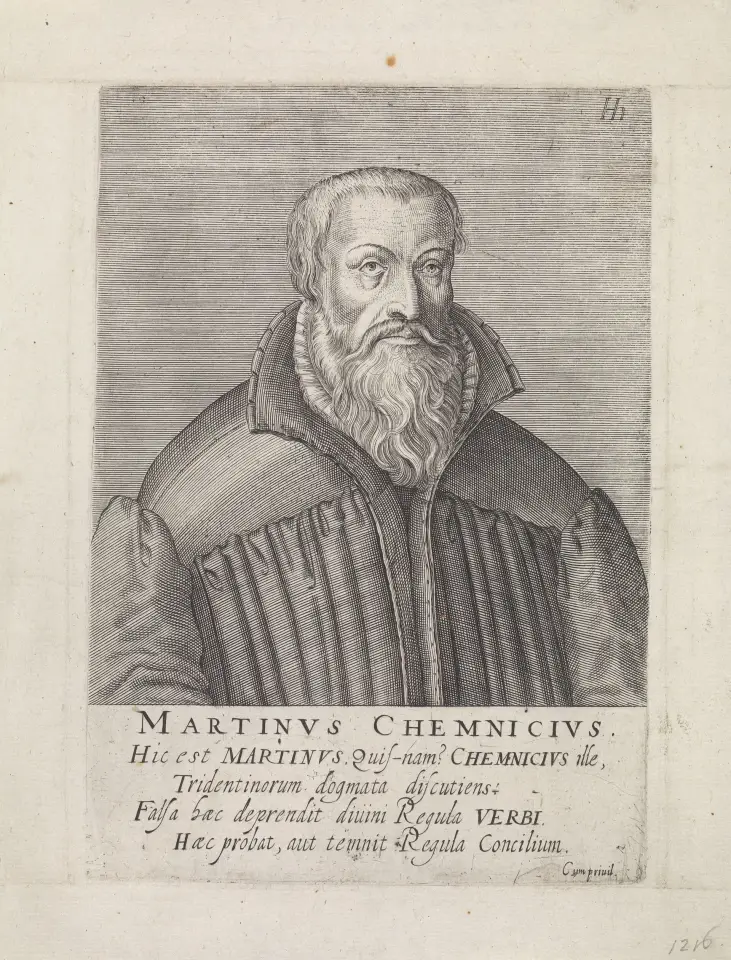
Luther's teaching on the real presence in the Supper, according to Berkhof, led to the recognition of the ubiquity of Christ's human nature: each nature permeates the other, and the humanity possesses the attributes of divinity. The Lutherans understood the communication of properties literally, while the Reformed stressed the distinction of the natures and limited it. In 1571 Martin Chemnitz, in the treatise On the Two Natures in Christ, taught that the humanity received the attributes of divinity in the incarnation itself, and that the limitations of Jesus' earthly life were imposed by will; instead of "ubiquity" he spoke of "multivolipresence" – Christ's body is present wherever he chooses. The Formula of Concord (1577) adopted the communication of properties "in deed and truth" (Epitome VIII.2): "This majesty He always had according to the personal union, and yet He abstained from it in the state of His humiliation", exercising it when it pleased Him (VIII.16).
Positions
- Strict Lutherans
- Christ's humanity possesses divine attributes; Christ's body is ubiquitous
- The Reformed and the "Crypto-Calvinists"
- The properties of each nature are ascribed to the Person; the body cannot be in heaven and on many altars at once
- Giessen theologians (Chemnitz)
- In humiliation Christ laid aside the divine attributes or used them occasionally
- Tübingen theologians (Brenz)
- Christ always possessed the divine attributes but concealed them
Key points
- Berkhof: ascribing human properties to the divine nature soon fell away; he calls the Formula of Concord ambiguous and inconsistent: it leans towards the Giessen view, which came to prevail. In Quenstedt the presence of divine powers in the humanity becomes merely a possibility
- González: for Chemnitz "God is man and man is God", Mary is "Theotokos"; his teaching was later taken up by Lutheran scholasticism
- Lugioyo: in the Confession Concerning Christ’s Supper (1528) Luther took from the scholastics three modes of presence: local, definitive, repletive (God alone). Christ is present in the Eucharist definitively, like angels; the unity of natures gives the human nature omnipresence – the later genus maiestaticum. Luther demanded the two natures stay inseparable in one person; his move is “super-Alexandrian”: properties communicate between natures too. Congar, Lienhard and Loofs fear docetism in Luther; Bayer and Hinlicky reply that his teaching refutes docetism. For Luther the communication of properties runs both ways and puts suffering into God’s life; Lienhard calls this “Dei-passianism”, not patripassianism. This idea influenced Barth, Bonhoeffer and Moltmann; per Steiger the communicatio idiomatum is the “hermeneutical motor” of Luther’s whole theology. The Christology of Luther’s heirs grew from his Eucharistic writings; Chemnitz, “the second Martin”, built it on Luther’s reflections. The Christological article of the Formula of Concord (1577) draws mainly on Luther, with over ten citations of his 1528 Confession on the Supper
- Elliott: the Swabians pushed the argument from the Supper back to earthly life: if the exalted Christ is omnipotent and ubiquitous, so was Jesus of Nazareth. Chemnitz reversed the direction: not the Eucharist determines Christology but the incarnation; the genus maiestaticum makes presence possible. The Tübingen theologians (Hafenreffer, Osiander, Thumm) spoke of perichoresis of natures and the “concealment” (krypsis) of Christ’s human power. The Giessen theologians taught a “kenosis of use”: Christ’s humanity received majesty only after the resurrection; Mentzer taught that the ubiquity of Christ’s humanity rests on promise and is only presence of God’s action. For Giessen the Logos rules “not through the flesh”; Tübingen saw this as akin to the Reformed extra calvinisticum. Most Lutherans did not hold that Christ’s humanity shared in the Word’s universal dominion, but believed him somehow universally present to creatures. With Giessen’s victory the two-states doctrine entered Lutheran theology as a settled category; Gerhard’s influence advanced the genus tapeinoticum, and he took the triple office from Calvin. Buddeus rejected Tübingen’s “hidden use” and read the offices morally. Spener saw kenosis as the core of the incarnation’s mystery; Mosheim assigned “Sonship” to the doctrine of God, freeing Christology for a human person
- Mattox: Luther explained Christ’s body on many altars by the ubiquity of his humanity (“repletive”); Lutherans accepted this only in softened form.
Outcome
A Lutheran christology of the communication of properties, tied to Christ's will, took shape; on the question of humiliation the Giessen view prevailed. Berkhof notes that some Lutherans today tend to accept the Reformed view.
People
- Martin Luther
- Martin Chemnitz
- Brenz
- Johann Andreas Quenstedt
- Theodor Thumm
- Balthasar Mentzer
- Lucas Osiander the Younger
Terms
- communication of properties – communicatio idiomatum
- The transfer of the properties of one of Christ's natures to the other: the actions and states of the humanity may be ascribed to the divinity and vice versa. In Luther and strict Lutherans, the basis of the ubiquity of Christ's body.
- multivolipresence
- The capacity of Christ's body to be in several places by his will.
Sources disagree
González: Chemnitz's treatise – 1571, the Formula of Concord – 1577; Berkhof: 16th century (ubiquity) and 16th–17th centuries (the Giessen–Tübingen dispute) without exact dates. Elliott: the Tübingen–Giessen dispute over kenosis and ubiquity belongs to the seventeenth century: L. Osiander II – 1617, Thumm – 1621 and 1628, Mentzer condemned in 1622, Meisner – 1624, Decisio Saxonica – 1624 (the entry's 1571–1577 is the start of the dispute)
Sources
Primary sources
- Formula of Concord, pt. 1, art. 8
Textbooks
- Louis Berkhof – History of Christian Doctrines (Russian edition), p. 79–80
- Justo L. González – A History of Christian Thought, vol. III: From the Protestant Reformation to the Twentieth Century (Abingdon, rev. ed. 1987), p. 131–133
- The Oxford Handbook of Christology, ed. Francesca Aran Murphy (2015), p. 339, 339–341, 341, 329, 370–371, 371–373, 372–374, 374, 371–374, 375–376, 371, 372–373
- The Oxford Handbook of Sacramental Theology, ed. Hans Boersma, Matthew Levering (2015), p. 339–340
Related entries
- Rejected in: Calvin: the distinction of natures, the "extra calvinisticum" and the threefold office (1536–1566)
- Develops: Zwingli, the Supper controversy and the Marburg Colloquy (1529) (1523–1529)
Data compiled: 2026-11-17