1618–1648 · 17th century
The Thirty Years' War
The Peace of Augsburg had not covered Calvinists and left the choice of religion to rulers alone. In 1606 disturbances broke out at Donauwörth, and Maximilian of Bavaria forcibly re-Catholicized the town. After this a Protestant Union formed in 1608, and a Catholic League a year later.
In Prague in 1618, Protestants threw two royal councillors out of a window, touching off the war. The Catholic League's army crushed Frederick of the Palatinate, whom the Bohemians had elected king. Bohemia's population fell by four-fifths.
Denmark under Christian IV entered the war in 1625 and was defeated. In 1630 Sweden's Gustavus Adolphus invaded Germany and defeated the League at Leipzig. But he died victorious at Lützen.
After that the war degenerated into plunder and power struggles. Catholic France under Cardinal Richelieu backed the Protestants against the Habsburgs.
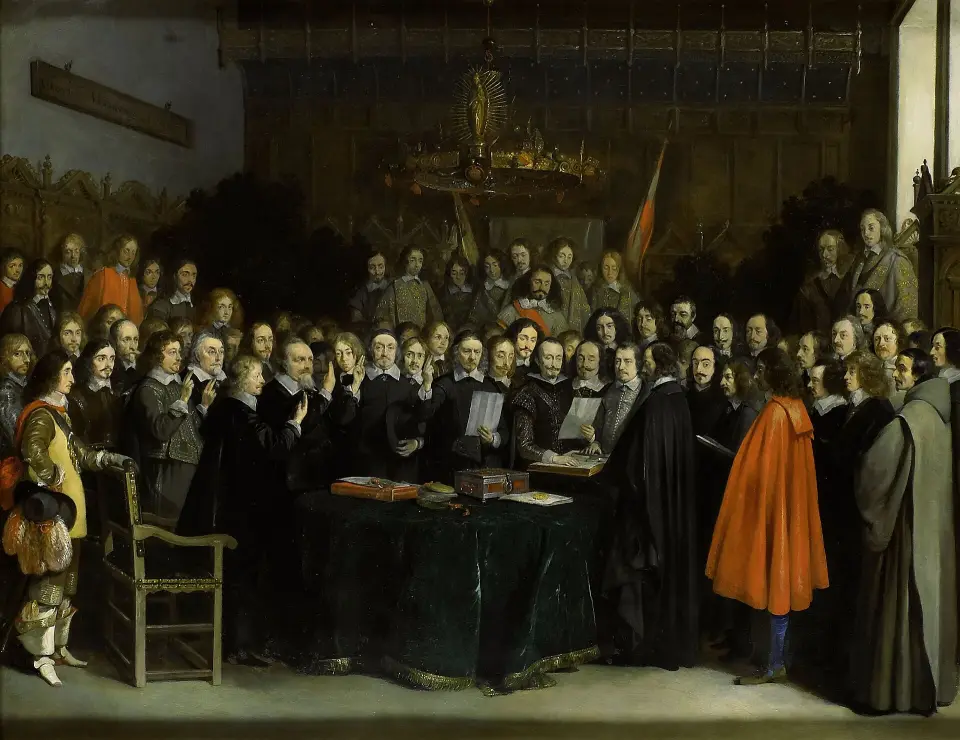
The bloodiest pan-European war before the twentieth century ended in 1648 with the Peace of Westphalia.
Key points
- The Defenestration of Prague (1618) as the war's trigger
- Bohemia crushed, its population falling by four-fifths
- Sweden's Gustavus Adolphus intervenes and dies at Lützen (1632)
- Catholic France under Richelieu backed the Protestants against the Habsburgs
- Ended by the Peace of Westphalia (1648)
- Shelley: the Thirty Years’ War began in Bohemia (1618), where Ferdinand II tried to root out Protestantism; the Bohemians lost near Prague in 1620. Christian IV of Lutheran Denmark entered the war against Frederick and the Catholic forces but was crushed in the Harz mountains in 1626. Then Sweden’s Gustavus Adolphus invaded Germany as Protestantism’s new leader, moved by conviction and the empire’s hold on the Baltic; victories took him to Munich, Protestants called him the “Lion of the North”; at Lützen (1632) the Swedes won but Adolphus fell. The war outlasted him but its outcome was clear: Catholics could not conquer the Protestant north, nor Protestants the south. In the last years religion no longer stirred anyone: France and Spain, nominally Catholic, fought for political advantage in the Rhineland. Germany lay in ruins and split into three hundred states; Catholic and Calvinist zeal cooled, and denominationalism became the alternative.
People
- Rudolf II
- Maximilian of Bavaria
- Ferdinand II
- Frederick V of the Palatinate
- Albrecht von Wallenstein
- Christian IV
- Gustavus Adolphus
Place
Donauwörth; Prague; Bohemia; Germany; Lützen
Sources disagree
The books date the war's start to the 1618 Prague defenestration; the background (Donauwörth 1606, Union 1608, League 1609) is given without one single precise date.
Sources
- Justo L. González – The Story of Christianity, vol. II (Russian edition), Part 2, ch. 15
- J. North – A History of the Church (Russian edition), p. 284–287
- Bruce L. Shelley – Church History in Plain Language (Russian edition), Ch. 31, sec. «Тридцатилетняя война»
Data compiled: 2026-11-09