1618–1619 · 17th century
The Synod of Dort
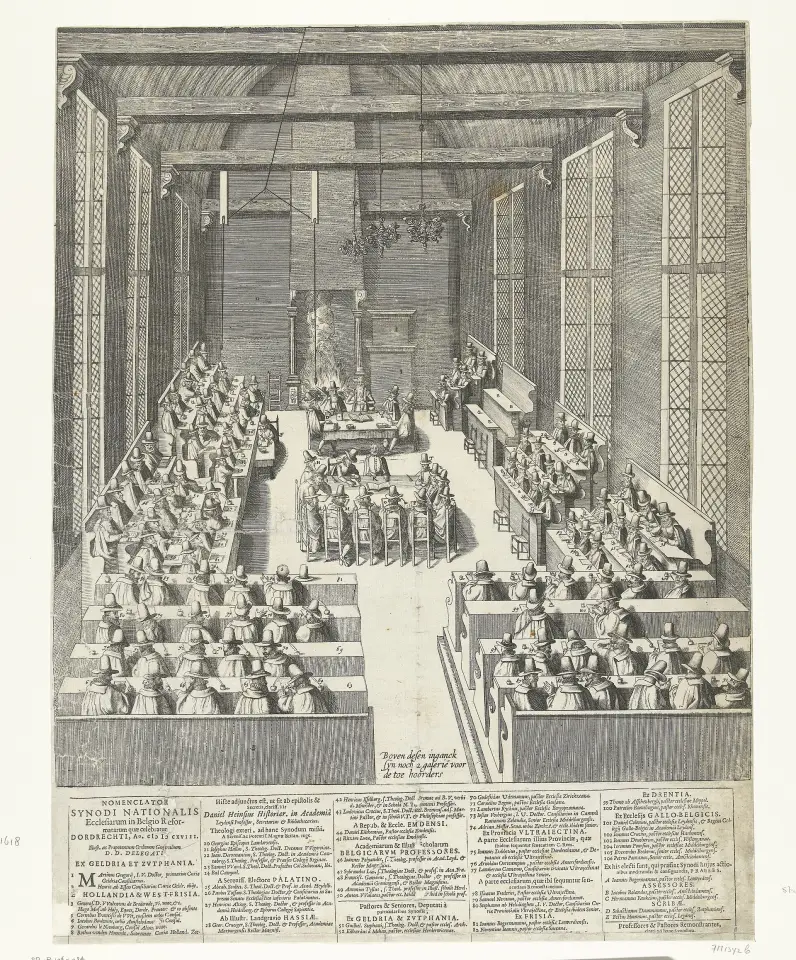
Maurice of Nassau's faction consolidated power and arrested Oldenbarnevelt and Hugo Grotius. Grotius later escaped in a book chest. The Dutch States General then convened a synod at Dordrecht, which sat from Nov. 1618 to May 1619.
The synod had 84 members, including foreign delegates from England, Scotland, the Palatinate, Hesse, Nassau, Bremen, Emden and Switzerland. French Huguenots were barred by Louis XIII. The Remonstrants were present only as defendants.
Over 154 sessions the synod condemned Arminianism. It formulated the five points later known by the acronym TULIP: total depravity, unconditional election, limited atonement, irresistible grace, and perseverance of the saints.
Oldenbarnevelt was executed, and about a hundred Arminian ministers were banished. Freedom of worship was restored to the Remonstrants from 1631. A new Dutch Bible translation was also commissioned.
The synod's canons became a touchstone of Reformed orthodoxy. They later influenced the Westminster Confession.
Key points
- The five points of Calvinism (TULIP): depravity, election, atonement, grace, perseverance
- The synod's international makeup, with French Huguenots barred from attending
- Execution of Oldenbarnevelt and banishment of about a hundred Arminian ministers
- The synod's canons influenced the Westminster Confession
People
- Maurice of Nassau
- Franciscus Gomarus
- Johan van Oldenbarnevelt
- Hugo Grotius
- Jacobus Arminius
Place
Dordrecht (the Netherlands)
Sources disagree
All books agree on 1618–1619 (convened in 1618, sessions running to May 1619).
Sources
- Justo L. González – A History of Christian Thought in One Volume (Abingdon, 2014), p. 364–365, 368
- Justo L. González – A History of Christian Thought, vol. III: From the Protestant Reformation to the Twentieth Century (Abingdon, rev. ed. 1987), p. 289–292, 306
- Louis Berkhof – History of Christian Doctrines (Russian edition), p. 109–110, 138
- Justo L. González – The Story of Christianity, vol. II (Russian edition), Part 2, ch. 20
- Tony Lane – Christian Thinkers (Russian edition), p. 187–188
- J. North – A History of the Church (Russian edition), p. 253
More on the doctrine
- Arminius, the Remonstrance (1610) and the Synod of Dort (1618–1619) (1603–1619)
- For whom did Christ die: limited atonement from Gottschalk to Dort, Westminster and Owen (1618–1733)
Data compiled: 2026-11-09