1801 – early 19th c. · 19th century
The Second Great Awakening and the Restoration Movement in the US
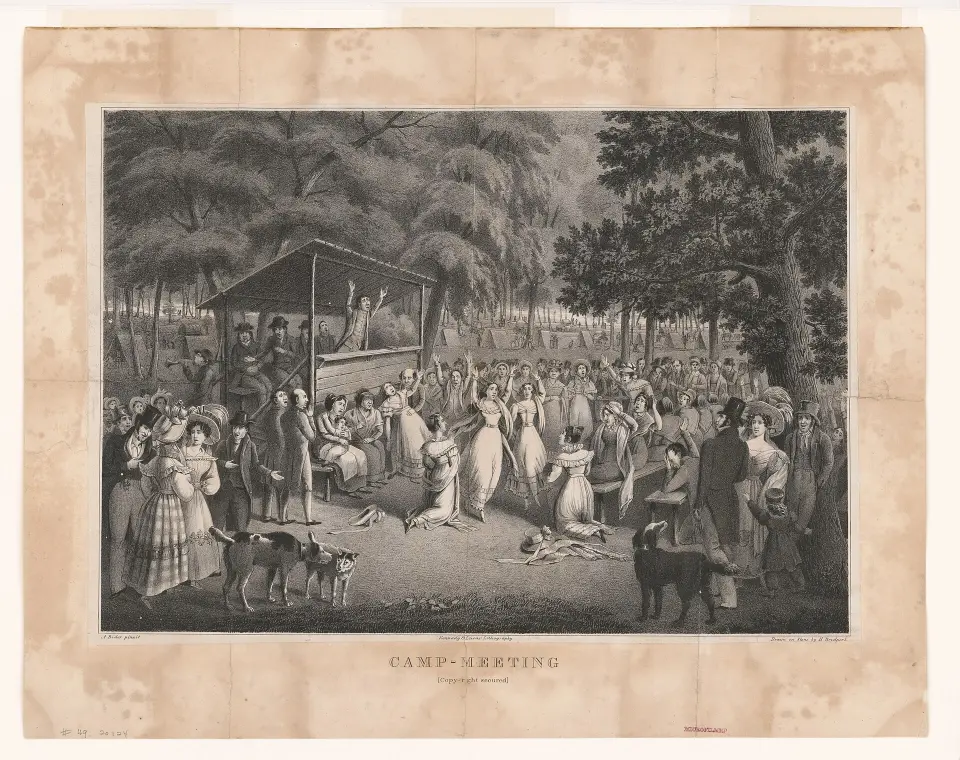
A mass camp meeting at Cane Ridge, Kentucky in 1801 drew an estimated 20,000–30,000 people. It became a landmark event of the Second Great Awakening. The Awakening spread across the American frontier and drove rapid growth among Baptist and Methodist churches.
Riding this wave, Barton Stone and Thomas and Alexander Campbell led a movement to "restore" New Testament Christianity. It rejected denominational divisions in favor of unity on the Bible alone. The Churches of Christ and the Christian churches grew out of it.
Key points
- The Cane Ridge camp meeting (1801) drew 20,000–30,000 people
- Growth of Baptist and Methodist churches on the frontier
- The Stone–Campbell Restoration Movement
- Rejection of denominational divisions in favor of unity on the Bible alone
- Shelley: in 1835 Lyman Beecher in A Plea for the West urged Christians to shape the religious destiny of the empire being born in the wilderness; the era is called the age of the “righteous empire”, and the idea of a Christian America was the main theme of 19th-century American Protestantism. Evangelicals had two instruments – voluntary societies and revival; the societies took over responsibility for public morals, and Beecher (1830) saw the Church’s influence and triumphs of forty years as their work. The Frontier revival (Kentucky, Tennessee) was rough and fierce; the preacher, white or black, brought Christianity to the unlettered. In July 1800 at Gasper River McGready gathered people for a multi-day open-air service – the start of the camp meeting
- Holifield: Presbyterian awakenings partly grew from Scots and Scotch-Irish sacramental gatherings; the Supper was celebrated at frontier camp meetings. Nevin (1843) set the catechizing of the baptized against Finney’s revivalism; by 1847 he saw sacraments as the key to any theological system. His The Mystical Presence (1846) taught Christ’s real spiritual presence in the Supper; Hodge saw a memorial and communion with the Spirit. Alexander Campbell rejected infant baptism, accepted only immersion, and by 1823 saw its purpose as remission of sins, with no efficacy in the rite. Schmucker, drawn by revivalism, proposed revising the Augsburg Confession; his Definite Platform drew confessionalist opposition: Krauth and Walther (Missouri Synod, 1847) defended the confessions, and in 1867 the dispute split American Lutherans into two general bodies.
- George: 1790–1830 was “the time of greatest religious chaos and originality” (Wood); Adventist, Holiness, Restorationist and later Pentecostal churches arose. Even the Civil War could not destroy the shared Protestant consensus in North America; Wayland (1861): Baptists hold “the doctrines of the Reformation”. All who worked for the YMCA, with which Moody became affiliated in Chicago in the 1850s, had to subscribe to justification by faith alone. The evangelical consensus spawned interdenominational orphanages, Bible societies, publication boards, colleges and a global missionary movement.
- Billings: Nevin said the ‘modern puritans’ after the First Great Awakening deemed the Apostles’ Creed outdated; he defended its trinitarian and christological core. Nevin’s The Mystical Presence drew a scathing review from his former professor Hodge; Nevin drew on Calvin and on German idealism. His diagnosis – the Enlightenment and revivalism de-catholicize the Reformed faith through ‘biblicism’ and ‘conversionism’.
People
- Barton Stone
- Thomas Campbell
- Alexander Campbell
- John Williamson Nevin
- Charles Hodge
- Samuel Simon Schmucker
- Charles Porterfield Krauth
Place
Kentucky; United States
Sources
- J. North – A History of the Church (Russian edition), p. 11
- Bruce L. Shelley – Church History in Plain Language (Russian edition), Ch. 39, sec. «Судьба нации»; «Вызов американского Запада»; Ch. 39, sec. «Вызов американского Запада»; Ch. 39, sec. «Огнеопасный Джеймс Макгриди»
- The Oxford Handbook of Sacramental Theology, ed. Hans Boersma, Matthew Levering (2015), p. 467, 465–466, 466–467, 467–468, 463–464, 464
- The Cambridge Companion to Evangelical Theology, ed. Timothy Larsen and Daniel J. Treier (2007), p. 290–291, 291, 291–292
- The New Cambridge Companion to Christian Doctrine, ed. Michael Allen (2023), p. 357, 358
Data compiled: 2026-11-09