1801–1814 · 19th century
Napoleon's Concordat and the captivity of Pius VII
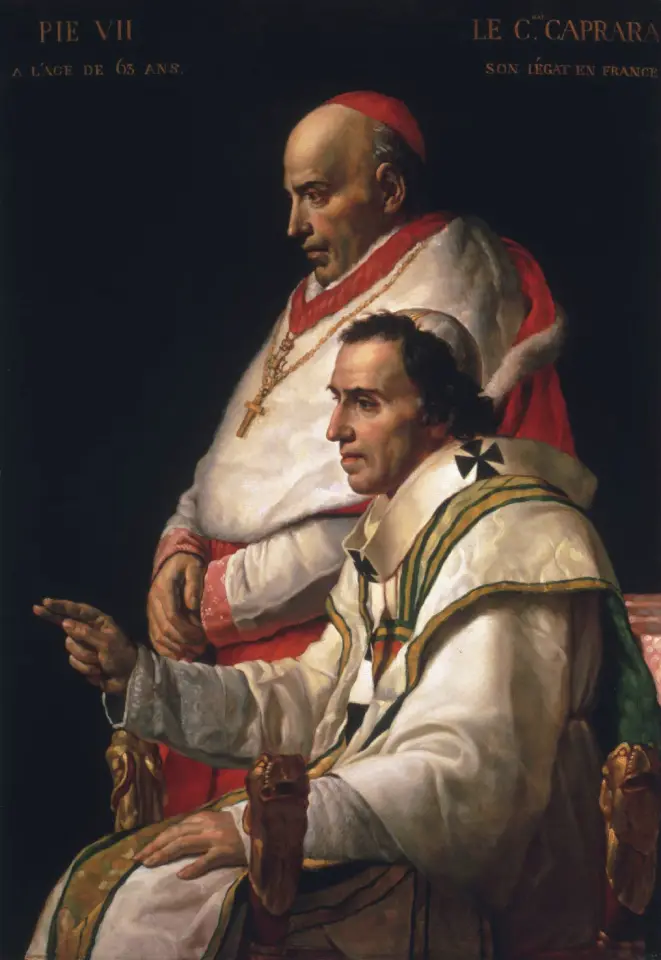
In 1801 Napoleon, newly in power, signed a concordat with Pope Pius VII. It recognized Catholicism as the religion of most French people and granted Protestants freedom. In 1804 Pius VII attended his coronation.
In 1806 Napoleon abolished the Holy Roman Empire and created the Confederation of the Rhine, ending Charlemagne's political legacy.
After the Papal States were annexed to the empire, Pius VII excommunicated those responsible. From 1808 to 1814 Napoleon held him under guard in France. On his return, though, the pope forgave his opponents. Paradoxically, papal authority over the French church, and the papacy's standing in Catholic Europe, grew stronger as a result.
Key points
- The 1801 Concordat between Napoleon and Pius VII
- Secularization of church lands in western Germany
- Dissolution of the Holy Roman Empire (1806)
- Pius VII's excommunication of those who annexed the Papal States
- Five-year captivity of the pope (1808–1814) and the papacy's rising popularity after Napoleon's fall
- Shelley: in 1801 Napoleon concluded a concordat restoring the Church’s special place – Catholicism “the religion of the great majority of the French”; yet the Church lost its power for ever, no return to the alliance of throne and altar was possible, and it had no love for liberalism. In 1815 absolutist kings tried to regain lost positions, but the restoration met liberal resistance; uprisings in Spain and Italy were crushed, but the overthrow of the French kings (1830) and the revolution of 1848 promised change
People
- Napoleon Bonaparte
- Pius VII
- Francis II
Place
France; Rome; Germany
Sources
- Justo L. González – The Story of Christianity, vol. II (Russian edition), Part 3, ch. 26; ch. 29, section «Папство и Французская революция»
- J. North – A History of the Church (Russian edition), p. 311–313
- Bruce L. Shelley – Church History in Plain Language (Russian edition), Ch. 36, sec. «Лихорадка революции»; «Католичество против либерализма»
Data compiled: 2026-11-09