1806–1899 · 19th century
The expansion of Protestant and Catholic foreign missions in the 19th century
A student prayer meeting at a haystack (1806) sparked a movement that led in 1810 to the founding of the American Board of Commissioners for Foreign Missions. It was the first major American Protestant mission agency. In 1886, under Dwight Moody's influence, the Student Volunteer Movement arose. Its motto was "the evangelization of the world in this generation."
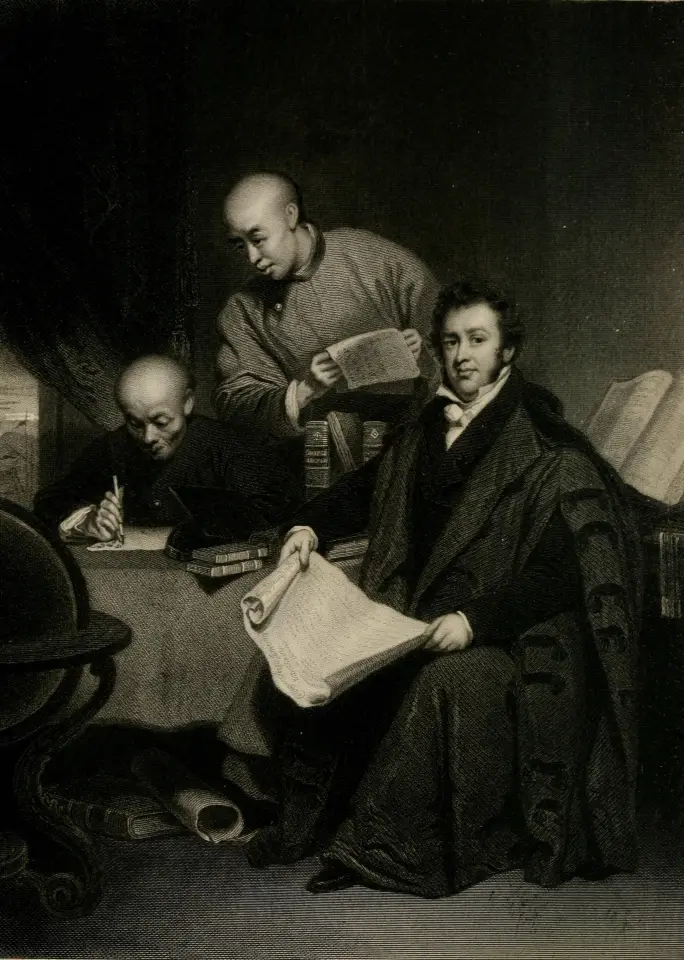
In China, Robert Morrison began translating the Bible from 1807, and Hudson Taylor founded the interdenominational China Inland Mission. Despite the Taiping Rebellion (from 1850) and the Boxer Uprising (1899–1901), the number of Christians in China grew. Indigenous Protestant churches were established in Japan from 1854, after Commodore Perry forced it open, and in Korea from 1884.
In parallel, Catholic mission activity revived. It worked through the Lyon-based Society for the Propagation of the Faith (1822) and Cardinal Lavigerie's White Fathers (1868), directed at evangelizing Africa.
Key points
- Founding of the American Board of Commissioners for Foreign Missions (1810)
- Protestant missions in China: Morrison, the Taiping Rebellion, Hudson Taylor, the Boxer Uprising
- Missions in Japan (from 1854) and Korea (from 1884)
- The Lyon Society for the Propagation of the Faith (1822) and Cardinal Lavigerie's Missionaries of Africa, the Pères Blancs (1868)
- The Student Volunteer Movement (1886)
- Shelley: in the early 19th c. the Gospel had barely touched Asia and Africa was the “dark continent”; the century became a great era of Christian expansion. The first Protestant missionaries were Pietists and Moravians, but their communities were tiny, and expansion belonged to Catholic Spain and Portugal. In 1793 Carey went to India; the Company barred him from Calcutta, so he settled at Serampore under the Danish flag. Carey, Marshman and Ward built a network of stations; by 1824 Carey completed six full and twenty-four partial Bible translations. The Serampore trio's example proved contagious: early in the 19th century Protestantism was seized by the aim of bringing the Gospel to all peoples. Pioneers numbered hundreds: Martyn in India, Morrison in China, Williams in the South Seas, Judson in Burma, Duff, Gardiner, Moffat. For the first three decades of the missionary era only evangelicals took part: awakenings made preaching a call to God through faith, and evangelicals saw no difference between Britain's “baptized pagans” and non-Christian peoples. Interest in missions became a common feature of English church life only in the 1820s and 1830s. Motives were the evangelical stress on those perishing without Christ and Edwards-style millennialism mixed with the optimism of the age of progress; the Gospel is not the private property of Europeans. Livingstone (1813–1873) came to Africa as a doctor in 1841 and crossed it from Angola to Quelimane without force. He saw the slave trade as the “open sore of the world” and sought a path for commerce and Christianity, yet he was no forerunner of colonial exploiters: slavery would end when Africans took up legitimate trade. No traditional form of church government could carry out the world mission, so Protestants found another – the voluntary society. Carey's Enquiry proposed a company of serious Christians, lay and clergy, with a committee to gather information, funds and missionaries. In 1795 the London Missionary Society resolved to send the heathen not Presbyterianism, Independency or Episcopacy but “the glorious Gospel of God”. In the US the first was the American Board of Commissioners for Foreign Missions (1810), created by Andover students under Samuel Mills; Adoniram Judson took part in the Board. By the late 19th century almost every Christian body, from the Russian Orthodox Church to the Salvation Army, took part in foreign missions. Voluntary societies undermined established forms of church government, let Anglicans, Baptists, Congregationalists and Methodists cooperate, and encouraged lay leadership: ordinary Christians, first men and then women, took key posts. Missions highlighted marks of modern Christianity: expansion proceeds voluntarily, without state support, as since Constantine; the wealth and talents of ordinary Protestants were put to work; alongside preaching came schools, hospitals, written languages and translations, health measures, agriculture. A problem: early missionaries identified Christianity with Western culture
People
- Adoniram Judson
- Robert Morrison
- Hudson Taylor
- Matthew Perry
- Cardinal Lavigerie
- David Livingstone
- Henry Stanley
- Dwight Moody
Place
United States; China; Japan; Korea; France; Africa
Sources
- J. North – A History of the Church (Russian edition), p. 13
- Justo L. González – The Story of Christianity, vol. II (Russian edition), Part 3, ch. 30, section «Азия и Океания»
- Bruce L. Shelley – Church History in Plain Language (Russian edition), Ch. 38, sec. «Первопроходец в современных миссиях»; Ch. 38, sec. «Запал миссионерства»; Ch. 38, sec. «Ливингстон в Африке»; Ch. 38, sec. «Создание добровольного общества»; Ch. 38, sec. «Создание добровольного общества»; «Знаки современного христианства»
Data compiled: 2026-11-09