410 (sack of Rome); 412–426 ("City of God"); 430 (death of Augustine) · 5th century
The sack of Rome by Alaric and Augustine's "City of God"
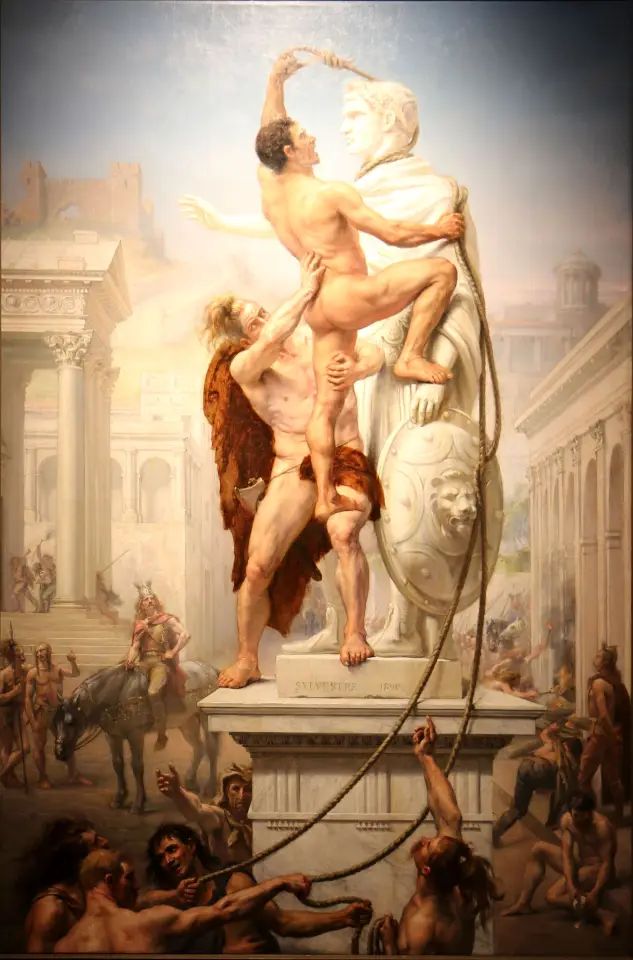
In 410 Rome, the "Eternal City," fell for the first time in 790 years to the Visigoths of Alaric. Pagans blamed the disaster on Christians who had abandoned the old gods.
In response, Augustine of Hippo wrote "The City of God" between 412 and 426 – the greatest apologetic work of the early Church. Its first part refutes the pagan accusations. Its second unfolds a philosophy of history as the struggle of two cities, intermingled until the end of time. The earthly city is founded on love of self, the heavenly on love of God. Rome was given power only to serve the spread of the Gospel.
At Augustine's request, his disciple Paulus Orosius supplemented the work with a "History Against the Pagans." Augustine died in 430 while Vandals besieged his city of Hippo. His work shaped Christian understanding of history and the state well into the modern era.
Key points
- Sack of Rome by Alaric's Goths in 410 – the first in 790 years
- Pagans blamed Christians for abandoning the empire's gods
- "City of God": two cities – earthly and heavenly, self-love and love of God (14.28)
- Rome existed to spread the Gospel and fell due to its own sin
- At Augustine's request, Orosius wrote a complementary "History Against the Pagans" (c. 414 and later)
- Augustine died in 430 during the Vandal siege of Hippo
- Shelley: the Romans came out beyond the walls to beg mercy, but Alaric demanded all their gold and silver and above all Germanic slaves. The Visigoths plundered all but the churches: the Christian Alaric set church treasures apart and had vessels carried to Peter's and Paul's churches. Jerome said: “My voice sticks in my throat. The city that took the whole world has itself been taken”. Romans stared at the empty pedestals of the pagan gods, and the question arose whether the gods were angry at the emperors' conversion. Augustine in a sermon compared Rome's fall to Sodom's punishment but noted cities consist of people, not walls, and Rome was punished, not destroyed; he worked sixteen years, almost to the end of his life, on his answer to Rome's fall – The City of God
- Daley: after the Goths’ sack of Rome (410) even Jerome wondered whether eschatological prophecies were being fulfilled in unrest, migrations and heresies; the poet Orientius called moral decay “funeral rites of a collapsing world”, while Augustine urged patience and did not calculate the end
People
- Augustine of Hippo
- Alaric
- Paulus Orosius
- Jerome
- Pelagius
Place
Rome, Hippo
Sources disagree
North gives inconsistent dates for the sack of Rome (409 and "the following year"); most books (Lane, Hall, González) give 410. Bruce (Shelley) writes that before 410 no foreign invader had stood at the walls of Rome for 620 years, since the days of Hannibal; the site record gives 790 years since the previous capture of the city.
Sources
Primary sources
- Augustine – The City of God, bk. XI, ch. 1; bk. XIV, ch. 28
Textbooks
- Jaroslav Pelikan – The Christian Tradition: A History of the Development of Doctrine, vol. 1 (Russian edition), p. 47, 49–50
- Justo L. González – The Story of Christianity, vol. I (Russian edition), Ch. 17, sec. 17.2; ch. 18
- Tony Lane – Christian Thinkers (Russian edition), p. 57–58, 90
- Stuart G. Hall – Doctrine and Practice in the Early Church (Russian edition), p. 133, 136–137
- Justo L. González – A History of Christian Thought in One Volume (Abingdon, 2014), p. 174, 182–184, 187
- J. North – A History of the Church (Russian edition), p. 96–97
- Bruce L. Shelley – Church History in Plain Language (Russian edition), Ch. 13, sec. «Вступление» и «Град Божий на руинах Рима»; Ch. 13, sec. «Вступление»
- The Oxford Handbook of Eschatology, ed. Jerry L. Walls (2008), Ch. 5, sec. «Latin Writers; Augustine»
More on the doctrine
- Augustine, The City of God: the meaning of history, the two cities and the relation to the state (413–427)
Data compiled: 2026-11-09