1675–1793 · 17th century
Pietism, Moravian Missions, and the Birth of the Modern Protestant Missionary Movement
Pietism arose as a reaction against a stagnant Lutheran orthodoxy. The Frankfurt pastor Philipp Jakob Spener gathered home Bible-study groups (collegia pietatis). In 1675 he published the movement's manifesto, Pia Desideria. It was a call for living faith, the universal priesthood of laypeople, and renewed pastoral training.
Orthodox theologians at Leipzig and Wittenberg accused his disciple August Hermann Francke of 283 heresies. Despite this, Francke founded a university at Halle in 1694 with a school for the poor and an orphanage. He made it a center for training Pietist – and, new for Protestantism, missionary – leaders.
When the Danish king Frederick IV decided to send missionaries to his Indian colonies, he turned to Halle. In 1706–1707 Bartholomäus Ziegenbalg and Heinrich Plütschau founded the Tranquebar mission. This was the beginning of Protestant missions as such.
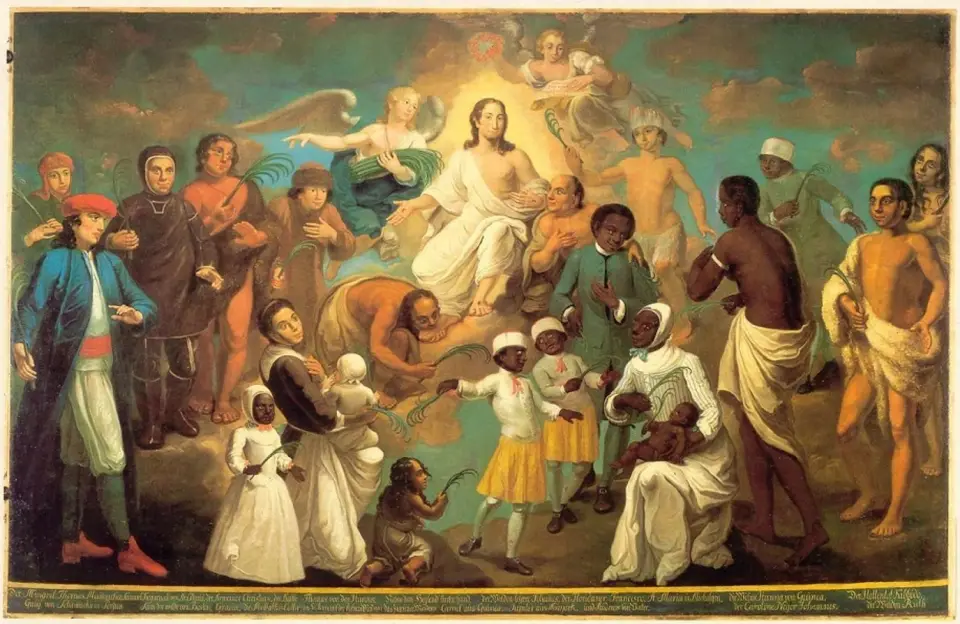
In 1722 Spener's godson, Count Nikolaus Ludwig von Zinzendorf, a graduate of Halle, gave refuge to persecuted Bohemian "Moravian Brethren" on his Saxon estate. There the community of Herrnhut arose. After an encounter in 1731 with Inuit converted by Hans Egede, the Moravians caught missionary fervor. From 1732 they sent missionaries to the West Indies, Africa, India and America, including Bethlehem, Pennsylvania, in 1741. Their influence on John Wesley and later on Schleiermacher far outweighed their numbers.
Finally, in 1792 William Carey secured the founding of the Baptist Missionary Society, and in 1793 he sailed for India. This is traditionally regarded as the start of the modern Protestant missionary movement. In its wake, many new missionary societies were founded across Europe from 1795 through the 1830s.
Key points
- Spener's Pia Desideria (1675) – the manifesto of Pietism
- Francke's University of Halle (1694) – a center of Pietism and missions
- The Tranquebar mission (1706–1707) – the start of Protestant missions
- Zinzendorf and the Moravian Brethren, Herrnhut (1722), missions from 1732
- William Carey and the Baptist Missionary Society (1792–1793)
- Helmer: the Pietists – from Arndt to Spener – aimed at a living personal faith; they understood sola scriptura as persons’ capacity to discover biblical truths. Hence Losungen – randomly chosen passages read as God’s word to one’s circumstances; Pietism contributed to the rise of modern subjectivity. Historical criticism, she says, was launched by Pietism – Bengel’s critical edition of the New Testament (1734) and his Gnomon (1742); the experience of redemption made history a subject of study – church history, Scripture, ancient mystical texts. Pietism also produced speculative currents: Zinzendorf’s Jesus-centred piety went with a “novelty” – the Spirit as Mother; Boehme moved speculation toward theogonic narrative, Oetinger joined Scripture, kabbala and the Trinity; they fed Hegel and Schelling
- Shelley: Philipp Spener (1635–1705) grew up under Arndt and the English Puritans and at Strasbourg understood justification by faith as spiritual rebirth. At Frankfurt he preached only from the Bible, calling for repentance; the breakthrough came in 1669 with a talk on the Sermon on the Mount. Twice weekly Spener gathered a small group at home for Scripture reading; these meetings, mockingly called gatherings of the pious, birthed pietism. In Pia Desideria he recommended Bible study groups, strict Christian living, care for theology students' morals and simpler sermons; each congregation needs a group who know true Christianity, and ministry should be entrusted only to the “born again”. In 1692, after conflicts with authorities, Spener moved to Berlin and persuaded the future king to invite Francke to the new university at Halle. After two years of struggle Francke, writing on John 20:31, fell to his knees and prayed to a God he “did not yet know”; his sorrow left him, and he knew he was saved. At Halle Francke founded a school for the poor, an orphanage, hospital, Latin school, widows' house, printing press and Bible society; in 1705 King Frederick IV of Denmark found the first missionaries for an Indian mission among his students. Count Zinzendorf (1700–1760), fervent and emotional, held that the mark of true Christianity is simple childlike faith in Jesus' blood and sang the soul's bond with Christ in vivid, almost erotic images; he was raised by an ardently religious grandmother and studied law at Wittenberg for three years. The carpenter Christian David revived the Bohemian Brethren, who in 1722 founded Herrnhut (“the Lord's Watch”) on Zinzendorf's estate; the Moravians dreamed of a city only for Christians – a free communal monasticism without celibacy. From 1727 Zinzendorf was Herrnhut's “guardian angel,” and ten years later was ordained in the United Brethren church. He was always drawn to missions, and the Moravians became the first major Protestant missionary force: in 1731 at Copenhagen Zinzendorf met a black man from the Danish West Indies and was struck by his account of the enslaved; in 1732 Dober and Nitschmann set out from Herrnhut for St Thomas, and missions then arose in Greenland, Lapland, Georgia, Guinea, South Africa, Guiana, Ceylon and Algeria. Zinzendorf leaned toward sentimental religion, but some of his hymns are used in many churches; he told the Herrnhuters: “I have but one passion – it is He, only He”. Pietism shifted the emphasis of 18th-century churches from rivalry to care for souls, making preaching and pastoral visitation central; it greatly enriched Protestant music and stressed the role of spiritual laypeople, and its greatest legacy is its emphasis on small groups and zealous study of Scripture. Pietism's main theme was renewal as personal experience: doctrine became reality in the depths of the heart. Pietism was the source of all modern “revivals” and of modern evangelical Christianity; evangelicals inherited from it emotionality (hence weak resistance to secularism) and a shift of faith into close voluntary groups. The Moravians who sailed with Wesley to Georgia were an important wing of the awakening; from them he learned “justification by faith” and small groups, but parted from them over Herrnhuter self-satisfaction and the cult of Zinzendorf; Methodists, like pietists, were a “church within the Church”. The shoemaker William Carey (1761–1834), with a world map above his bench, thought of evangelizing whole countries and put local ministry first: Christianity must be rooted in a country’s culture. Baptized in 1783, pastor at Moulton; Shelley calls him the “Father of Modern Missions”. Andrew Fuller, a Calvinist, believed in both election and the call to repent; Carey concluded the Gospel must go to all the world. In 1792 he published the Enquiry answering five objections to missions; in October the Baptist Missionary Society was formed
- Holmes: Andrew Fuller (1754–1815), dissatisfied with Gill’s high Calvinism, was pointed to Edwards and developed an ‘evangelical Calvinism’.
- McGinn: Arndt’s True Christianity (1606–10) challenged Protestant scholasticism: God’s word must be practised, not only known
People
- Philipp Jakob Spener
- August Hermann Francke
- Bartholomäus Ziegenbalg
- Heinrich Plütschau
- Nikolaus Ludwig von Zinzendorf
- Hans Egede
- John Wesley
- William Carey
- Bengel
- Jakob Boehme
- Friedrich Christoph Oetinger
- Andrew Fuller
Place
Frankfurt; Halle; Tranquebar (India); Herrnhut (Saxony); India
Sources disagree
One book gives 1707 for the Tranquebar mission's founding, another 1706–1707; both are noted.
Sources
- Tony Lane – Christian Thinkers (Russian edition), p. 169–171
- Justo L. González – A History of Christian Thought in One Volume (Abingdon, 2014), p. 373–376
- Justo L. González – A History of Christian Thought, vol. III: From the Protestant Reformation to the Twentieth Century (Abingdon, rev. ed. 1987), p. 308–313, 325
- Justo L. González – The Story of Christianity, vol. II (Russian edition), Part 2, ch. 23
- J. North – A History of the Church (Russian edition), p. 13, 294–295
- The Cambridge Companion to the Trinity, ed. Peter C. Phan (2011), p. 168–169, 169–170, 170
- Bruce L. Shelley – Church History in Plain Language (Russian edition), Ch. 33, sec. «Возрождение души»; Ch. 33, sec. «Плотник и граф»; Ch. 33, sec. «Взгляд по прошествии веков»; Ch. 34, sec. «Тепло святого сердца»; «Структура методистов»; Ch. 38, sec. «Первопроходец в современных миссиях»
- The Cambridge Companion to Evangelical Theology, ed. Timothy Larsen and Daniel J. Treier (2007), p. 256
- The Oxford Handbook of Mystical Theology, ed. Edward Howells, Mark A. McIntosh (2020), Ch. 4, sec. «Protestant Mysticism»
More on the doctrine
Data compiled: 2026-11-09