1682–1740 · 17th century
Peter the Great's Church Reform: Abolishing the Patriarchate and the Holy Synod
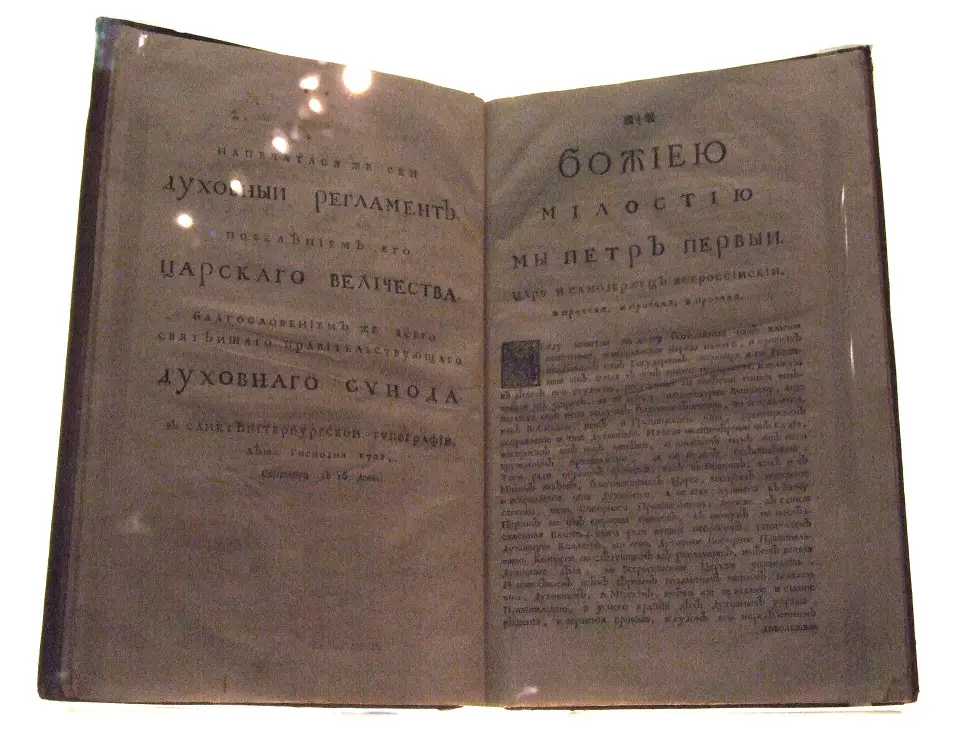
Peter the Great, on the throne from 1682, sought to bring Russia closer to the West. After Patriarch Adrian's death in 1700 he blocked the election of a successor. In 1721 he finally abolished the patriarchate altogether, replacing it with the Holy Synod he created. This was a state collegial body headed by a lay procurator. It subjected the church to state control for nearly two centuries.
Theologian Feofan Prokopovich and his followers, unlike the Latin-influenced Kyiv school, leaned toward Protestantism. His ideas had reached even the Kyiv school by 1715. Under Catherine II a Prokopovich-influenced churchman, Platon Levshin, became Metropolitan of Moscow.
Key points
- Patriarch Adrian's death (1700) and the block on electing a successor
- Abolition of the patriarchate and founding of the Holy Synod (1721)
- The Synod, headed by a lay procurator, subjected the church to the state
- Protestant tendencies in Feofan Prokopovich's circle
People
- Peter I
- Feofan Prokopovich
- Platon Levshin
- Catherine II
Place
Saint Petersburg; Moscow
Sources disagree
The dates 1700 (Adrian's death) and 1721 (abolition of the patriarchate) agree across the books.
Sources
- Justo L. González – A History of Christian Thought, vol. III: From the Protestant Reformation to the Twentieth Century (Abingdon, rev. ed. 1987), p. 432–434
- Justo L. González – A History of Christian Thought in One Volume (Abingdon, 2014), p. 407–408
- J. North – A History of the Church (Russian edition), p. 6
Data compiled: 2026-11-09