1090s–mid-13th century · 11th century
Peter Lombard's 'Sentences' and the Rise of the Universities
The return of stability in France fostered a revival of the Paris theological schools. They sought to systematize Christian doctrine and show its rationality. The school of Saint-Victor (William of Champeaux, Hugh and Richard of Saint-Victor) and the school of Chartres combined dialectic with the religious life.
The translators of Toledo worked under Bishop Raymond's patronage. They introduced the West to the works of Aristotle, Avicenna, al-Ghazali and Averroes. These came through Arabic and Jewish intermediaries (Maimonides, Avicebron).
Peter Lombard arrived in Paris around 1130 and became its bishop. He compiled the "Four Books of Sentences" – a compendium of the opinions of the Bible and the Fathers on every branch of theology. It adds his own moderate conclusions. He was the first to clearly name seven sacraments, later confirmed by the Council of Florence (1439).
The "Sentences" became the standard university theology textbook until the late 16th–early 17th century. A commentary on them was a required step toward the doctorate.
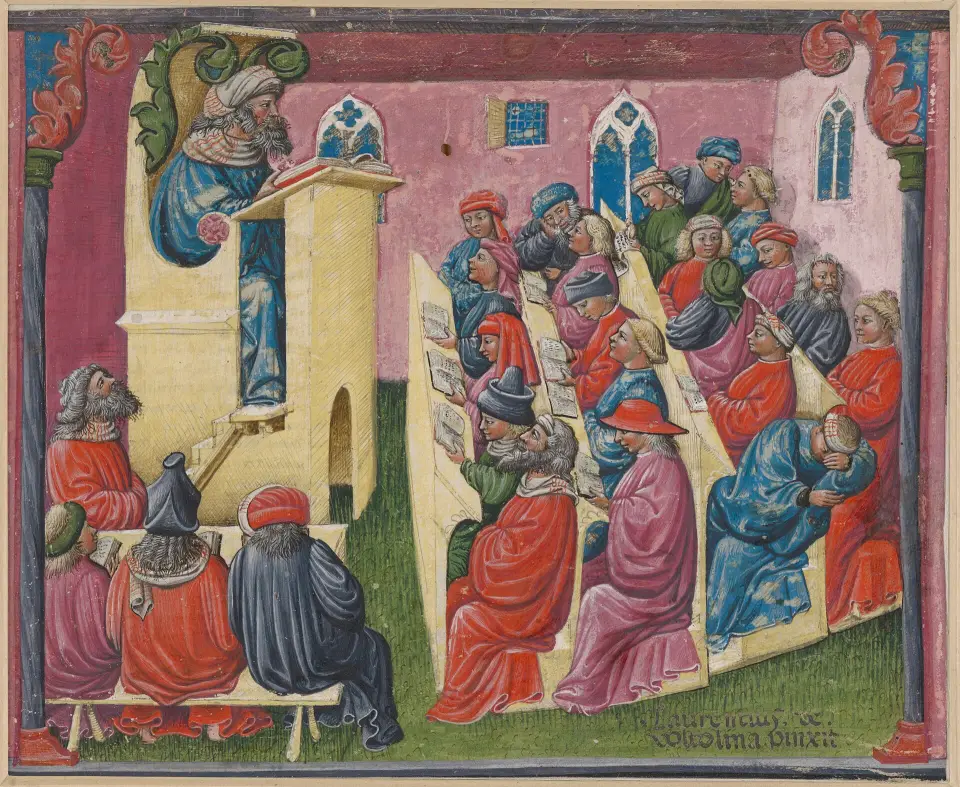
In the 12th–13th centuries the first universities were born out of cathedral schools, growing cities, and guilds – Paris, Bologna, Oxford, Salerno. They were corporations of teachers and students. They displaced monasteries as centers of learning.
Key points
- The Toledo translations bring Aristotle and Arabic-Jewish philosophy to the West
- Peter Lombard's 'Four Books of Sentences' as the standard theology textbook
- The fixing of the number of sacraments at seven (confirmed at Florence in 1439)
- The birth of the universities (Paris, Bologna, Oxford) as corporations of teachers and students
- Shelley: universities grew out of cathedral schools; their highest task was to understand and explain the light of God’s revealed truth. Earlier learning came from Benedictine schools and Charlemagne’s decree for a school at every monastery “for those able, with God’s help, to learn”; for laymen the best opportunity was the cathedral schools, which trained parish priests. The curriculum was the seven liberal arts: grammar, rhetoric, logic, arithmetic, geometry, music, astronomy. Texts were few (Cassiodorus, Boethius); Augustine, Gregory the Great and other fathers were auctores whom students did not dare contradict. Scholasticism (from schola) had a double aim: to reconcile doctrine with reason and to arrange the Church’s teaching in an orderly system; there was no free search for truth, and debates aimed to show the reasonableness of doctrines. The flourishing of universities, following Anne Fremantle, was marked by students and teachers joining into guilds, universitas. In Italy (adult students, law and medicine) student guilds prevailed: they hired teachers and fined a lecturer who skipped part of his subject; in England and France, where students were younger, the teachers’ guilds prevailed, policing swearing, gambling, curfew and table manners. There were no permanent buildings: lectures were given in roadside huts at Oxford and Cambridge, in Paris cathedral galleries, in Italian squares; students sat on straw, and a university could move anywhere. After the lecture the second method was the disputation: Abelard’s question-and-answer approach, rowdy clashes and “logic wars”; students learned to think, and traditional authorities were no longer accepted unquestioningly. Gerbert of Aurillac (later Sylvester II), a 10th-century Reims teacher, studied mathematics in Spain under a Christian bishop; he required study of the Roman classics in the original and built a large library
- Gunton: Lombard’s Sentences (c. 1150, four books) were a compilation on which hundreds of later theologians wrote commentaries; Lombard applied the scholastic method of question and debate, citing for and against Scripture, councils, canons and the Fathers, especially Augustine. In Gunton’s scheme the Fathers hammered out the creeds, the Middle Ages took them for granted, and the modern world calls them into question again.
People
- Peter Lombard
- William of Champeaux
- Hugh of Saint-Victor
- Averroes
- Maimonides
- John of Salisbury
Place
Paris; Toledo; Chartres
Sources
- Alister McGrath – Reformation Thought (Russian edition: «Theological Thought of the Reformation»), p. 83, 101–102, 376–377
- Justo L. González – A History of Christian Thought in One Volume (Abingdon, 2014), p. 222–227, 243, 246–249
- Louis Berkhof – History of Christian Doctrines (Russian edition), p. 178, 186
- Tony Lane – Christian Thinkers (Russian edition), p. 116–118
- Justo L. González – The Story of Christianity, vol. I (Russian edition), Ch. 24, sec. 24.4; ch. 25, sec. 25.3
- Bruce L. Shelley – Church History in Plain Language (Russian edition), Ch. 20, sec. «Расцвет университетов»; Ch. 20, sec. «Магнетизм достойного учителя»
- The Cambridge Companion to Christian Doctrine, ed. Colin E. Gunton (1997), p. 29–30, 30, 29
More on the doctrine
- Peter Lombard, The Four Books of Sentences (1147–1151)
- The seven sacraments: from Hugh of St Victor and Peter Lombard to the Council of Florence (1147–1151)
Data compiled: 2026-11-09