1098–1153 · 11th century
The Founding of the Cistercian Order and the Work of Bernard of Clairvaux
In 1098 Robert of Molesme founded the monastery of Cîteaux. It gave rise to the Cistercian order ("white monks"). The order had a strict rule and an active economic life – sheep-farming, land clearance.
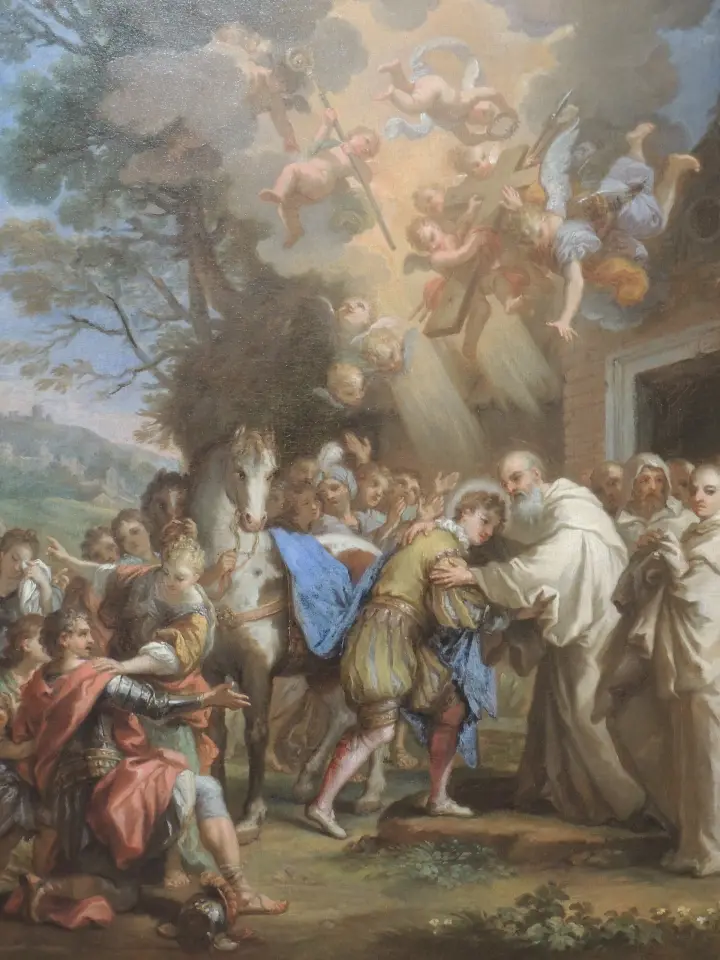
In 1112/1113 the 23-year-old Bernard joined with relatives and friends. He soon founded the community of Clairvaux, which became a center of reform. Under him more than 70 Cistercian monasteries were founded.
Bernard was the "Mellifluous Doctor", a mystic focused on Christ's humanity. In the 1130s he secured Pope Innocent II's victory over the antipope Anacletus. He also secured Abelard's condemnation at the Council of Sens (1140). In 1145 his own disciple was elected Pope Eugenius III. Bernard then preached across Europe for two years in support of the Second Crusade (1147–1148). It ended in defeat, a severe blow to him.
He left works on grace, love of God, and humility, and 86 sermons on the Song of Songs. He also developed the "two swords" theory of church and secular power.
Key points
- The founding of Cîteaux (1098) and the Cistercian order
- Bernard of Clairvaux – the 'Mellifluous Doctor' and mystic of Christ's humanity
- Abelard's condemnation at the Council of Sens (1140)
- Preaching the Second Crusade (1147–1148)
- McGinn: under Bernard the Cistercians produced mystics – William of St Thierry, Aelred of Rievaulx, Isaac of Stella; the monastery as the “School of Christ”. Their formula is credo ut experiar (“I believe in order to experience”); love (caritas) is the key to all. For Bernard love runs from “carnal love of Christ’s humanity” (amor carnalis) to the spousal love of Christ and the soul (amor sponsalis), after the Song of Songs; union with Christ is the work of love granting intuitive understanding: amor ipse intelligentia est (“love itself is a form of understanding”). Hugh (d. 1141) and Richard (d. 1173) of St Victor, at the Paris abbey founded in 1108, were the first systematizers of mystical theology in the West
People
- Robert of Molesme
- Bernard of Clairvaux
- Innocent II
- Anacletus
- Eugenius III
- Peter Abelard
- William of St Thierry
Place
Cîteaux; Clairvaux (France)
Sources
- Tony Lane – Christian Thinkers (Russian edition), p. 114–116
- J. North – A History of the Church (Russian edition), p. 189–191
- Justo L. González – The Story of Christianity, vol. I (Russian edition), Ch. 23, sec. 23.1
- Justo L. González – A History of Christian Thought in One Volume (Abingdon, 2014), p. 221, 226
- Louis Berkhof – History of Christian Doctrines (Russian edition), p. 127
- The Oxford Handbook of Mystical Theology, ed. Edward Howells, Mark A. McIntosh (2020), Ch. 4, sec. «Western Monastic Mysticism»
Data compiled: 2026-11-09