15th–16th centuries · 15th century
"Moscow, the Third Rome", and the establishment of the Moscow Patriarchate
The Union of Florence was accepted by a Greek metropolitan, but the Russians rejected it. They concluded that the Greek church had fallen while Russia remained the guardian of true Orthodoxy. The fall of Constantinople in 1453 reinforced this sense.
In the early 16th century the Pskov monk Philotheus formulated the idea: "two Romes have fallen, a third stands, and a fourth there shall not be". Moscow inherits from Rome and Constantinople as the last bastion of Orthodoxy. The "Third Rome" becomes a kind of theocracy centered on the emperor rather than the church. This tended toward caesaropapism.
An heir of this mystical tradition in Rus was Nil Sorsky. He often invoked Symeon the New Theologian and wrote of "the light which the world has not seen". Sergius of Radonezh dedicated a church to the Holy Trinity and founded the Trinity Lavra near Moscow. He became an example of hesychast mysticism on Russian soil.
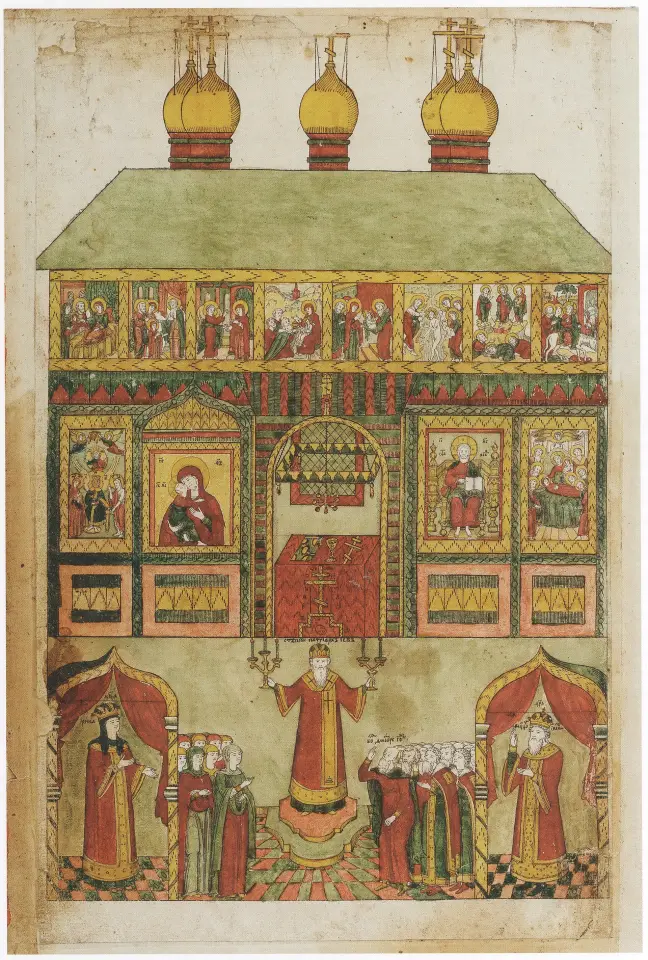
The Moscow patriarchate was then established – in 1589, with the approval of the Eastern patriarchs (one book gives 1596).
Key points
- Rus's rejection of the Union of Florence as the occasion for the 'Third Rome' idea
- Philotheus of Pskov's formula: 'two Romes have fallen...'
- Nil Sorsky – heir to Symeon the New Theologian's hesychast tradition
- Sergius of Radonezh and the founding of the Trinity Lavra
- The "Moscow, Third Rome" theory (Filofei of Pskov, early 16th c.)
- Ivan IV takes the title of tsar (1547)
People
- Philotheus of Pskov
- Nil Sorsky
- Sergius of Radonezh
- Ivan IV the Terrible
- Jeremiah, Patriarch of Constantinople
Place
Moscow; Pskov; Radonezh
Sources disagree
González (Christian Thought, vol. III) places Philotheus's formula 'early 16th c.' and the Moscow patriarchate at 1596 (standard chronology dates the patriarchate to 1589; the book itself notes this discrepancy).
Sources
- Jaroslav Pelikan – The Christian Tradition, vol. 2: The Spirit of Eastern Christendom (600–1700) (Russian edition), p. 403–404, 450–451; p. 451
- Justo L. González – A History of Christian Thought, vol. III: From the Protestant Reformation to the Twentieth Century (Abingdon, rev. ed. 1987), p. 426–427
- Justo L. González – A History of Christian Thought in One Volume (Abingdon, 2014), p. 406–407
- J. North – A History of the Church (Russian edition), p. 4–5
Data compiled: 2026-11-09