October 28, 312 · 4th century
The Battle of the Milvian Bridge and Constantine's Vision
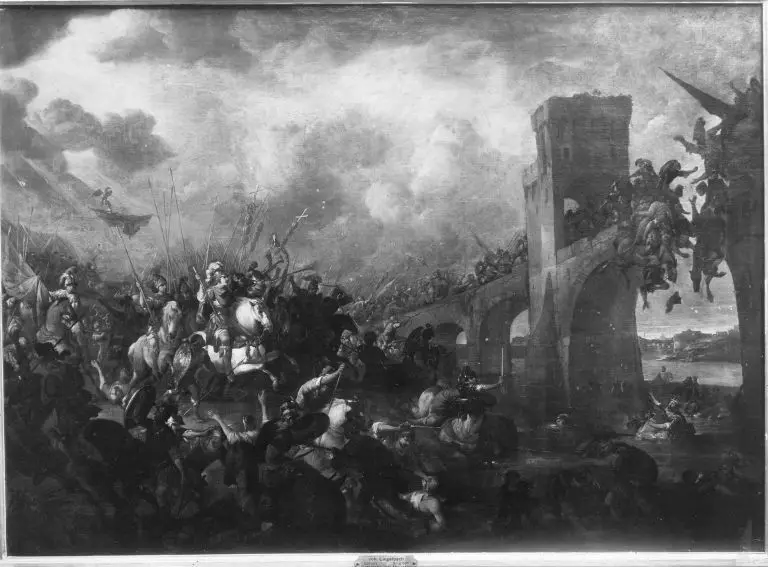
In 312 Constantine crossed the Alps and marched on Rome. At the Milvian Bridge he defeated Maxentius's army. Maxentius drowned in the Tiber, and Constantine became master of the entire West.
According to Lactantius, Constantine received instructions in a dream to place the monogram of Christ (chi-rho) on his soldiers' shields. According to Eusebius, he saw a cross in the sky with the words "by this conquer".
The two accounts differ. Scholars debate the sincerity and depth of his conversion. They note that Constantine continued for some time to honor the cult of the Unconquered Sun.
Key points
- The whole West passed under Constantine's rule
- The accounts of Lactantius and Eusebius diverge
- The labarum – the monogram of Christ's name on the standards
- The cult of Sol Invictus persisted after the battle
- Shelley: in 312 Constantine before the Milvian Bridge saw a cross and the words “In this sign conquer” and beat Maxentius on 28 October; the idea of the “conversion” as political manoeuvre fits poorly with Constantine’s public and private deeds
People
- Constantine the Great
- Maxentius
- Lactantius
- Eusebius of Caesarea
Place
Milvian Bridge, Rome
Sources
- Stuart G. Hall – Doctrine and Practice in the Early Church (Russian edition), p. 79–80
- Justo L. González – The Story of Christianity, vol. I (Russian edition), Ch. 6 «Великие гонения и конечная победа»
- J. North – A History of the Church (Russian edition), p. 60–61
- Tony Lane – Christian Thinkers (Russian edition), p. 11
- Bruce L. Shelley – Church History in Plain Language (Russian edition), Ch. 9, introduction; sec. «Христиан – в огонь!»
Data compiled: 2026-11-09