1519–1531 · 16th century
Huldrych Zwingli and the Reformation in Zurich
In January 1519 the humanist-Erasmian Huldrych Zwingli was appointed preacher in Zurich. He began a programme of reform grounded in the "clarity and certainty of the Word of God". Scripture alone was to be the basis of faith.
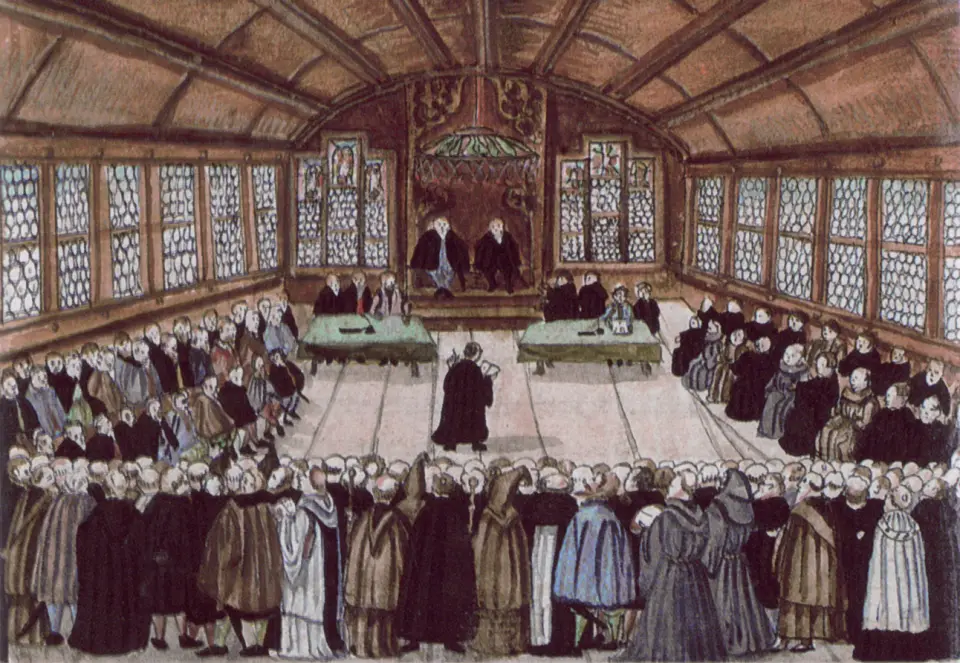
In 1522 the "Froschauer affair" (breaking the Lenten fast) and the dispute over clerical marriage showed the need for a formal mechanism to settle disputes. In January 1523 the First Zurich Disputation confirmed the city council's right to decide what accorded with Scripture. The Second Disputation (October 1523) dealt with the mass and images.
By 1525 images had been removed, the monasteries dissolved, and the mass abolished. Zwingli increasingly saw the Reformation not as an educational process but as the work of divine providence.
Key points
- The First (January 1523) and Second (October 1523) Zurich Disputations
- Removal of images (June 1524) and abolition of the mass (April 1525)
- "On the Lord's Supper" (1526): "is" means "signifies"
- Infant baptism justified as the Christian counterpart of circumcision
- Stephens: Zwingli was born in January 1484, six weeks after Luther. In Vienna and Basel he met both scholasticism (Lombard, Aquinas, Duns Scotus) and humanism; the old way (via antiqua) influenced Zwingli, as the modern way (via moderna) influenced Luther. Ordained in 1506, Zwingli served as priest in Glarus for a decade; his early work The Ox attacked Swiss mercenaries, and Marignano (1515), where thousands died as mercenaries against the French, deepened his opposition. At Glarus he met Erasmus, who had a decisive impact on him. He saw his turn “to Christ and to scripture” (probably 1516) as independent of Luther; his fully Reformation writings date from 1522. After two years at Einsiedeln, a pilgrimage centre, he ministered in Zurich from 1 January 1519 until killed at Kappel on 11 October 1531; from January 1519 he preached consecutively through books of the Bible rather than the lectionary. From 1525 the daily “prophecy” led to commentaries and the Zurich Bible (1531); at the 1523 disputation Scripture was judge
- Shelley: from 1519 Zwingli began the Zurich Reformation with biblical sermons and rejected what the Bible did not prescribe. Grebel and Manz first backed him, but he would not join their revolution: he needed the city fathers’ support
People
- Huldrych Zwingli
Place
Zurich
Sources
- J. North – A History of the Church (Russian edition), p. 244–246
- Alister McGrath – Reformation Thought (Russian edition: «Theological Thought of the Reformation»), p. 75, 88–89, 178–180, 206, 223–224, 243–254, 300, 377–378
- Justo L. González – A History of Christian Thought, vol. III: From the Protestant Reformation to the Twentieth Century (Abingdon, rev. ed. 1987), p. 75–86
- Justo L. González – A History of Christian Thought in One Volume (Abingdon, 2014), p. 296–301
- Tony Lane – Christian Thinkers (Russian edition), p. 173
- The Cambridge Companion to Reformation Theology, ed. David Bagchi, David C. Steinmetz (2004), p. 91–92, 93
- Bruce L. Shelley – Church History in Plain Language (Russian edition), Ch. 25, sec. «Радикалы в Швейцарских Альпах»
More on the doctrine
- Sola Scriptura: The Formal Principle of the Reformation and the Dispute over the Right to Interpret Scripture (1520s)
- Reformed teaching on church and magistrate: Zwingli, Bucer, Calvin, Erastus (1523–1559)
Data compiled: 2026-11-09