1878–1899 · 19th century
Leo XIII's encyclicals (Aeterni Patris, Rerum Novarum, Providentissimus Deus) and the condemnation of Catholic modernism
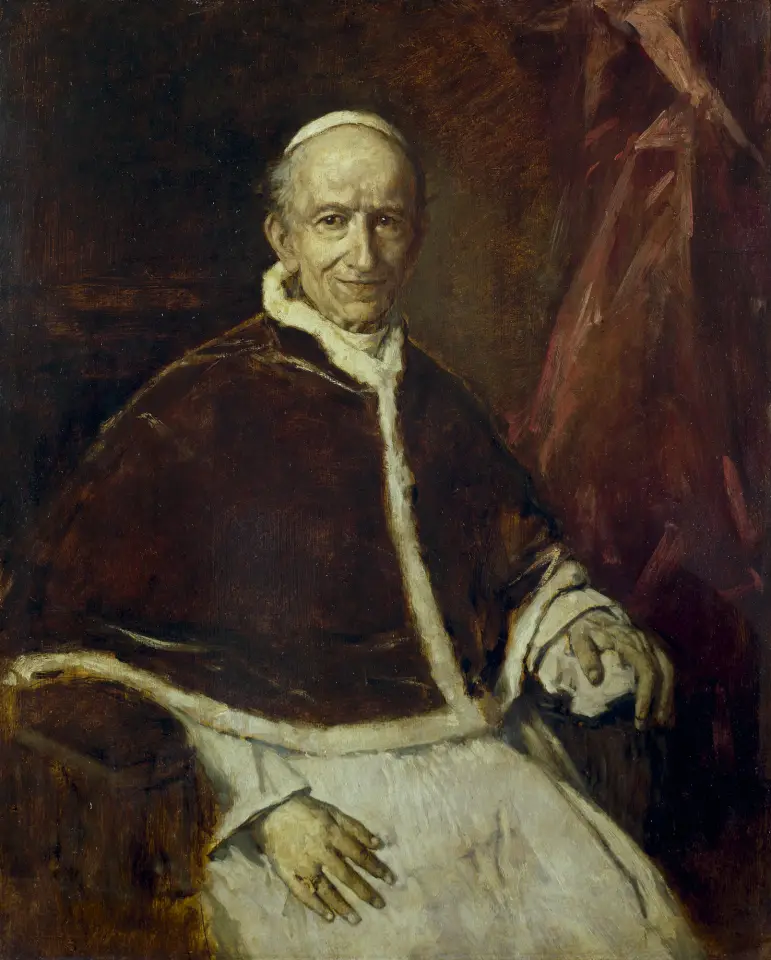
Leo XIII was an "enlightened moderate" between Pius IX and Pius X. In the encyclical Aeterni Patris (1879) he exhorted the bishops "to restore the golden wisdom of St. Thomas" and carefully selected teachers "to implant the doctrine of Thomas Aquinas in the minds of students" (§ 31). This launched a revival of Thomism. Leo XIII also opened the Vatican archives to scholars.
In Rerum Novarum (1891) he condemned the gulf between the wealth of the few and the poverty of the masses. He affirmed workers' right to a just wage and to form (Catholic) unions. Yet he rejected socialism and defended private property as a God-given right. The encyclical launched Catholic social teaching and the Catholic labor movement.
Providentissimus Deus (1893) cautiously allowed the use of biblical-critical scholarship. Immortale Dei (1885) upheld the ideal of a Catholic state.
During Leo XIII's pontificate, "Catholic modernism" also arose, led by Alfred Loisy and George Tyrrell. It embraced skeptical biblical criticism. The movement was condemned and largely halted under Pius X.
Key points
- Aeterni Patris (1879): mandated study of Aquinas, revival of Thomism
- Rerum Novarum (1891): right to a just wage (§ 45) and to workingmen's unions (§ 49); rejection of socialism (§§ 4–15)
- Providentissimus Deus (1893): professors of Scripture are to know the oriental languages and "the art of true criticism", but the so-called "higher criticism" is condemned as "an inept method" (§ 17)
- Immortale Dei (1885): the ideal of a Catholic state
- Catholic modernism (Loisy, Tyrrell) and its subsequent condemnation
- Shelley: the pope spoke on the crisis only in 1891: Leo XIII (1878–1903) set out a position on capital and labour basic for Catholicism. Rerum Novarum drew attention to the Industrial Revolution's evils, rejected socialism and defended the family as society's vital cell. Leo XIII stressed that capitalists must treat workers justly, defended Catholic workers' right to organize and bargain with owners, their “right to a living wage and reasonable rest”; he criticized capitalist monopoly and industrial slavery equally with socialism (at least the one he imagined)
- Casarella: Leo XIII’s Mirae Caritatis (1902) presents the Eucharist as source of life, mystery of faith, bond of charity and sacrifice of the Mass. Leo XIII praised frequent communion and Pius X affirmed it in decrees of 1905 and 1910; the debate went back to Jansenist fears.
- White: Aeterni Patris (1879) called for scholastic renewal against secularizing philosophies; Thomist centres arose in Rome, Leuven, Toulouse, Fribourg. From the 1870s to the 1950s European Catholic theology was scholastic in tone (Franzelin, Scheeben, Garrigou-Lagrange, Maritain, Journet).
People
- Leo XIII
- Thomas Aquinas
- Alfred Loisy
- George Tyrrell
- Pius X
- Réginald Garrigou-Lagrange
- Jacques Maritain
- Charles Journet
Place
Rome; France; England
Sources disagree
The condemnation of modernism and the introduction of the anti-modernist oath occurred under Pius X in the early 20th century; it is included here as the direct continuation of the controversy that began under Leo XIII.
Sources
Primary sources
- Leo XIII – Encyclical Aeterni Patris, para. 31
- Leo XIII – Encyclical Rerum Novarum, para. 4–15, 45, 49
- Leo XIII – Encyclical Providentissimus Deus, para. 17
Textbooks
- Justo L. González – The Story of Christianity, vol. II (Russian edition), Part 3, ch. 29, section «Лев XIII»
- Tony Lane – Christian Thinkers (Russian edition), p. 130, 307
- Justo L. González – A History of Christian Thought, vol. III: From the Protestant Reformation to the Twentieth Century (Abingdon, rev. ed. 1987), p. 417–418
- Justo L. González – A History of Christian Thought in One Volume (Abingdon, 2014), p. 402–404
- Bruce L. Shelley – Church History in Plain Language (Russian edition), Ch. 41, sec. «Маркс, пророк новой эры»
- The Oxford Handbook of Sacramental Theology, ed. Hans Boersma, Matthew Levering (2015), p. 498–499, 499
- The New Cambridge Companion to Christian Doctrine, ed. Michael Allen (2023), p. 366
Data compiled: 2026-11-09