303–311 · 4th century
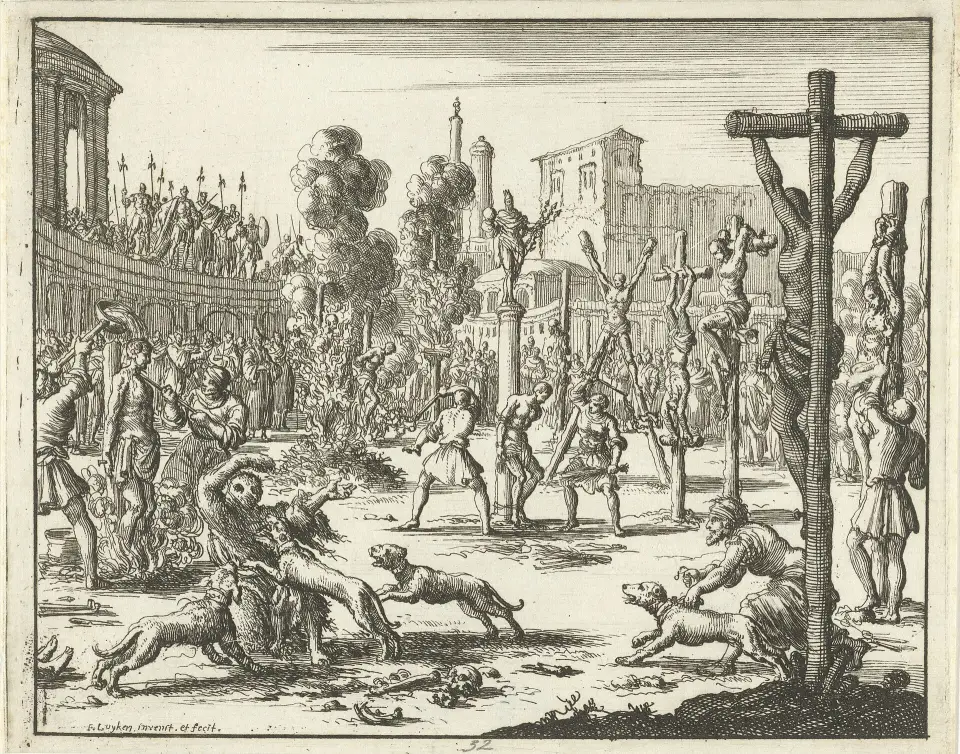
The Great Persecution of Diocletian and Galerius
At the urging of Caesar Galerius, four edicts were issued in 303–304. They excluded Christians from the army and public office, ordered churches destroyed and sacred books burned, called for the arrest of clergy, and required universal sacrifice.
This was the harshest persecution the early church endured. Thousands died, and others were tortured or sent to the mines.
In the West Constantius Chlorus enforced only the first edict. In the East, Galerius and Maximinus Daia ruled after Diocletian's and Maximian's abdication in 305. There persecution continued for several more years.
The persecution may have been fueled by an anti-Christian book the Neoplatonist Porphyry had recently published.
The question of "traditor" bishops who had handed over the sacred books later gave rise to the Donatist schism in North Africa.
Key points
- Four edicts in 303–304
- Leniency of Constantius Chlorus in the West
- Martyrdom of Pamphilus of Caesarea and other confessors
- The dispute over "traditores" gave rise to Donatism
- Possible influence of Porphyry's anti-Christian work
- Shelley: in the early fourth century a believer in Sicily was accused of owning Gospels; at trial he read the governor ‘Blessed are the persecuted for righteousness’ and ‘If any would follow me, let him deny himself’, and the judge ordered him led to execution. Roman officials realized that suppressing Christianity meant destroying its sacred books, and in the last great persecution Scripture was burned. Diocletian suddenly ordered churches destroyed and books burned, bishops were executed; he abdicated in 305 and Constantius Chlorus halted the attacks.
People
- Diocletian
- Galerius
- Maximian
- Constantius Chlorus
- Maximinus Daia
- Eusebius of Caesarea
- Pamphilus
- Dorotheus
Place
Roman Empire (most severe in the East)
Sources disagree
Most books date the main phase of the persecution to 303–311 (Galerius's edict); Lane and Hall note that in Maximinus Daia's territories the persecution continued until 313.
Sources
- Tony Lane – Christian Thinkers (Russian edition), p. 34
- Justo L. González – The Story of Christianity, vol. I (Russian edition), Ch. 6 «Великие гонения и конечная победа»
- J. North – A History of the Church (Russian edition), p. 58–59
- Stuart G. Hall – Doctrine and Practice in the Early Church (Russian edition), p. 77
- Justo L. González – A History of Christian Thought in One Volume (Abingdon, 2014), p. 170–171
- Bruce L. Shelley – Church History in Plain Language (Russian edition), Ch. 6, introduction; Ch. 9, sec. «Христиан – в огонь!»
Data compiled: 2026-11-09