1559–1598 · 16th century
The French Wars of Religion: from the Vassy massacre to the Edict of Nantes
French Protestants (Huguenots) were organized into Reformed churches from the 1550s and held a national synod in 1559. They were drawn into the rivalry of the noble houses of Guise and Bourbon. In 1562 Guise's men massacred Huguenots at Vassy, which opened a series of religious wars.
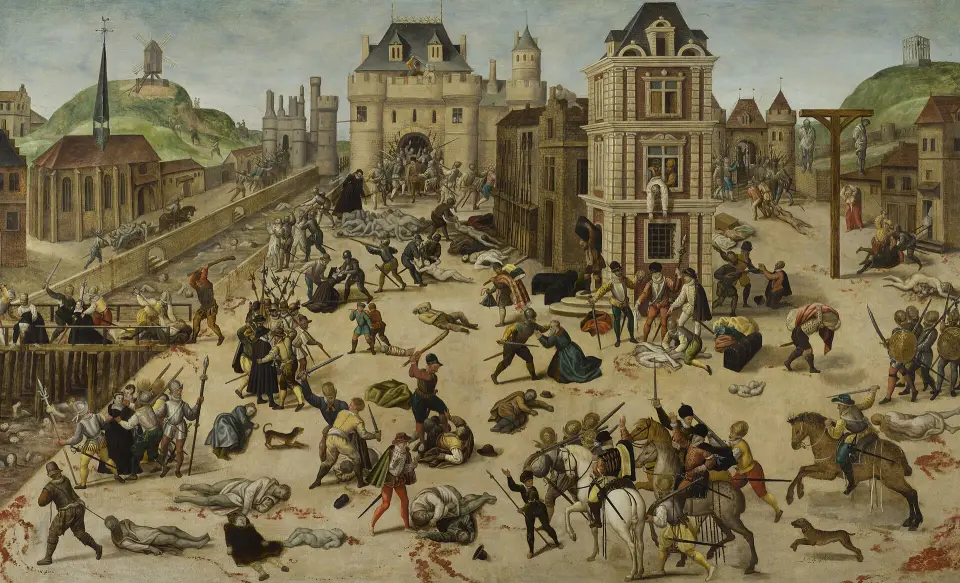
The climax came with the St Bartholomew's Day Massacre on 24 August 1572. Tens of thousands of Protestants, including Admiral Coligny, were killed in Paris and across France. The event provoked rejoicing in Rome. Among the Huguenots it gave rise to a theory of lawful resistance to tyranny (the "monarchomachs").
After the "War of the Three Henrys", the former Huguenot Henry of Navarre converted to Catholicism to secure the throne ("Paris is worth a Mass"). In 1598 he issued the Edict of Nantes. For the first time it granted Huguenots limited freedom of worship and fortified towns. This compromise was revoked only in 1685 by Louis XIV.
Key points
- The Vassy massacre (1562) – the start of the religious wars
- St Bartholomew's Day Massacre (24 August 1572)
- The "monarchomach" theory of the right to resist a tyrant
- The Edict of Nantes (13 April 1598) issued by Henry IV
- Shelley: from 1562 to 1598 France suffered wars between Catholics and Huguenots; the Edict of Nantes (1598) sealed the outcome: Huguenots received freedom of worship and political control of some regions, while Catholicism stayed the official religion
People
- Catherine de' Medici
- Charles IX
- Henry de Guise
- Gaspard de Coligny
- Henry IV
- Theodore Beza
Place
France (Vassy, Paris, Nantes)
Sources
- Justo L. González – The Story of Christianity, vol. II (Russian edition), Part 1, ch. 11
- Justo L. González – A History of Christian Thought, vol. III: From the Protestant Reformation to the Twentieth Century (Abingdon, rev. ed. 1987), p. 293, 321–323
- Alister McGrath – Reformation Thought (Russian edition: «Theological Thought of the Reformation»), p. 380
- J. North – A History of the Church (Russian edition), p. 288, 192
- Justo L. González – A History of Christian Thought in One Volume (Abingdon, 2014), p. 368–369
- Bruce L. Shelley – Church History in Plain Language (Russian edition), Ch. 31, sec. «Подавление инакомыслящих»
Data compiled: 2026-11-09