284–305 · 3rd century
Diocletian's reforms and the establishment of the Tetrarchy
For decades in the 3rd century there was military anarchy, as the army made and unmade emperors. Diocletian came to power in 284 and restored stability by dividing power.
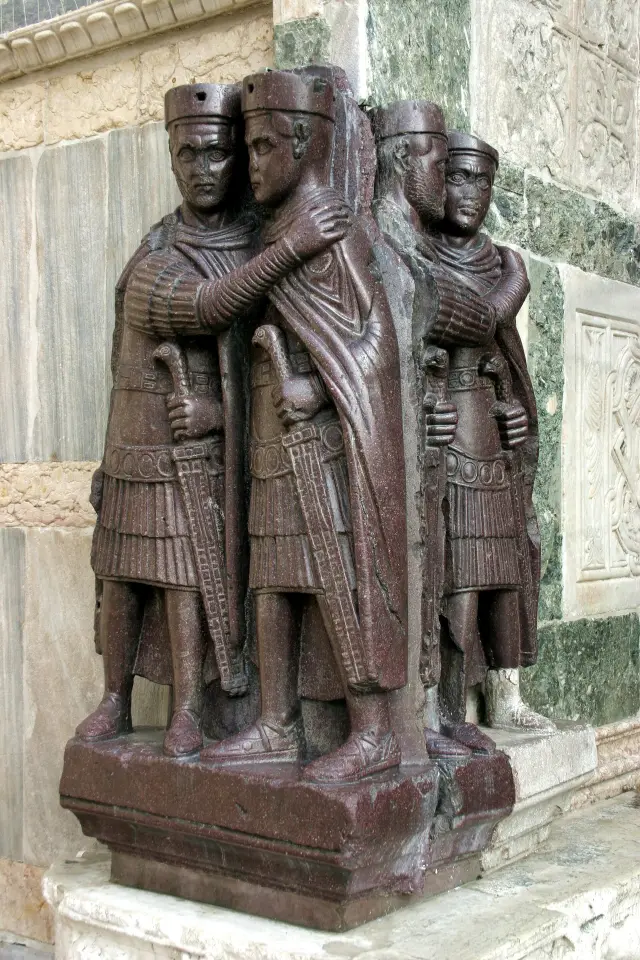
In 285 he made Maximian co-ruler in the West. In 293 he added two junior co-rulers, the Caesars Constantius Chlorus and Galerius. This created a system of four rulers, the Tetrarchy, under which a military coup lost its point.
Alongside this, Diocletian reformed the army, taxation and administration. These reforms secured the empire roughly two more centuries of existence. At first these changes, like the preceding "Peace of Gallienus," also benefited the Church.
Yet the same centralization of power and drive for religious uniformity would later, under that same Diocletian, lead to the harshest persecution of Christians. This was the Great Persecution, which began in 303.
Key points
- The end of the era of "soldier-emperors" of the 3rd century
- 285: Maximian as co-ruler in the West; 293: the Tetrarchy (two Augusti, two Caesars)
- Reforms of the army, taxation and the judiciary
- The four-ruler system made a coup pointless
- The centralization of power later led to the Great Persecution of 303
- Shelley: by 284 all signs of the empire’s disintegration were present: in the third century thirty emperors held the throne; the Senate no longer pretended the “election” of a Caesar meant anything, and the previous Caesar’s sons and relatives often faced swift execution. Diocletian, son of Dalmatian slaves, became an army commander before forty and was raised to the purple “by decision of the generals and officers”. He shared power with three co-rulers (two “augusti,” each helped by a “caesar”) and founded three imperial courts outside Rome, his own in Nicomedia in Asia Minor, to watch the eastern frontiers. Quoting Hutchinson and Harrison, Rome’s turn from chaos to flowering was largely the result of Diocletian’s reign (284–305); he deserves mention among the truly great emperors. The West’s collapse was still 175 years away, and in the East the empire lasted almost until Columbus sailed
People
- Diocletian
- Maximian
- Constantius Chlorus
- Galerius
Place
The Roman Empire
Sources
- Stuart G. Hall – Doctrine and Practice in the Early Church (Russian edition), p. 11, 76–77
- J. North – A History of the Church (Russian edition), p. 57–58
- Bruce L. Shelley – Church History in Plain Language (Russian edition), Ch. 9, sec. «Разворот империи»
Data compiled: 2026-11-09