late 13th century–1473 · 13th century
Rhineland Mysticism and the 'New Devotion' (Devotio Moderna)
The Dominican Meister Eckhart taught Neoplatonic contemplation of the ineffable God and spoke of a "divine spark" in the soul. He was charged with heresy in 1326 and posthumously condemned by the pope in 1329. His teaching, however, was popularized by his disciples Johannes Tauler and Henry Suso. Tauler nursed the sick during the Black Death.
The Flemish Jan van Ruusbroec and Geert Groote built on this the "modern devotion" (devotio moderna). It meant imitation of Christ's life, frequent communion, and practical holiness without elaborate speculation. Groote founded the Brethren of the Common Life. Its schools at Deventer and Windesheim educated many reformers, including Erasmus of Rotterdam.
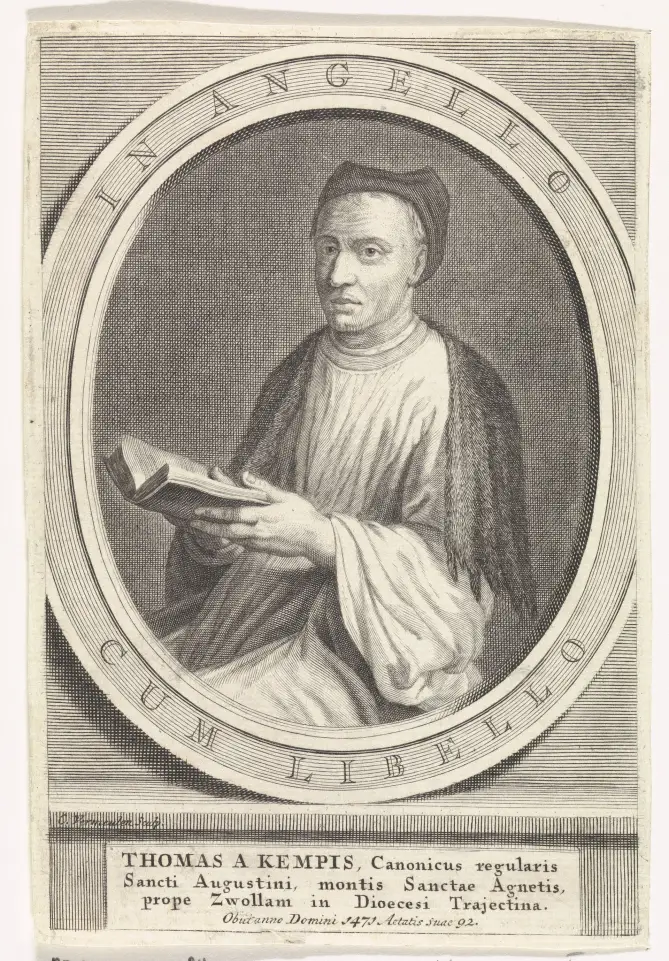
The movement's best-known fruit was the treatise "The Imitation of Christ". It is attributed to Thomas à Kempis, who entered the Windesheim community in 1399 and died in 1471. By 1427 its four books already circulated separately. The first printed edition of all four (1473) spawned countless reprints.
Key points
- The condemnation of Meister Eckhart (1329) and his continuing influence through disciples
- Geert Groote's founding of the Brethren of the Common Life
- 'The Imitation of Christ', attributed to Thomas à Kempis
- The first printed edition of all four books of the 'Imitation' in 1473
- McGinn: from the 13th century mysticism used the vernacular, giving women a voice: the “conversational model” of illiterate women dictating to confessors. The beguine Marguerite Porete (Mirror of Simple Annihilated Souls, c.1290) was burnt with her book in 1310; the book was still read in translation. Eckhart’s core is the “ground” (grunt): a hidden depth where God and the soul are, on some level, one; 28 articles condemned in 1329. Tauler’s sermons to Dominican nuns and the “friends of God” were praised by Luther; he is perhaps the most continuously read of the medieval mystics. Flemish line: beguine Hadewijch (13th c.) and Jan van Ruusbroec (1293–1381), Trinitarian mysticism; Modern Devotion: Gerlach Peters, Alijt Bake
People
- Meister Eckhart
- Johannes Tauler
- Henry Suso
- Jan van Ruusbroec
- Geert Groote
- Thomas à Kempis
- Erasmus of Rotterdam
Place
Cologne; Strasbourg; the Netherlands (Deventer, Windesheim)
Sources
- Justo L. González – The Story of Christianity, vol. I (Russian edition), Ch. 27, sec. 27.5; ch. 28, sec. 28.1
- Tony Lane – Christian Thinkers (Russian edition), p. 91, 136–137, 145–147
- Justo L. González – A History of Christian Thought in One Volume (Abingdon, 2014), p. 265–266
- Justo L. González – A History of Christian Thought, vol. III: From the Protestant Reformation to the Twentieth Century (Abingdon, rev. ed. 1987), p. 20–21
- Alister McGrath – Reformation Thought (Russian edition: «Theological Thought of the Reformation»), p. 42–43, 311–312
- The Oxford Handbook of Mystical Theology, ed. Edward Howells, Mark A. McIntosh (2020), Ch. 4, sec. «Late Medieval Vernacular Mysticisms»; Ch. 4, sec. «German Mysticism»; Ch. 4, sec. «Flemish Mysticism»; Ch. 4, sec. «French and Italian Mysticism»
Data compiled: 2026-11-09