1534–1549 · 16th century
The beginning of Catholic reform under Paul III
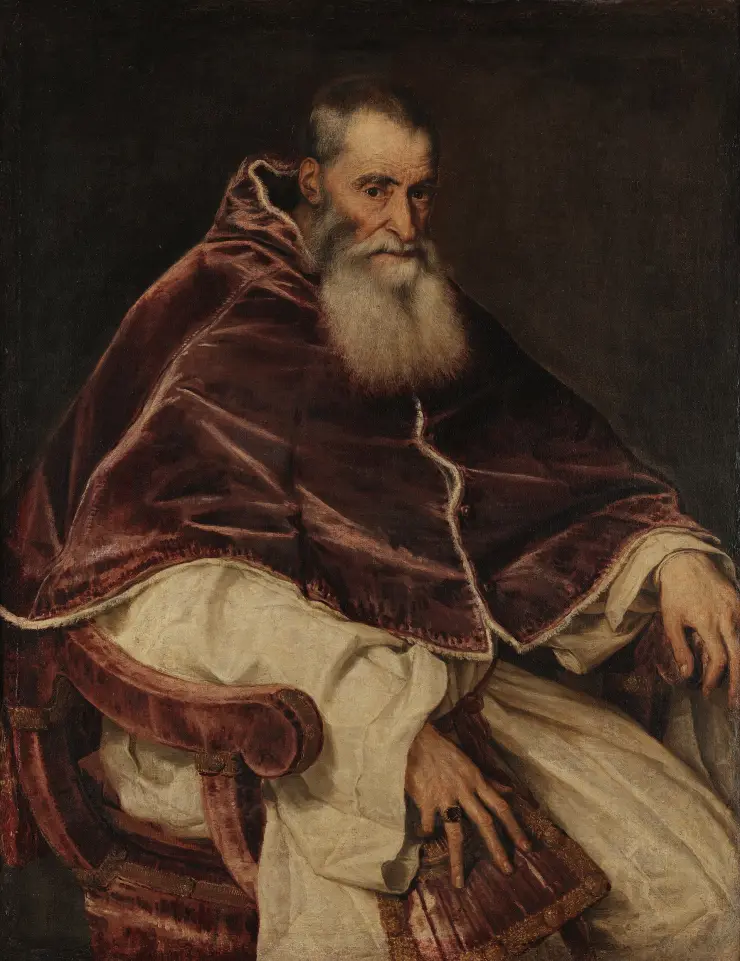
Pope Paul III had led a rather worldly life before his election, yet he became the first reforming pope. He appointed reform-minded cardinals, including the future Paul IV, Carafa. In 1536 he set up a commission to draft a programme of church reform. Its 1537 report exposed numerous abuses and, to the papacy's displeasure, fell into Protestant hands. Paul III recognized the Jesuit order in 1540, and in 1542 he established the Congregation of the Holy Office – the Roman Inquisition.
Reconciliation with the Lutherans at the 1541 Colloquy of Regensburg failed. Even so, under Paul III Catholic reform took on a centralized, papally-driven character. It persisted under his successors to the end of the sixteenth century. The Church's moral and disciplinary life changed, but not its doctrine or institutions.
Key points
- The report of the cardinals' reform commission (1537)
- Recognition of the Jesuit order
- Establishment of the Roman Inquisition (1542)
- The failed attempt at reconciliation with the Lutherans at Regensburg (1541)
- Hazlett: from 1533 Bucer sought church reconciliation: the Paris colloquy was aborted, the 1538–41 talks torpedoed, the Cologne blueprint vetoed by the emperor. Bucer saw Trent as sealing the division and advised believers in the old church (“Nicodemites”) not to secede
- Bagchi: he divides Catholic theological writing before Trent into three phases – polemical (1518–c. 1530), political (to 1541) and propagandist (1541–1545); earlier schemes (Jedin, Dolan, Chrisman) saw only one shift, from polemic to propaganda for fellow Catholics, and did not win general agreement. After the diets of 1530 and 1532 Protestants were too strong to suppress by force, and religious colloquies began: polemicists (Eck, Pighius) obstructed them; moderates (Gropper, Contarini) admitted the problems and double justification. The failure of the Regensburg Colloquy (1541) ended the pre-Tridentine colloquies and perhaps shifted papal policy from reform to repression. Until the council met polemic and dialogue achieved little, and Catholic literature turned to propaganda for home consumption: in the 1540s catechisms and sermons (Witzel, Dietenberger, Nausea; Eck’s postils). This tone held to the end of the sixteenth century – catechisms of Canisius and Trent, little weighty polemic (Bellarmine). In nuncio van der Vorst’s survey the main disputes in Germany in the late 1530s were papal supremacy, saints, confession, purgatory and the mass, next came communion in both kinds, images, baptism in Latin, monastic vows and celibacy; Catholic controversialists would largely have agreed
- Shelley: Catholicism was both a Counter-Reformation and a Catholic Reformation; its roots predate Luther, its shape was set by the Protestant attack. Six aspects – Jesuits, Teresa of Ávila, writings and priestly training, Trent, missions and a cruel inquisition; Protestants stayed in northern Europe. Even before Luther Roman nobles formed the Oratory of Divine Love; its members included Sadoleto, Pole and Carafa. In the 1520s and 1530s the Church took no major steps toward reform: popes feared a council and were busy with politics. Clement VII treated the Papal States as highest law; on 6 May 1527 Charles V’s mercenaries sacked Rome and held the pope six months. Paul III brought reformers into the College of Cardinals; the Contarini commission in 1537 found the curia too worldly. Paul III’s new strictness – the Roman Inquisition and the Index of Forbidden Books, with reformers’ books and Protestant Bibles; it lasted to 1959, and in Spain such a book was long punishable by death. By 1545 Rome yielded to “the charm of the new asceticism” and the depravity of Paul’s early years became unacceptable.
People
- Paul III
- Gasparo Contarini
- Gian Pietro Carafa (Paul IV)
- Johann Gropper
- Johann Eck
Place
Rome; Regensburg
Sources
- J. North – A History of the Church (Russian edition), p. 280–281
- Justo L. González – A History of Christian Thought, vol. III: From the Protestant Reformation to the Twentieth Century (Abingdon, rev. ed. 1987), p. 240–241
- Justo L. González – The Story of Christianity, vol. II (Russian edition), Part 1, ch. 12
- The Cambridge Companion to Reformation Theology, ed. David Bagchi, David C. Steinmetz (2004), p. 113, 118, 232, 233, 233–234, 234
- Bruce L. Shelley – Church History in Plain Language (Russian edition), Ch. 28, introduction; «Аспекты Контрреформации»; Ch. 28, sec. «Возвращение к духовному»; Ch. 28, sec. «Призыв к Вселенскому Собору»
Data compiled: 2026-11-09