c. 480 (birth) – 525/529 (Monte Cassino) · 5th century
Benedict of Nursia, Monte Cassino, and his "Rule"
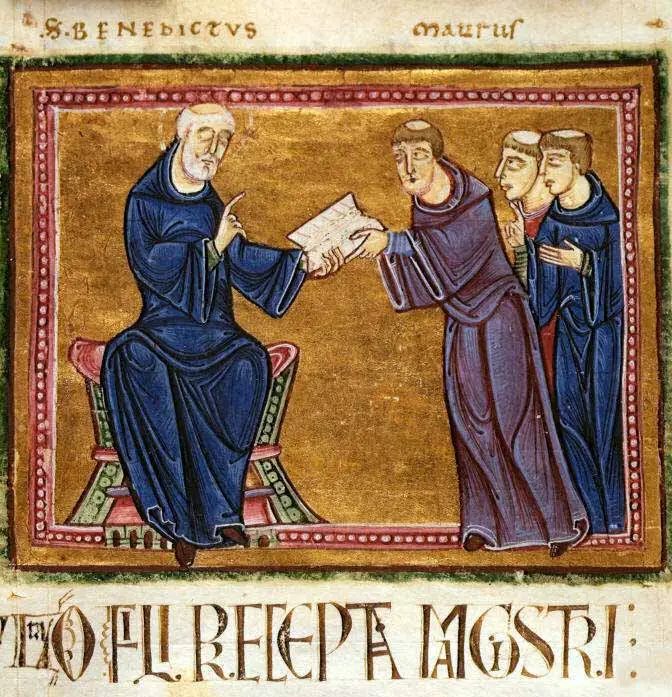
Benedict was born c. 480 in Nursia. Around 500 he withdrew as a hermit to a cave, and he then founded several monasteries. In 525 (by other accounts 529) he founded the monastery at Monte Cassino on the site of a former pagan shrine. He lived there until his death. His sister Scholastica founded a corresponding community for women.
His "Rule" drew on Basil the Great, John Cassian, and the anonymous "Rule of the Master." It set out a reasonable, moderate way of life without extreme asceticism. Its elements were manual labor (ch. 48), worship ("the Work of God", to which nothing is to be preferred, ch. 43), common prayer at fixed hours (ch. 16), obedience to the abbot as "father" (ch. 2), and twelve degrees of humility (ch. 7).
In 589 Monte Cassino was destroyed by the Lombards, and the monks brought the Rule to Rome. From there, with papal support, it spread across the West. That support included Gregory the Great, himself a Benedictine. From the 7th to 11th centuries the Rule became virtually the sole form of Western monasticism.
Key points
- Founding of Monte Cassino (525/529) on the site of a pagan shrine
- The "Rule" draws on Basil the Great, Cassian, and the "Rule of the Master"
- Moderate asceticism: labor, liturgy, common prayer, obedience
- Twelve degrees of humility; the monastery as a family
- Destruction of Monte Cassino by the Lombards (589) and the Rule's spread via Rome
- Gregory the Great, himself a Benedictine, helped spread the Rule across the West
- Shelley: Benedict was born in the late fifth century in Nursia; studying in Rome, he withdrew to a cave south of the city and studied Scripture for three years. Chosen abbot of a nearby monastery, he wearied the monks with strict discipline and barely escaped death when they tried to poison him. In 529 he founded Monte Cassino, mother house of the Benedictines, wrote his Rule for it and lived there until his death in 542. The Rule set a year’s novitiate, a threefold vow, an abbot elected by the monks, seven day Hours and a night Office, manual labor and reading; the monastery was self-sufficient. Monasteries preserved Latin learning and offered protection and study.
People
- Benedict of Nursia
- Scholastica
- Gregory the Great
Place
Nursia, Monte Cassino (Italy)
Sources disagree
The books give close but not fully matching dates for the founding of Monte Cassino (525 and 529).
Sources
Primary sources
- Benedict of Nursia – Rule, ch. 2, 7, 16, 43, 48, 58, 64, 73
Textbooks
- Tony Lane – Christian Thinkers (Russian edition), p. 101–103
- Justo L. González – The Story of Christianity, vol. I (Russian edition), Ch. 20, sec. 20.2
- Justo L. González – A History of Christian Thought in One Volume (Abingdon, 2014), p. 189
- J. North – A History of the Church (Russian edition), p. 87
- Bruce L. Shelley – Church History in Plain Language (Russian edition), Ch. 12, sec. «Гений Запада»; Ch. 12, sec. «Гений Запада», «Немного «за» и «против»»
Data compiled: 2026-11-09