c. 480 – execution in 524/526 · 5th century
Boethius: theological treatises, the "Consolation of Philosophy," and his execution
The Roman aristocrat Boethius served under the Arian Ostrogothic king Theodoric. He intended to translate all of Plato and Aristotle into Latin. But he managed only to translate and comment on Aristotle's logical works ("Categories," "On Interpretation"). Through these the West knew Aristotle until the 12th–13th centuries.
He also wrote orthodox theological treatises, "On the Holy Trinity" and "Against Eutyches and Nestorius." In them he applied philosophical method to questions of faith, laying the groundwork for the scholastic method for a thousand years to come.
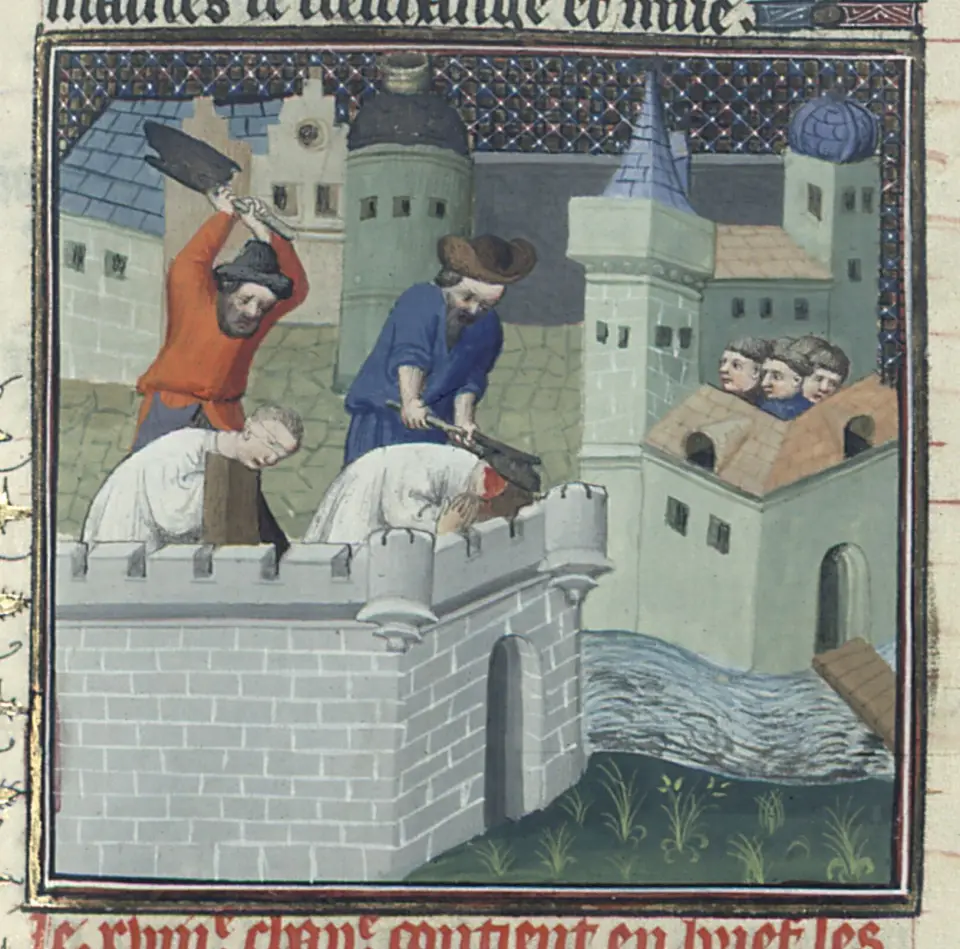
Suspected of conspiring with Constantinople, Boethius was imprisoned at Pavia. He himself (Consolation of Philosophy 1.4) says he was accused of wishing to save the senate and, on forged letters, of having "hoped for the freedom of Rome". There he wrote the "Consolation of Philosophy" – a meditation on Providence, free will, and the good, containing no direct reference to Christian doctrine. He was executed in 524 (by other accounts 526) along with his father-in-law Symmachus.
The Church venerated him as a martyr. Soon afterward Emperor Justinian sent Belisarius to conquer Ostrogothic Italy.
Key points
- Translations and commentaries on Aristotle's logic – the main channel of classical logic for the early Middle Ages
- Theological treatises "On the Trinity" and "Against Eutyches and Nestorius": reason applied to faith (On the Trinity 4 applies the ten categories to God)
- "Consolation of Philosophy" written in prison before his execution
- Executed in 524/526 on a charge of treason, along with his father-in-law Symmachus
- Venerated as a martyr; linked to the deterioration of Theodoric's relations with Constantinople
- Gunton: the task of the scholastic age was set by Boethius in the sixth century: to combine faith (the creeds) with reason (the discoveries of philosophy).
People
- Boethius
- Theodoric
- Symmachus
- Pope John I
- Belisarius
Place
Rome, Pavia, Ravenna (Ostrogothic Italy)
Sources
Primary sources
- Boethius – The Consolation of Philosophy, bk. I, ch. 4
- Boethius – On the Holy Trinity (The Trinity is One God not Three Gods), ch. 4
Textbooks
- Tony Lane – Christian Thinkers (Russian edition), p. 89, 94–98
- Justo L. González – A History of Christian Thought in One Volume (Abingdon, 2014), p. 187–188
- J. North – A History of the Church (Russian edition), p. 100–102
- Jaroslav Pelikan – The Christian Tradition: A History of the Development of Doctrine, vol. 1 (Russian edition), p. 51–53, 378–380
- Justo L. González – The Story of Christianity, vol. I (Russian edition), Ch. 20, sec. 20.1
- The Cambridge Companion to Christian Doctrine, ed. Colin E. Gunton (1997), p. 29
More on the doctrine
Data compiled: 2026-11-09