160–220 · 2nd century
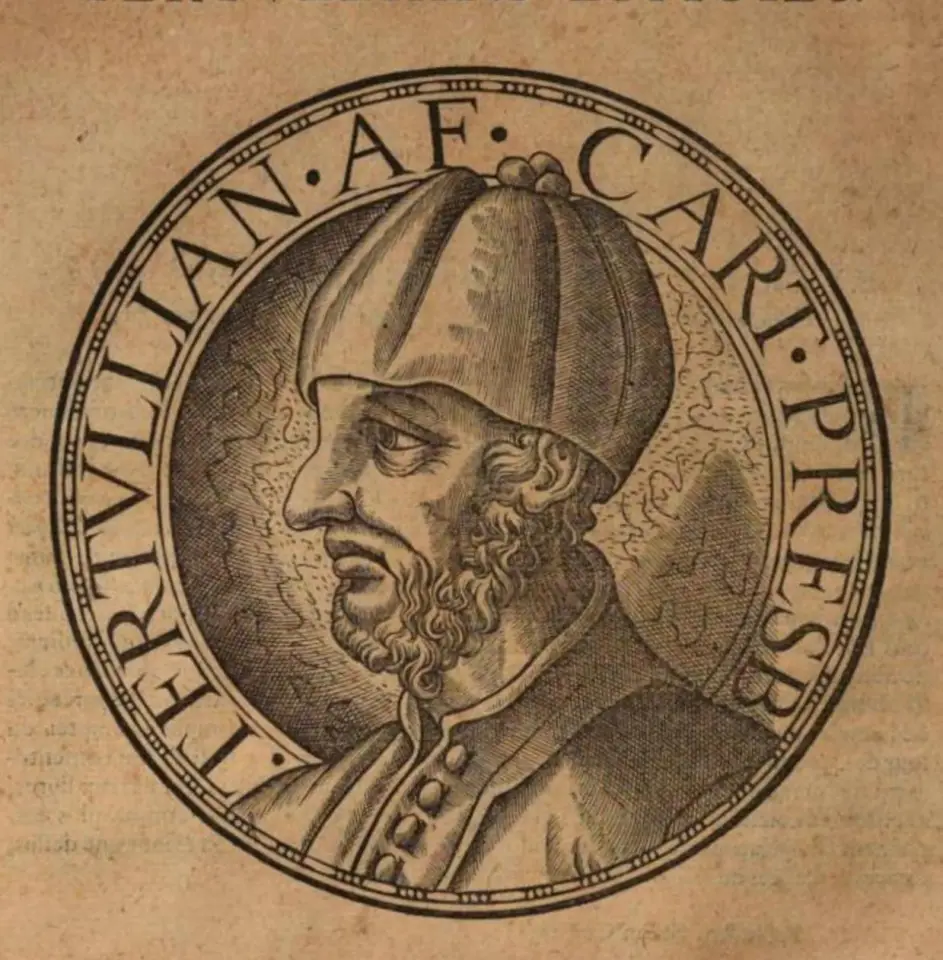
Tertullian of Carthage – founder of Latin theology
Tertullian, a Carthaginian with a brilliant rhetorical and probably legal education, came to Christ as an adult (before 197) and became the first major Christian writer in Latin. North Africa, not Rome, was the cradle of Latin theological language.
In the Apology (197) and the Prescription against Heretics he defended the faith before pagans and denied heretics the right to interpret Scripture (Prescription against Heretics 15–19, 37). Around 207 he joined the Montanists because of their moral strictness. This was not a break with orthodoxy, but it set him apart from the "psychic" Christians and gave rise to his own group of "Tertullianists." In the Montanist period he wrote the treatise Against Praxeas, aimed at the modalist Praxeas, and introduced into Latin the terms "Trinity," "substance" and "person" (Against Praxeas 2–3).
Key points
- The first major Christian writer in Latin; North Africa was the cradle of Latin theology
- The Apology (197) and the Prescription against Heretics
- Joined Montanism around 207 because of its moral strictness
- Against Praxeas (c. 207–220); introduced the words trinitas, "substance" and "person" (Against Praxeas 2–3)
- Shelley: in the third century Tertullian was the fiercest opponent of reconciling Christianity with Greek philosophy: philosophy breeds heresy. The Church fought Gnosticism to the death, so this is no mere zealot’s reaction: the Gnostic Valentinus turned his philosophical arsenal to the Gospel.
- Tertullian: “What has Athens to do with Jerusalem? …We have no need of curiosity after Jesus Christ”; Valentinus was a Platonist, Marcion a Stoic (Prescription against Heretics 7).
- Roetzel: against Marcion Tertullian moved 'of this world' in 2 Cor. 4:4 to modify 'the unbelievers', to preserve a single God; he draws an idealized Paul in harmony with the apostles and treats the Antioch quarrel (Gal. 2:11–21) as an error of judgment.
People
- Tertullian
- Praxeas
- Marcion
- Hermogenes
Place
Carthage; Rome
Sources disagree
The chronology of Tertullian's works "continues to elude precise determination" (Pelikan); his turn to Montanism is dated variously to 200 or c. 207.
Sources
Primary sources
- Tertullian – The Prescription against Heretics, ch. 7, 15–19, 37
- Tertullian – Against Praxeas, ch. 2–3
Textbooks
- Stuart G. Hall – Doctrine and Practice in the Early Church (Russian edition), p. 13, 46–50
- Tony Lane – Christian Thinkers (Russian edition), p. 21–24
- Justo L. González – A History of Christian Thought in One Volume (Abingdon, 2014), p. 72–77
- Jaroslav Pelikan – The Christian Tradition: A History of the Development of Doctrine, vol. 1 (Russian edition), p. 40, 59–60, 121–123, 150–151, 170–175
- J. North – A History of the Church (Russian edition), p. 69–70
- Louis Berkhof – History of Christian Doctrines (Russian edition), p. 40–45, 55
- Justo L. González – The Story of Christianity, vol. I (Russian edition), sec. «Тертуллиан Карфагенский»
- Bruce L. Shelley – Church History in Plain Language (Russian edition), Ch. 8, sec. «Свет миру»
- The Cambridge Companion to St Paul, ed. James D. G. Dunn (2003), p. 249, 249–250
More on the doctrine
- Tertullian, The Prescription against Heretics: Scripture Belongs to the Church (c. 200)
- Tertullian's Against Praxeas and Novatian's On the Trinity: one substance in three Persons (early 3rd century – c. 250)
- Tertullian: two substances in one person (c. 207)
Data compiled: 2026-11-09