c. 200–253 · 2nd century
Alexandrian Exegesis: Clement and Origen – Inspiration, the Three Senses of Scripture and the Hexapla
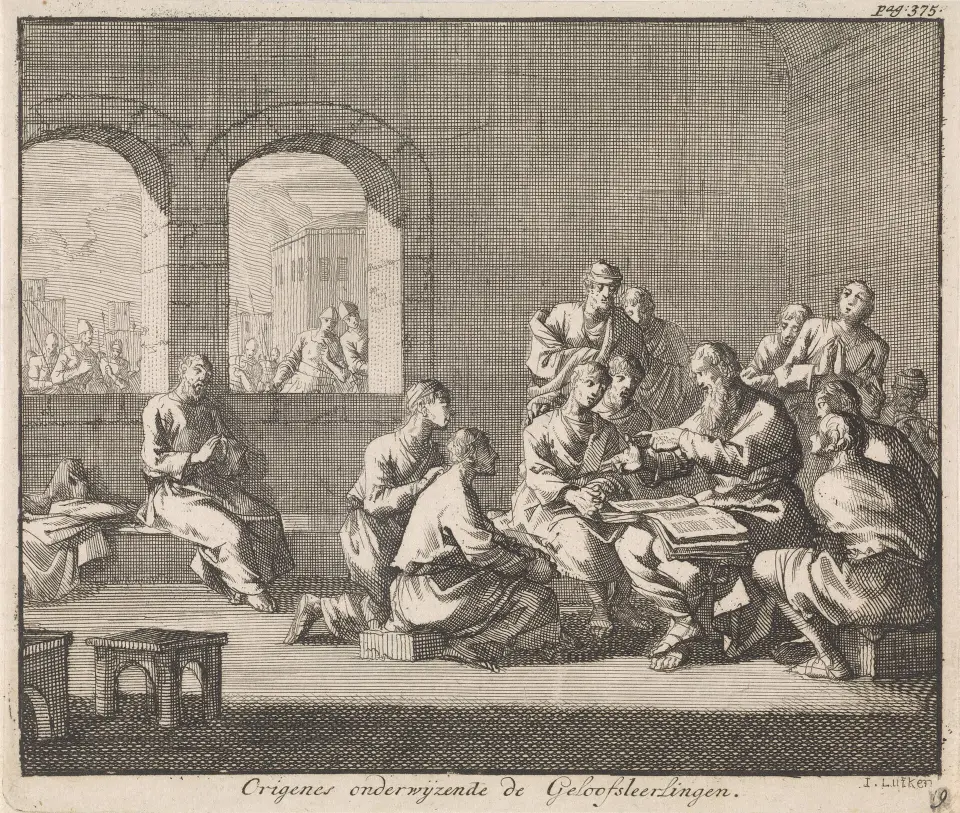
Clement of Alexandria, following Philo and the Epistle of Barnabas, regarded allegory as the main tool of hermeneutics: every text has a literal ("first") and a spiritual sense, but the primary sense must not be discarded unless it is unworthy of God. Origen believed in the inspiration of every word of Scripture and precisely for that reason demanded "spiritual" interpretation: the sense of Scripture is threefold, like a human being – literal ("flesh"), moral ("soul") and spiritual (On First Principles 4.1.11). As the foundation of theology he accepted the teaching handed down from the apostles, leaving the wise Christian room for inquiry as long as it did not contradict these foundations (On First Principles, preface 3). In the Hexapla, Origen for the first time in Christian history provided a tool for establishing the original text of the Old Testament.
Positions
- Clement
- The teaching is preserved by itinerant teachers who inherit from the apostles "as sons from fathers" (Stromata 1.1); for him the "rule of the Church" (6.15), according to R. Hanson, is above all the allegorical interpretation of the Old Testament
- Origen
- Literal interpretation often leads to absurdity; texts that seem absurd prove the need for the spiritual sense, which is perfect (On First Principles 4.1.15–16)
- Irenaeus, Tertullian (according to Lane)
- The opposite view: did not allow going beyond the apostolic foundations
- A pagan critic; Jerome
- Origen introduces Plato's ideas into foreign myths; the allegory of paradise is "the destruction of historical truth" (Jerome, Against John of Jerusalem 7)
Key points
- Hall: the method goes back to the Greeks, who interpreted the legends of the gods, and to Philo; it is also found in Paul (Gal. 4:21–5:1) and in Irenaeus. Origen regarded only the Septuagint as inspired, the other translations as supplementary; through Jerome his approach to Scripture spread in the West
- González: Origen also follows typology (Isaac’s sacrifice as a type of the passion) but often abandons the historical sense for allegory; the rule of faith serves as a limiting factor on it
- On First Principles is a model of coherent dogmatics built on apostolic teaching; it survives mainly in Rufinus's "corrected" Latin translation
- Lane: Ambrose introduced the allegorical method in the West, preparing the ground for Augustine’s conversion
- Shelley: Origen was the most influential third-century sage to defend in allegory Christian claims to the Old Testament; allegory infuriated pagans, whose arguments rested on a literal Old Testament, and revealed the Christian message beneath it. Origen saw three levels of meaning in the Bible – literal, moral and spiritual; conflict with morality signals a deeper lesson. He sought the voice of the whole Bible and “outplayed heretics”; he held seeing the spiritual sense a gift of the Spirit
- Morgan: Origen read Romans 9 against the grain: election means that God foreknew what people would choose, so as not to deny free will. For Origen and Gregory of Nyssa Paul teaches ceaseless prayer and contemplation; Gregory's Life of Moses owes more to 'Paul' than to the Old Testament.
Outcome
Allegorical interpretation became the main tradition of Christian exegesis, and the Hexapla the first attempt to establish the original text of Scripture; in the dispute between Jerome and Rufinus (394–410), Rome condemned "everything that Origen wrote against our faith."
People
- Clement of Alexandria
- Origen
- Philo of Alexandria
- Rufinus
- Jerome
- Ambrose of Milan
- Gregory of Nyssa
Terms
- three senses of Scripture
- Literal (physical), moral (psychic), spiritual (intellectual).
- first sense
- In Clement, the sense found directly in the text, not necessarily literalistic.
- Hexapla – hexapla
- A six-column parallel edition of the Hebrew Old Testament text, its transliteration and Greek translations.
Place
Alexandria, Caesarea
Sources disagree
Clement – c. 200–215 (Hall, González). Origen: González – c. 202–250, Lane – c. 202 to the 250s, Hall – c. 203–253; the books do not date the works precisely.
Sources
Primary sources
- Origen – On First Principles (De Principiis), preface; bk. IV, ch. 1
- Clement of Alexandria – The Stromata, bk. I, ch. 1; bk. VI, ch. 15
- Jerome – Against John of Jerusalem, ch. 7
Textbooks
- Stuart G. Hall – Doctrine and Practice in the Early Church (Russian edition), p. 65–66, 69–71, 122–123
- Jaroslav Pelikan – The Christian Tradition: A History of the Development of Doctrine, vol. 1 (Russian edition), p. 72–74
- Justo L. González – A History of Christian Thought in One Volume (Abingdon, 2014), p. 80–83, 87–91
- Tony Lane – Christian Thinkers (Russian edition), p. 27–29, 48
- Bruce L. Shelley – Church History in Plain Language (Russian edition), Ch. 6, sec. «Основы Библии»; Ch. 8, sec. «Ориген и жажда истины»
- The Cambridge Companion to St Paul, ed. James D. G. Dunn (2003), p. 261
Related entries
- Rejected in: The Antiochene School: The Historical-Grammatical Method and Typology against Allegory (3rd – early 5th century)
In church history
Data compiled: 2026-11-17