1799–1830 · 18th century
Schleiermacher: Religion as Feeling and Theology as the Expression of Religious Self-Consciousness
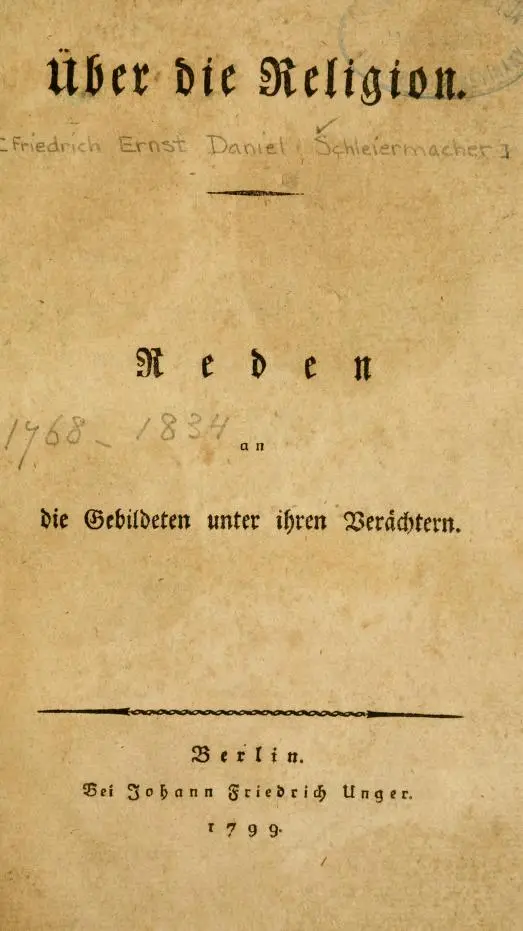
In On Religion: Speeches to Its Cultured Despisers (1799) Schleiermacher assigned religion a third domain – "a necessary, an indispensable third" alongside science and practice: religion "is neither thinking nor acting, but intuition and feeling", "sense and taste for the Infinite" (Second Speech). In The Christian Faith (1821–1822; 1830), according to González probably the most influential theological work of the 19th century, piety is "the consciousness of absolute dependence," and Christianity is a monotheistic faith of the teleological type in which everything is related to the redemption accomplished by Jesus of Nazareth. Doctrines are descriptions of Christian religious feelings; the criterion is the experience of believers, so doctrines are subject to revision. Barth accused him of replacing talk about God with talk about man; González also points to the debt of 20th-century theology to him.
Positions
- Eighteenth-century rationalism
- Jesus is above all a teacher of enlightened natural morality
- Schleiermacher
- Jesus is the redeemer; theology is the believer's reflection on the experience of communion with God
- Barth, Mackintosh; Grenz and Olson
- Schleiermacher replaced revelation with discovery, the word of God with religious consciousness; a first step toward the loss of transcendence
- González
- He overcame the individualism of pietism and the subjectivism of the Romantics and put the person of Jesus at the center
Key points
- Religion exists in concrete communities ("positive religion")
- Lane: statements about God's attributes concern how our feeling of dependence relates to God; the Bible, for Schleiermacher, is a record of religious experience
- Berkhof: on this view dogmas are intellectual formulations of the community's experience
- González: Schleiermacher is to be understood as a response to Kant
- Swain: Wegscheider saw the sacraments’ efficacy as moral, “a means to the means of grace”; the Supper serves moral formation. Schleiermacher and Dorner sought to retrieve sacramental teaching; Schleiermacher allowed infant baptism might be given up, Dorner defended it. Lutheran–Reformed unity came by state mandate, not persuasion (Prussian Union, 1817), and spurred the quest for a new “evangelical” synthesis.
Outcome
Lane sees the Speeches as the beginning of liberal theology, Grenz and Olson call Schleiermacher the father of modern theology; "we still do theology in the shadow of Schleiermacher" (González).
People
- Friedrich Schleiermacher
- Karl Barth
- H. R. Mackintosh
- Julius August Ludwig Wegscheider
Terms
- feeling – Gefühl
- Not a passing emotion but immediate self-consciousness that precedes rational judgments.
- feeling of absolute dependence
- Consciousness of the Other whose presence is the source and ground of all that exists; the essence of piety.
- God-consciousness
- The perfect and continuous sense of union with the divine – the essence of Jesus in Schleiermacher; Christian religious feeling bound up with Christ's redemptive work.
Place
Berlin
Sources disagree
Speeches – 1799 (all books); The Christian Faith – 1821–1822, 2nd ed. 1830 (González, Grenz and Olson); Lane gives 1830–1831 for the second edition.
Sources
Primary sources
- Schleiermacher – On Religion: Speeches to Its Cultured Despisers, oration 2, p. 36–39, 277
Textbooks
- Louis Berkhof – History of Christian Doctrines (Russian edition), p. 5
- Justo L. González – A History of Christian Thought in One Volume (Abingdon, 2014), p. 388–390
- Justo L. González – A History of Christian Thought, vol. III: From the Protestant Reformation to the Twentieth Century (Abingdon, rev. ed. 1987), p. 357–361, 368–369
- Tony Lane – Christian Thinkers (Russian edition), p. 230–232
- Stanley Grenz, Roger Olson – 20th-Century Theology: God and the World in a Transitional Age (Russian edition), p. 49–60, 65–67
- The Oxford Handbook of Sacramental Theology, ed. Hans Boersma, Matthew Levering (2015), p. 449–450, 450, 435
Related entries
- Response to: Kant: The Critique of Pure Reason, the Limits of Knowledge and the Religion of Practical Reason (1781–1788)
- Developed in: Protestant Liberalism: Ritschl's Value Judgments and Harnack's Thesis of "Hellenization" (1870–1900)
- Rejected in: Barth and Dialectical Theology: The Revolt against Immanence (1919–1932)
In church history
Data compiled: 2026-11-17