1519–1559 · 16th century
Zwingli and Calvin: God's Sovereignty, Providence and the Knowledge of God
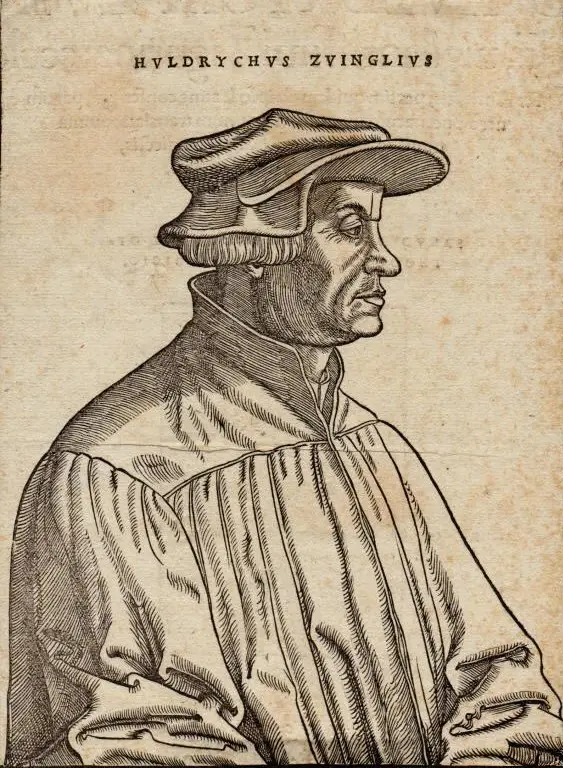
Reformed theology, according to McGrath, starts from the idea of divine sovereignty: Zwingli, who survived the plague in Zurich (1519–1520), stressed God's omnipotence and human powerlessness. Calvin begins the Institutes (1.1.1) by saying that nearly all wisdom is knowledge of God and knowledge of ourselves, so intertwined that it is hard to say which comes first. In every person there is a "seed of religion" (1.4.1), and creation is a "theater of God's glory" (1.5.8), but because of sin this knowledge only renders a person inexcusable (1.5.14); moreover, in revelation God "accommodates" himself to our limited perception (1.13.1). Providence for Calvin is not mere foreknowledge but the actual bringing about of events (1.16.4); he regarded the distinction between God's active and permissive will as a diminishing of God's glory: to substitute "a bare permission for the providence of God" is "the merest trifling" (1.18.1).
Positions
- Zwingli's critics
- The teaching resembles the fatalism of Seneca
- Zwingli (according to McGrath)
- The emphasis on God's sovereignty goes back to Paul, reinforced by Seneca and existentially confirmed by illness
- Those who softened the doctrine
- God actively wills good and merely permits evil
- Calvin
- The distinction between active and permissive will diminishes God's glory; this is not Stoic fatalism (Institutes 1.16.8) but universal divine government
Key points
- McGrath: Zwingli's theology was shaped by a sense of God's sovereignty, Luther's by the experience of justification. Calvin approved of astronomy and medicine as revealing the Creator's wisdom (Institutes 1.5.2) – a religious stimulus to the study of nature
- González: God cannot be known in his highest glory, only as he has revealed himself; one should not go beyond the bounds of the Word of God. Calvin discusses predestination in the section on the work of Christ – from the standpoint of grateful faith
- Stephens: Zwingli held knowledge that God exists to be not innate but from God (Rom 1:19), and religion God’s call to fallen man. God’s sovereignty was the center of his thought; in On Providence he built providence from God as highest good. In Zwingli Christ saves as Son of God by fulfilling God’s will, and as man by a sacrifice satisfying God’s righteousness. The Anselmian view dominates, but there is also Irenaean recapitulation, Athanasian divinization, Abelard’s love of God and victory over the devil. Christ’s death is effective for those before Christ (Jethro, Cornelius) and for Gentiles (Mal 1:11); the heaven-with-Socrates vision in the Exposition of the Faith scandalized Luther, but Zwingli never tied salvation to works or free will. Salvation rests on God’s election, Christ’s death and the Spirit’s freedom; the Spirit “blows where he will” (John 3:8), unbound by Word and sacrament: Word and sacrament need the Spirit, but the Spirit does not need them. The article on the outward Word Luther drew up at Marburg could have been Zwingli’s, but Luther said “Word and Spirit”, Zwingli “Spirit and Word”. Here are both Augustinian sovereignty of God and a Platonist contrast between flesh and spirit. Later differences between Lutheran and Reformed theology partly go back to the differences between Luther and Zwingli. Zwingli stressed the unity of the Old and New Testaments, Luther their contrast and a “canon within the canon”; Luther said “law and gospel,” Zwingli “gospel and law,” seeing in the law good news that reveals God's will to the believer. Justification by faith was central for Luther but not for Zwingli, who stressed “making righteous” rather than “declaring righteous”. For Zwingli faith is faith in the Creator rather than the creature (all that is not God), whereas Luther set faith against works. Luther stressed the unity of Christ's natures, Zwingli their distinction; Luther called Zwingli a Nestorian, and he Luther a Marcionite. Providence and predestination play a far larger role in Zwingli's theology than in Luther's
- Steinmetz: knowledge of God for Calvin is not mere cognition but embraces love, trust, fear, obedience and worship; Adam and Eve knew God through nature and history, “the theatre of his glory”, and providence contained the damage of the fall
- Shelley: Calvin’s central doctrine was God’s sovereignty – Ruler of all things, who directs individual lives too; this is not ruthless fatalism but the personal decisions of the Almighty; Calvin’s motto – “Thy will be done on earth as in heaven”
Outcome
The doctrine of God's sovereignty became the basis of the Reformed understanding of grace (McGrath); the Reformed doctrine of the natural and revealed knowledge of God and of all-embracing providence took shape (González).
People
- Huldrych Zwingli
- John Calvin
Terms
- seed of religion
- The natural awareness of divinity implanted in man, which bears no fruit.
- accommodation
- God's adaptation of revelation to limited human capacities; this explains the anthropomorphisms of Scripture.
- theater of God's glory
- An image of the universe in which people are understanding spectators.
Place
Zurich; Geneva
Sources disagree
McGrath: the plague in Zurich – August 1519 – February 1520; González takes Calvin's teaching from the 1559 edition; Lane – from the editions of 1539–1559.
Sources
Primary sources
- Calvin – Institutes of the Christian Religion, bk. I, ch. 1, sec. 1; ch. 4, sec. 1; ch. 5, sec. 2, 8, 14; ch. 13, sec. 1; ch. 16, sec. 4, 8; ch. 18, sec. 1
Textbooks
- Justo L. González – A History of Christian Thought, vol. III: From the Protestant Reformation to the Twentieth Century (Abingdon, rev. ed. 1987), p. 140–141, 144–146
- Alister McGrath – Reformation Thought (Russian edition: «Theological Thought of the Reformation»), p. 177–179, 325–326
- Tony Lane – Christian Thinkers (Russian edition), p. 179
- The Cambridge Companion to Reformation Theology, ed. David Bagchi, David C. Steinmetz (2004), p. 96, 95–98, 109, 130–131
- Bruce L. Shelley – Church History in Plain Language (Russian edition), Ch. 26, sec. «Всевластие Божье»
Related entries
- Developed in: Predestination among the Reformers: Zwingli and Calvin (1523–1559)
Data compiled: 2026-11-17