1330–1351 · 14th century
Gregory Palamas against Barlaam: The Essence and Energies of God
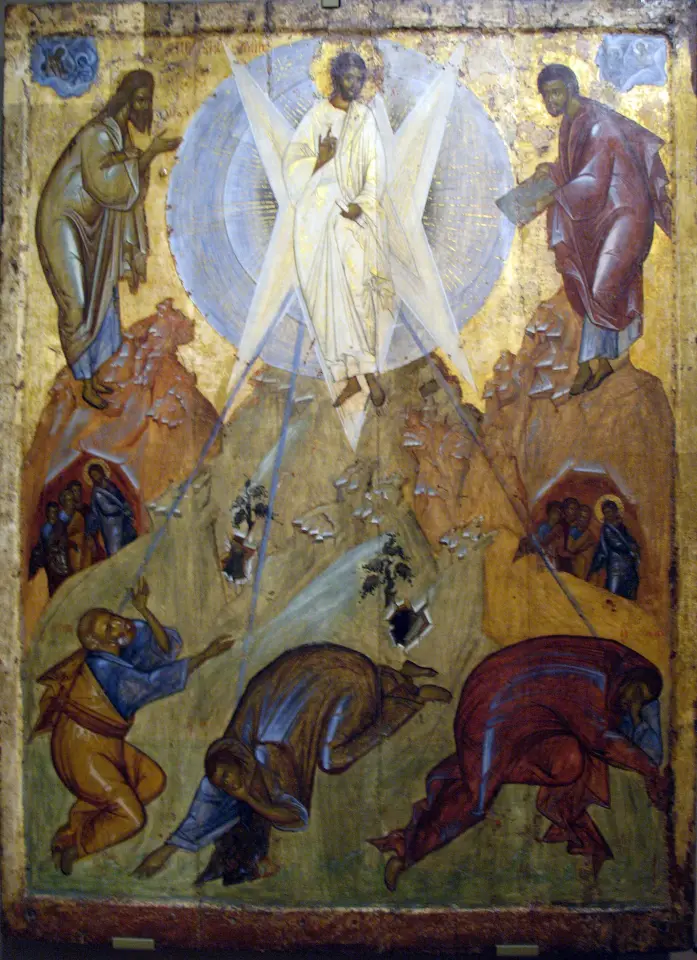
Symeon the New Theologian (11th century) taught about personal experience of the uncreated light, accessible to all Christians, and regarded experience as a principle of knowledge within tradition. In 1330 Gregory Palamas entered into a dispute with Barlaam, who mocked the prayer of the hesychasts: following Dionysius, Barlaam held that God can be known only indirectly through creation and gave philosophy an independent place. Palamas maintained that God can be known directly in experience: God is inaccessible in his essence, but not in his energies; the mystic sees the uncreated light that the apostles saw on Tabor. His opponents accused him of ditheism. The councils of 1341 and 1351 in Constantinople rejected Barlaam's accusations.
Positions
- Barlaam of Calabria
- God is knowable only indirectly through creation; revelation and philosophy lead to one goal – "Plato is Moses speaking Attic Greek"
- Gregory Palamas
- God is known directly in experience; the essence is inaccessible, the energies accessible; believers are united not by knowledge but by union with God
- Palamas's opponents
- A distinction in the Godhead according to activities leads to two deities – a revival of polytheism
Key points
- "We are partakers of the divine nature, and yet God remains inaccessible" (Triads)
- Pelikan: traditional apophaticism, for Palamas, is not apophatic enough – God is beyond both affirmation and negation; he calls Palamas the systematizer of Symeon's themes
- Lane: the distinction of essence and energy was anticipated by Maximus the Confessor
- Councils: 1341 – Barlaam's accusations rejected; 1344 – Palamas excommunicated; 1351 – all charges dropped; 1368 – canonization
- Papanikolaou: the essence–energies distinction is central for most 20th-century theologians; for Lossky it expresses God’s transcendence and immanence.
Outcome
The council of 1351 was not ecumenical, but its decisions were accepted by the whole Eastern Church; the West did not accept Palamas's teaching, which became another occasion of division (Lane).
People
- Gregory Palamas
- Barlaam of Calabria
- Symeon the New Theologian
- Maximus the Confessor
Terms
- divine energies
- God's action directed toward us, his grace, in which one can participate, as distinct from the inaccessible essence.
- uncreated light
- The light that the apostles saw at the Transfiguration and the mystic sees.
- beyond unknowing – hyperagnostos
- God surpasses both knowledge and unknowing.
- knowledge and union – gnosis, henosis
- Knowledge of God as against union with him.
Place
Mount Athos; Constantinople; Thessalonica
Sources disagree
Lane: the dispute began in 1330, councils of 1341 and 1351; Pelikan dates only to the 14th century; Symeon – 980–1009 (Lane), 11th century (Pelikan).
Sources
- Jaroslav Pelikan – The Christian Tradition, vol. 2: The Spirit of Eastern Christendom (600–1700) (Russian edition), p. 403–404, 407–412, 416–417
- Tony Lane – Christian Thinkers (Russian edition), p. 82–86
- The Cambridge Companion to the Trinity, ed. Peter C. Phan (2011), p. 260, 267
Related entries
- Grew out of: Deification in Byzantine Theology: Maximus the Confessor and Symeon the New Theologian (7th–11th centuries)
- Developed in: Orthodox trinitarian theology in the twentieth century: Bulgakov, Lossky, Zizioulas (1933–1985)
In church history
Data compiled: 2026-11-17