16th century (Münster – 1525–1535) · 16th century
The Reformation and the last things: the rejection of chiliasm and the Münster "kingdom"
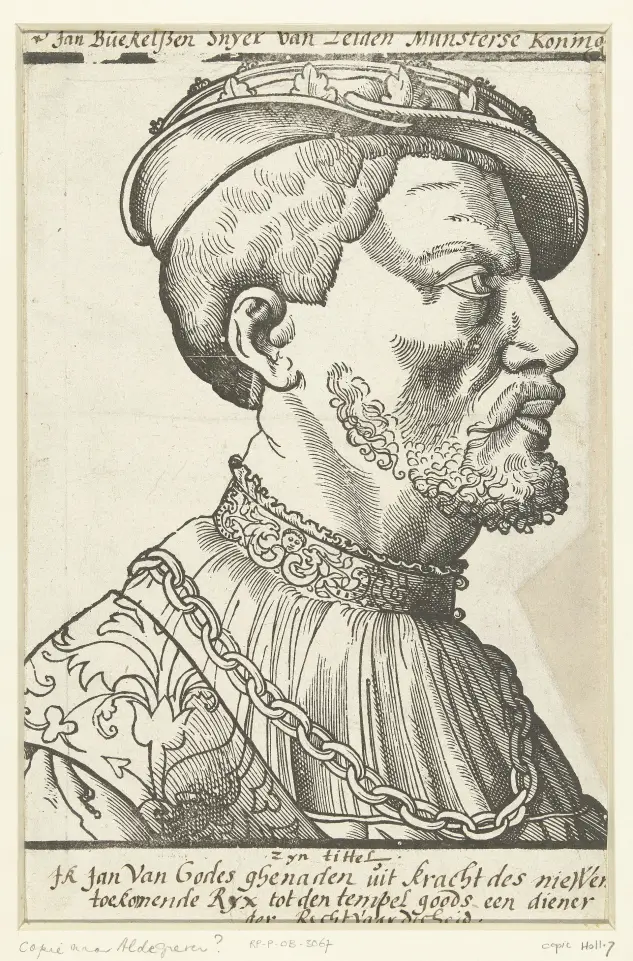
The Protestant churches of the Reformation rejected the doctrine of the millennium: Luther scornfully rejected the "dream" of an earthly kingdom of Christ before the Judgment, the Augsburg Confession (art. 17) condemns the "Jewish opinions" that before the resurrection of the dead the saints will take over the kingdom of the world, and the Second Helvetic Confession (ch. 11) the "Jewish dreams" of a golden age on earth before the day of Judgment. The Reformers taught that the risen body will be the same as the present one, distinguished a particular judgment at death from the general judgment, and held to eternal blessedness and eternal punishment. Chiliasm revived among the more fanatical Anabaptists: under the pressure of persecution Melchior Hoffman expected an imminent end and a New Jerusalem and rejected the absolute pacifism of the early Anabaptists, and his followers Jan Matthys and John of Leiden turned the expectation into a call to arms. In Münster they seized power, proclaimed the end at hand, expelled the "ungodly," and John declared himself king of the New Zion; the fall of the city was a deathblow to revolutionary Anabaptism.
Positions
- Luther and the Reformation confessions
- An earthly millennial kingdom before the Judgment is "Jewish opinions" and "dreams"
- The early Anabaptists
- Absolute pacifism
- Hoffman and his followers
- Christ will return and establish his kingdom in the New Jerusalem; the Lord will require the faithful to take up the sword
- Berkhof on modern liberalism
- Liberalism denies the resurrection or interprets it figuratively
Key points
- After the Reformation chiliasm also revived among the "Fifth Monarchy" men
- The Reformed confessions express the identity of the risen body with the present one
- Hoffman's prophecy of six months' imprisonment followed by the end did not come true; his followers reinterpreted it
- After the fall of Münster the moderate pacifists returned to the fore; the opponents of the Anabaptists constantly referred to Münster
- Packull: Hut and Hoffman gave adult baptism an apocalyptic meaning – the sign of Thau, the sealing of the end-time elect. Hoffman believed he lived in the sixth period of church history (sixth trumpet, vial, seal) and that the third period's corruption – the lay–clergy distinction, veneration of saints, perversion of the Supper and infant baptism – would be reversed. Followers saw Hoffman as a second Elijah sent to seal the 144,000, and awaited the Jews' conversion and the second witness, Enoch; Hoffman looked to Strasbourg and later Münster for the fulfilment. Hut expected God to punish Christendom through the Turks; meanwhile Anabaptists must suffer (the “sheathed sword,” per Stayer)
- Sauter: church doctrine rejected chiliasm (e.g. Augsburg Confession art. 17), but hope for better times did not disappear: the Puritans and revolutionary groups of the Reformation's “left wing” carried it, later pietism and awakening movements. It often accompanied the emigration of oppressed peoples, especially to the New World, and spurred Christian mission; universalist motifs revived the idea of the “restitution of all” (apokatastasis). From Reformed covenant theology (covenants with Noah, Abraham, David) grew the idea of progressive salvation history; combined with Hegel's philosophy of history, it was adopted by Lutheran theology and became very influential in the 19th century
- Weber: Luther more or less followed Augustine on the millennium and even doubted the canonicity of Revelation, yet found its images indispensable for his time: the pope the Antichrist, Rome the great apostasy, the judgment day at hand. He leaned on Bernard of Clairvaux, who divided time between the two comings into three eras, so the Antichrist would emerge from the church; he rejected date setting but was “certain from the Holy Scriptures that we have no more temporal things to expect”. Calvin commented on most of the Bible but not Revelation, followed Augustine's amillennialism and identified the pope as Antichrist; he saw the Reformation as a sign of the end of the age but had almost no interest in deciphering the signs of the times. Preaching Lutheranism in Estonia, Melchior Hoffman concluded that the Holy Spirit had made him Elijah. From 1529 he lived in Strasbourg, held it to be the new Jerusalem, and predicted Christ’s return in 1533; he told Anabaptists to avoid violence for now but be ready to take control of Strasbourg and other cities. Expelled, he returned in 1533 to await Jesus and stayed in jail until his death in 1543. In Münster (mid-1530s) the Anabaptists declared the city the new Jerusalem. Jan Matthys, as the prophet Enoch, took over, set a date for Christ’s return, instituted community of goods, burned all books but the Bible and put defiers to death; after he was killed Jan Bokelson imposed Old Testament law and polygamy and declared himself king of the world. The besieging armies took the city; Jan was tortured to death and his body hung in a cage from the cathedral for three centuries. After Münster most Protestants abhorred millennialism. Millennialism returned among the English Puritans: in 1627 Joseph Mede published Clavis Apocalyptica, a historicist reading of Revelation; he leapfrogged over Augustine to the early church’s apocalyptic millennialism and calculated the Parousia for 1736. The English translation of 1642 became wildly popular. Puritans saw the war with the king (1642; Charles I captured 1646, executed three years later) as God’s army fighting the papal Antichrist. The Fifth Monarchy men (after Daniel 7) petitioned in 1649, through high army officers, for a government of the saints; in 1653 Cromwell convened an assembly but rejected their demands as too extreme and set up the protectorate. They damned him as the beast of Daniel; in 1657 a number were arrested and hanged for plotting rebellion. After Cromwell’s death (1658) the protectorate fell apart and Parliament called Charles II to the throne; millennialism kept a small following, e.g. Isaac Newton in England and Johann Albrecht Bengel in Germany
Outcome
Chiliasm was condemned in the Reformation confessions; revolutionary Anabaptism collapsed with Münster.
People
- Martin Luther
- Melchior Hoffman
- Jan Matthys
- John of Leiden
Terms
- New Zion (New Jerusalem)
- The kingdom expected by the revolutionary Anabaptists; many considered Strasbourg, and later Münster, to be the New Jerusalem.
Place
Wittenberg, Strasbourg, Münster
Sources disagree
Berkhof speaks of the position of the Reformation and the Reformers only as 16th century; González (vol. III) places revolutionary Anabaptism in 1525–1535 (the date of the fall of Münster taken from the title of a work in a footnote); González (HCT) gives no dates for Hoffman and Münster.
Sources
Primary sources
- Augsburg Confession, art. 17
Textbooks
- Louis Berkhof – History of Christian Doctrines (Russian edition), p. 192, 194–196
- Justo L. González – A History of Christian Thought in One Volume (Abingdon, 2014), p. 305–307
- Justo L. González – A History of Christian Thought, vol. III: From the Protestant Reformation to the Twentieth Century (Abingdon, rev. ed. 1987), p. 95–97
- The Cambridge Companion to Reformation Theology, ed. David Bagchi, David C. Steinmetz (2004), p. 227–228
- The Oxford Handbook of Eschatology, ed. Jerry L. Walls (2008), Ch. 13, sec. «Eschatology and the Destination of History»; Ch. 20, sec. «The Reformation»
Related entries
- Rejects: Expectation of the end and chiliasm in the early Church: from Papias and Irenaeus to Augustine (2nd–5th centuries)
- Rejects: The Anabaptists: a believers' Church separated from the world and the state (1525–1527)
In church history
- The Münster Anabaptist Kingdom (1534–1535)
- Apocalyptic Radicalism in the English Revolution: the Fifth Monarchists, Anna Trapnel and Gerrard Winstanley (1649–1654)
Data compiled: 2026-11-17