254–257 · 3rd century
The rebaptism controversy: Cyprian and Stephen of Rome
The dispute concerned whether baptism performed by schismatics and heretics (for example, the Novatianists) was valid and whether converts should be baptized. Following the bishops of Carthage and Asia Minor, Cyprian held that baptism is true only in the one catholic Church, and received converts as catechumens; his opponents called this rebaptism, while he said such people "are not re-baptized among us, but are baptized" (Epistles 70.1; 72.1). Stephen of Rome required only the laying on of hands as a sign of penance (Epistle 73.1) and threatened to break communion; at a council in Carthage in 256 Cyprian declared that each bishop is free to decide for himself. The dispute ended with the persecution of 257, the death of Stephen and the martyrdom of Cyprian; the sides tacitly kept their own views. In 314 the Council of Arles ruled that those baptized in the name of the Trinity should not be rebaptized (canon 9), and according to Hall, here Rome's view prevailed over Cyprian's.
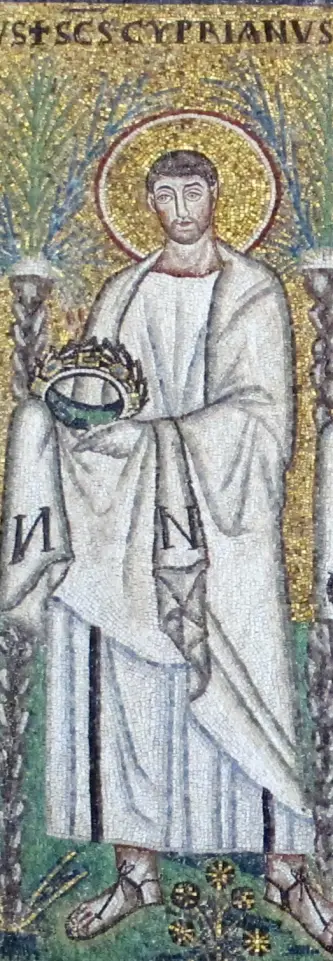
Positions
- Cyprian, Firmilian (North Africa, Asia Minor)
- Baptism outside the catholic Church is invalid; converts are baptized as catechumens
- Stephen (Rome)
- Invent nothing beyond what has been received from the ancients: the earlier baptism is valid, the laying on of hands as a sign of penance suffices (Cyprian, Epistle 73.1)
- The author of On Rebaptism
- Both Trinitarian baptism and baptism "in the name of Jesus" are legitimate
- Council of Arles (314)
- If a heretic was baptized in the name of the Father, Son and Holy Spirit, the laying on of hands suffices, so that he receive the Holy Spirit (canon 9); ordinations performed by a cleric deposed for handing over the Scriptures remain valid (canon 14)
Key points
- Lane: many Eastern bishops sided with Cyprian; in the 4th century the catholic church in Africa rejected his view, while the Donatists supported it
- Hall: the main meaning of the rite is renunciation of the world and a pledge of loyalty to Christ, and so it is performed only once; in the Roman position he sees a tradition of recognizing the baptism of other communities that is older than monarchical episcopacy
- Berkhof: recognition of baptism by the Trinitarian formula prevailed
Outcome
No single decision was reached in the lifetime of the disputants; Lane regards the tacit retention of each side's custom as a victory for Cyprian, but in the early 4th century Africa and the Council of Arles adopted the Roman practice; the estrangement of Rome and Africa, according to Hall, led to schism in the next century.
People
- Cyprian of Carthage
- Stephen of Rome
- Firmilian of Caesarea
- Novatian
Place
Carthage, Rome, Arles
Sources disagree
Hall: Stephen – 254–257, the council in Carthage – 256, the Council of Arles – 314; Lane: the dispute was settled with the persecutions of 257 and the death of Stephen, Cyprian was executed in 258; González gives no exact date.
Sources
Primary sources
- Cyprian of Carthage – Epistles, letters 70, 72, 73
- Council of Arles (314) – Canons, canons 9, 14
Textbooks
- Stuart G. Hall – Doctrine and Practice in the Early Church (Russian edition), p. 62–63, 79–80
- Justo L. González – A History of Christian Thought in One Volume (Abingdon, 2014), p. 105
- Tony Lane – Christian Thinkers (Russian edition), p. 33
Related entries
- Develops: Cyprian: the unity of the Church in the episcopate and "no salvation outside the Church" (251–258)
- Developed in: The Donatist controversy: the holiness of the Church and the validity of the sacraments (early 4th century (from 311))
- Rejected in: Augustine on the sacraments: validity, efficacy and sign (late 4th – early 5th century)
In church history
Data compiled: 2026-11-17