6th–16th centuries · 6th century
Purgatory: from Gregory the Great to the Council of Florence and indulgences
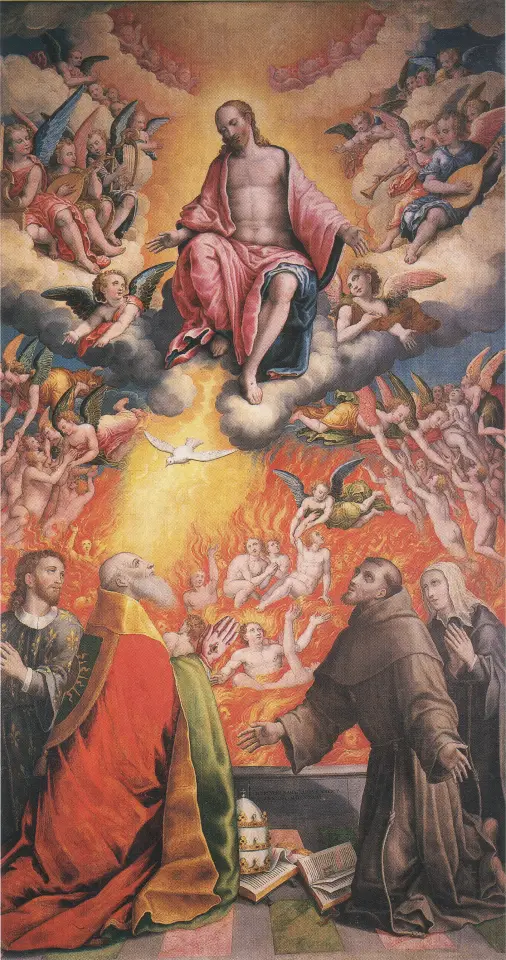
The doctrine of the intermediate state, according to Berkhof, long remained the least developed: the Apostolic Fathers held that the godly immediately inherit glory, while the later Fathers held that the dead descend before the judgment into hades with different compartments. The idea of a purifying fire developed mainly in the West, and Gregory the Great taught that "for certain light sins there is a purifying fire before the judgment," and was the first to clearly put forward the idea of deliverance from it by intercessory prayers and offerings, and according to Lane by the sacrifice of the Mass; therefore he is called the "inventor of purgatory." At the Council of Florence (1439) the Latins demanded that purgatory be accepted as apostolic teaching, while the Greeks replied that prayers for the dead give no grounds for it; the council's definition affirmed purification by the punishments of purgatory, but after the collapse of the union the East returned to its former position. In late medieval popular religion purgatory, requiem Masses and indulgences that promised a faster passage through it took a central place; the Council of Trent (1546) solemnly confirmed the doctrine, and the Reformers unanimously rejected it (Smalcald Articles II.2: purgatory is "nothing but a specter of the devil"; Thirty-Nine Articles, Art. 22).
Positions
- The Roman Church
- Purgatory is a place of purification after death; souls are freed by prayers, offerings and the Mass
- Greek theologians (the majority) at the Council of Florence
- Prayer for the dead is tradition but not a doctrine of purgatory; there is no official teaching, only theologoumena; the East saw in purgatory an echo of Origenism
- Academic theologians and the Paris faculty (1518)
- The teaching that a soul is instantly freed from purgatory for payment is "false and shameful"
- Wycliffe, Hus, Luther and the Reformers
- The doctrine of purgatory is contrary to Scripture; the Smalcald Articles – "a parasitic offspring of idolatry," the Thirty-Nine Articles – "vainly invented"
Key points
- Origen understood hell as a purifying fire; the Cappadocians, Ambrose, Ephrem and Augustine supported a purifying fire in the intermediate state
- The scholastics and mystics understood the fire of purgatory as material; the Greek Church did not accept the crude Western views
- Eastern writers appealed to the Liturgy of Chrysostom and to the parable of Lazarus, who was carried at once to Abraham's bosom
- On the eve of the Reformation Hamburg alone had 99 confraternities for the dead, most founded after 1450
- In France from 1515 there was a campaign selling indulgences for a crusade
- McGrath: the divergence of popular "unofficial" theology from academic theology hindered reform
- Shelley: for Gregory purgatory is for the not fully righteous, and Masses for the dead speed the soul’s release (the monk’s story in the Dialogues). To help sinners Gregory drew on the saints’ intercession – far older, but he made it central to Christian devotion – and urged his hearers to find in the martyrs defenders ‘in your guilt’ before the coming Judge. He encouraged collecting and venerating relics (hair, nails, fingers, clothing), which, he taught, had great power, even to protect themselves. Aquinas cautiously accepted indulgences: the Church draws on the “treasury of virtues” of Christ and the saints for those in need. The wicked go to hell, wise believers straight to heaven, the many who followed Christ too little are purified in purgatory, helped by the Church on earth. This is the Church’s summit and its “highest arrogance”: the power of pope and priests reaches into the afterlife.
- Daley: Augustine held that the souls of the dead remain part of the church and can profit from the prayers of the living, especially at the Eucharist; some souls may undergo a temporary purging punishment, while those who lived apart from Christ already begin eternal condemnation. Chrysostom may allow that prayers can lighten the punishment of the damned; Tertullian, that they affect souls in Hades’ ‘reception rooms’.
- Louth: purgatory was never part of Orthodox theology: a settled doctrine arose in 12th-century Latin theology, and the East rejected it. Orthodox teaching on the soul’s path after death rests on memorial services (3rd, 9th, 40th days) and “toll-houses,” but is not officially defined.
- Griffiths: mature purgatory doctrine emerged in the 12th–13th centuries from three threads: prayer for the dead, an intermediate state, post-baptismal sin. Prayer for the dead rested on 2 Macc 12:38–46 and the Passion of Perpetua (3rd c.), where Perpetua prays for her brother Dinocrates, tormented by thirst; the ‘classical scheme’ of two stages (pain or bliss at once, hell or heaven after judgment) dates from the 3rd century and is Rome’s dogma. Purgatory grew out of the discipline of penance for post-baptismal sin; by the 13th century it was largely accepted. In the 16th–17th centuries Protestants sharply rejected purgatory (Calvin, Luther, art. 22 of the Articles) as undermining Christ’s sacrifice. Only the Roman Church makes it binding doctrine: Trent (1563) decreed that it exists and that prayers and the mass help the souls held there, and told bishops to preach ‘sound doctrine’, avoiding hard questions and ‘filthy lucre’ (turpe lucrum) – a hint at indulgence abuses. Only two theses are binding: purgatory exists, and the dead can be helped by the intercession of the living. Dante’s Commedia (completed before his death in 1321) gives literature’s most detailed picture of purgatory, deeply shaping the Western imagination: a mountain opposite Jerusalem in the Southern Hemisphere, earthly paradise on top; souls sail from Ostia; Dante arrives at Easter 1300. Unlike hell, in purgatory souls feel time, progress toward heaven and the joy of anticipation; they have bodies that cast no shadow.
Outcome
The Roman Church affirmed purgatory (Florence, 1439; Trent, 1546), in the East it was not accepted as official Orthodox teaching, and the Reformers rejected both the popular rites and the theology on which they rested.
People
- Gregory the Great
- Origen
- Augustine
- Leo X
- Francis I
- John Wycliffe
- Jan Hus
- Martin Luther
Terms
- purgatory
- A place where the remaining sins of the dead are purged before admission to heaven; in Augustine, the purifying fire of which he spoke vaguely and hesitantly.
- limbo
- A limbo for children who died unbaptized and one for the fathers (Abraham's bosom) were distinguished from purgatory.
Place
Rome, Florence, Germany, Paris
Sources disagree
The main date is the pontificate of Gregory the Great (590–604, Lane); Berkhof does not date Gregory and places the Tridentine confirmation in 1546; Pelikan dates the dispute at the Council of Florence to 1439; McGrath dates the growth of popular piety to 1450–1520 and the decision of the Paris faculty to 1518. Griffiths dates the decree of the Council of Trent on purgatory to 1563 (the record has 1546)
Sources
Primary sources
- Luther – Smalcald Articles, pt. 2, art. 2
- Thirty-Nine Articles of Religion, art. 22
Textbooks
- Jaroslav Pelikan – The Christian Tradition, vol. 2: The Spirit of Eastern Christendom (600–1700) (Russian edition), p. 427–429
- Louis Berkhof – History of Christian Doctrines (Russian edition), p. 190–191
- Alister McGrath – Reformation Thought (Russian edition: «Theological Thought of the Reformation»), p. 42–48
- Tony Lane – Christian Thinkers (Russian edition), p. 103
- Bruce L. Shelley – Church History in Plain Language (Russian edition), Ch. 17, sec. «Защитник ортодоксии»; Ch. 20, sec. «Вершина познания»
- The Oxford Handbook of Eschatology, ed. Jerry L. Walls (2008), Ch. 5, sec. «Augustine; The Antiochenes»; Ch. 12, sec. «Purgatory»; Ch. 12, sec. «Individual Eschatology»; Ch. 24, sec. «Christian Reasons for Affirming Purgatory»; Ch. 24, sec. «Christian Reasons for Affirming Purgatory; Prolegomena»; Ch. 24, sec. «Christian Reasons for Denying Purgatory»; Ch. 24, sec. «The Basic Doctrine and Its Imaginative Elaboration»
Related entries
- Develops: Augustine, The City of God: the meaning of history, the two cities and the relation to the state (413–427)
- Develops: Penance after baptism: from Hermas to private confession (2nd–8th centuries)
- Develops: Origen: the "restoration of all things" (apokatastasis) and its condemnation (3rd century (condemnation – 6th century))
In church history
- The pontificate of Gregory the Great and the mission of Augustine of Canterbury to England (590–604) (588 (title dispute) – pontificate 590–604 – mission to England 596/597–c. 599 – 607 (title "Universal Bishop"))
Data compiled: 2026-11-17