c. 500 (Maximus – 7th century) · 5th century
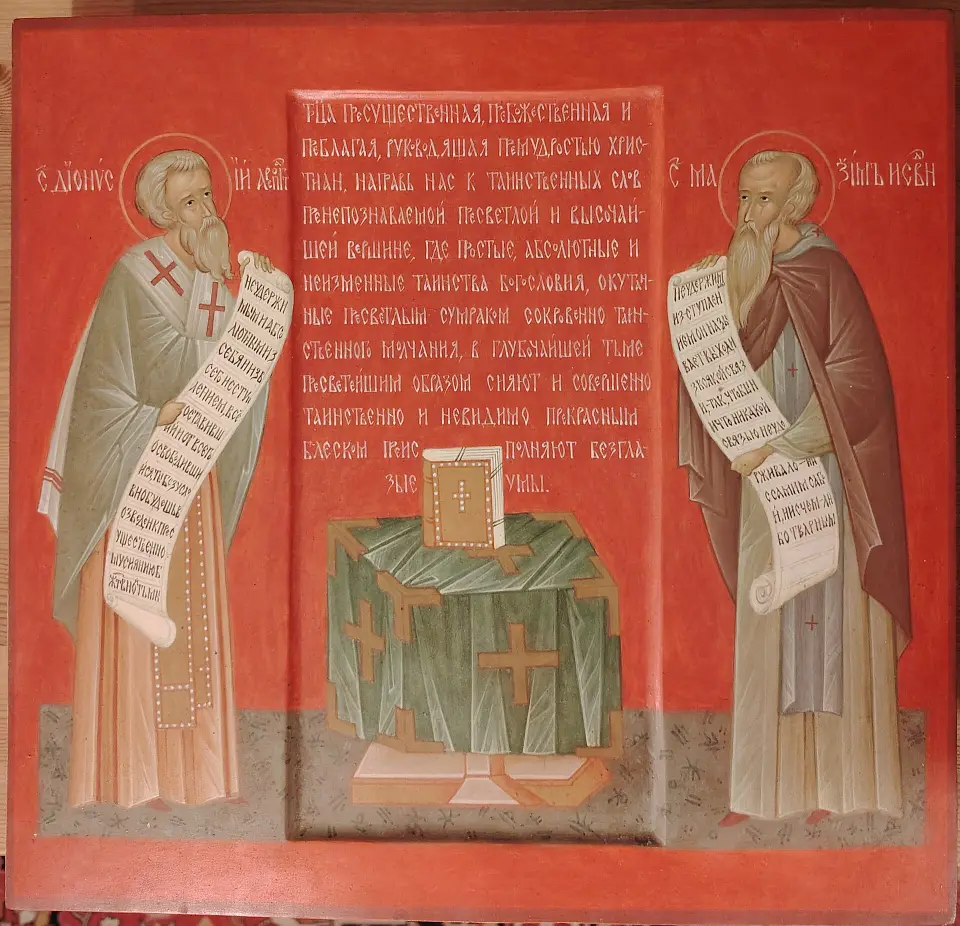
Pseudo-Dionysius the Areopagite and Maximus the Confessor: God beyond Being and the Negative Way
Around 500, probably in Syria, a corpus appeared bearing the name of Dionysius the Areopagite; for centuries it was regarded as the work of Paul's disciple. Under the influence of Neoplatonism (close to Proclus), Dionysius stresses God's transcendence and unity: God is beyond being, essence and personality; he "is not," yet from him everything receives being. Hence the via negativa: to speak not of what God is but of what he is not; positive names are only analogies. The negative way is also the way to union with God, "to the Ray of the divine Darkness." Maximus the Confessor, a commentator on Dionysius, taught that God is known not in his essence but in the greatness of creation and providence, and anticipated the distinction between essence and energy.
Positions
- Scholars (according to Lane)
- Some: Dionysius gave Neoplatonism a Christian coloring; others: he clothed Christian truth in a Neoplatonic garment; still others: he mixed them unsuccessfully
- Pelikan
- The teachings for which Origen was condemned are less dangerous to catholic orthodoxy than the "crypto-Origenism" of the Areopagitica
Key points
- Works: The Divine Names, The Mystical Theology, The Celestial Hierarchy, The Ecclesiastical Hierarchy, letters
- Pelikan: three stages of ascent – purification, illumination, union
- Lane: "the problem with Dionysius is that he tips the scales only one way"; Eriugena translated the works c. 850, which influenced the West
- Maximus: knowledge of God is "wise ignorance"; "remaining wholly man by nature, he becomes wholly god by grace"
- Louth: interest in Dionysius began with the Christology of Letter 4, which speaks of “a certain new theandric activity” in the Incarnation; the monophysites cited it at Justinian’s discussions in 532 as “one theandric activity” (μία θεανδρικὴ ἐνέργεια). This fits Severus’ stress on Christ’s unity, but Dionysius’ Christology cannot be confidently classed as monophysite: Letter 4 also seems to echo the Tome of Leo. The notion of theandric activity played an important role in the controversies of the seventh century. More important for Byzantine theology, he set all theology, Christology included, in a cosmic and liturgical context: Jesus is “the principle of all hierarchy, sanctification, and divine activity” (Ecclesiastical Hierarchy I.1), and the Christian’s way to deification – purification, illumination, perfection – rests on the union of divine and human in Christ
- McGinn: Dionysius taught God as a mystery beyond all affirmation and negation; the archetypal mystic is Moses entering the “darkness of unknowing”
Outcome
Enormous influence in the East (including hesychasm) and, through translations, in the West – on Bernard and Thomas (Pelikan); Neoplatonic mysticism entered Christian theology (Lane).
People
- Pseudo-Dionysius the Areopagite
- Maximus the Confessor
- Proclus
- John Scotus Eriugena
Terms
- negative way – via negativa
- An approach in which one says what God is not.
- deification – θέωσις
- The essence and final goal of salvation for the Greek Fathers: participation in the divine nature through union with Christ, becoming like God. "The Word became man so that we might be made divine."
- super-united Unity – υπερηνωμένη ένας
- God, who surpasses both unity and number.
Place
Syria
Sources disagree
Lane and Pelikan: c. 500; González: late 5th century; the authenticity of the name was challenged only in the 15th century (Lane); Maximus – 626–662 (Lane), 7th century (Pelikan).
Sources
- Jaroslav Pelikan – The Christian Tradition: A History of the Development of Doctrine, vol. 1 (Russian edition), p. 372–377
- Jaroslav Pelikan – The Christian Tradition, vol. 2: The Spirit of Eastern Christendom (600–1700) (Russian edition), p. 123–127
- Justo L. González – A History of Christian Thought in One Volume (Abingdon, 2014), p. 198–200
- Tony Lane – Christian Thinkers (Russian edition), p. 72–73, 76
- The Oxford Handbook of Christology, ed. Francesca Aran Murphy (2015), p. 188
- The Oxford Handbook of Mystical Theology, ed. Edward Howells, Mark A. McIntosh (2020), Ch. 4, sec. «Dionysian Mysticism»
In church history
- The appearance of the Pseudo-Dionysian corpus (c. 500)
- Genealogies of Christian Mystical Theology: from Origen to the Quietist Controversy (3rd–17th centuries)
Data compiled: 2026-11-17