386–430 · 4th century
Augustine: Neoplatonism, the Ascent to the Light and the Proof of God's Existence from Truth
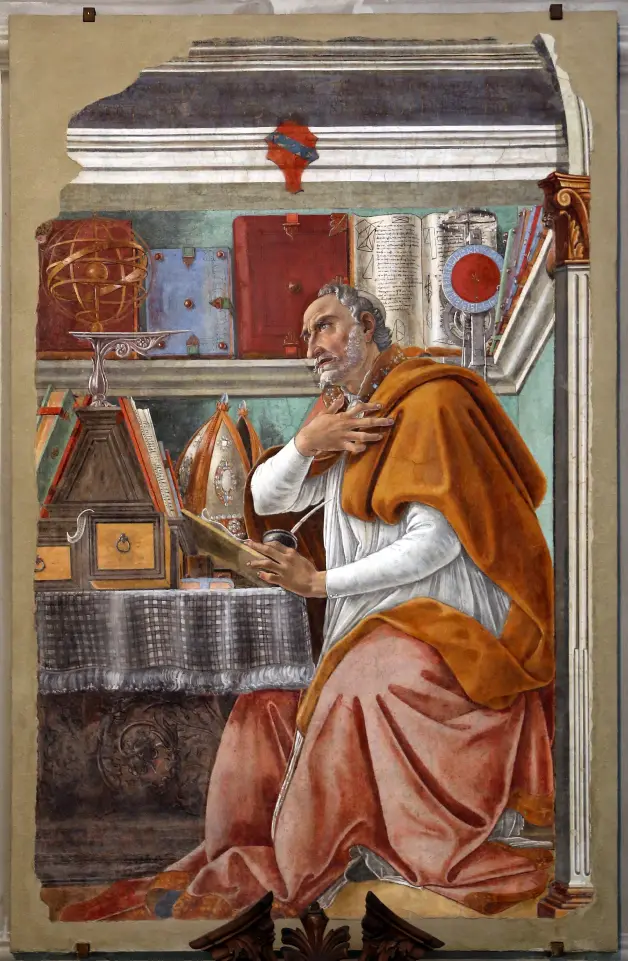
In 386 Augustine became acquainted with the "Platonic books" (Confessions 7.9) (according to Hall, the writings of Plotinus): the mind can rise above the material world to Mind and further to the "One," or the "Good"; his doubts about evil were resolved by the view that being as a whole is perfect. He experienced a vision of the "Unchangeable Light" (7.10), and the idea that man was created to see God became the basis of his spirituality. From the understanding of truth Augustine derives the existence of God: the mind perceives unchanging truths that it did not create and cannot change, and the ground of all truth is God. According to González, this is not a strict "proof" but a pointer that contingent beings fall into absurdity if they do not acknowledge a necessary reality above themselves.
Positions
- Stoics, skeptics, Gnostics (according to Hall)
- The spiritual is material; the highest is unknowable; dualism
- Augustine under the influence of Plotinus
- The highest reality exists; being as a whole is perfect, but divided into elements of different worth
Key points
- "I entered and with the eye of my soul saw... the Unchangeable Light" (Confessions 7.10.16)
- God is eternal, transcendent, infinite and perfect; as the highest light he is the source of all knowledge, as the highest good the goal of the will
- González: what attracts Augustine most is that God is triune
- Hall: Neoplatonic ideas had already entered theology through Origen and the Cappadocians
Outcome
The foundation of Augustine's philosophical spirituality; God's existence appears as an inescapable and evident reality.
People
- Augustine
- Plotinus
- Porphyry
Place
Milan; Hippo
Sources disagree
Hall: encounter with the Neoplatonists – 386; González does not date the doctrine of God (late 4th – early 5th century).
Sources
Primary sources
- Augustine – Confessions, bk. VII, ch. 9–10
Textbooks
- Stuart G. Hall – Doctrine and Practice in the Early Church (Russian edition), p. 129
- Justo L. González – A History of Christian Thought in One Volume (Abingdon, 2014), p. 175
Data compiled: 2026-11-17