2nd–3rd centuries · 2nd century
The Holy Spirit in Pre-Nicene Theology: Justin, Origen and the Gift of the Spirit in Baptism
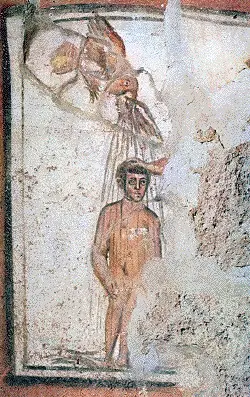
Pre-Nicene theologians did not yet have a clear doctrine of the Spirit's place in the Trinity. Interpreting Luke 1:35, Justin wrote that the Holy Spirit is the Word becoming incarnate in the Virgin's womb (Apology 1.33); this interpretation spread in the West and even entered Leo's Tome (449). Origen, according to Berkhof, called the Spirit the first creature of the Father through the Son, active not in all creation but only in the saints, though good by nature and worthy of worship as Deity. At the same time, the connection between the Spirit and baptism was established early: Tertullian taught that the Spirit is given by the laying on of hands (On Baptism 6, 8), and Cyprian that there is no baptism where the Holy Spirit is absent.
Positions
- Justin
- The Holy Spirit in Luke 1:35 is the Word becoming incarnate in the Virgin
- Origen (according to Berkhof)
- The Spirit depends on the Son and is counted among what was made by the Son; acts only in the saints
- Tertullian
- The Spirit is given by the laying on of hands that follows baptism and anointing (On Baptism 7–8)
- Cyprian
- Water alone does not wash away sins without the Holy Spirit; there is no baptism without the Spirit
Key points
- Berkhof: Clement makes no attempt to explain the relation of the Spirit to the other Persons; Berkhof judges Origen's teaching a departure from Scripture
- Hall: some referred the creed's words about birth from the Spirit and the Virgin to the Son-Word rather than to the Spirit as a Person of the Trinity
- Pelikan: Ignatius spoke of "speaking water"; the text of Hippolytus's Apostolic Tradition is ambiguous on when the Spirit is given. The teaching of the Spirit as baptism’s gift long preceded dogmatic definition; the absence of “personal” terms for the Spirit may have held back the doctrine of the Trinity
- Barnes: contrary to assumption, Montanism gave Tertullian no strong pneumatology, though he stressed the Spirit as source of prophecy and ecstasy; unlike Athenagoras, Theophilus and Irenaeus, Tertullian does not call the Spirit co-creator and lacks a causal model of his origin. In his incarnation account “Spirit” names the second person; Tertullian and Novatian apply every “high” Old Testament text on the Spirit to the Son. “Spirit Christology” is found in Tertullian, Hippolytus, Novatian, Cyprian, Lactantius, Phoebadius and Hilary of Poitiers; its most complicated form is in Hilary’s On the Trinity viii, and Augustine tries to untangle it in On the Trinity xv. After Hilary it fades from Latin writings (around 360); its decline helped a resurgence of “high” pneumatology. Barnes describes Latin theology of 200–370 as functionally binitarian
Outcome
The gift of the Holy Spirit was recognized as the chief gift of baptism, but the moment of its bestowal and the Spirit's place in the Trinity remained unclear.
People
- Justin Martyr
- Clement of Alexandria
- Origen
- Ignatius of Antioch
- Tertullian
- Hippolytus of Rome
- Cyprian of Carthage
- Leo the Great
Sources disagree
Hall: Justin's works – 140–163; Berkhof dates Origen's teaching to the 2nd–3rd centuries; Pelikan: late 2nd to mid-3rd century (Cyprian).
Sources
Primary sources
- Justin Martyr – First and Second Apology, bk. I, ch. 33
- Tertullian – On Baptism, ch. 6–8
Textbooks
- Stuart G. Hall – Doctrine and Practice in the Early Church (Russian edition), p. 39
- Jaroslav Pelikan – The Christian Tradition: A History of the Development of Doctrine, vol. 1 (Russian edition), p. 173–174
- Louis Berkhof – History of Christian Doctrines (Russian edition), p. 48
- The Cambridge Companion to the Trinity, ed. Peter C. Phan (2011), p. 88–89, 89–90
Data compiled: 2026-11-17