6th–9th centuries · 6th century
Moderate Augustinianism after Orange: Gregory the Great and the Drift toward Merit
Augustine's teaching on sin and grace was accepted as the anthropology of the Western Church, but, according to Berkhof, in a very moderate form: the principle of "grace alone" prevailed, but predestination was set aside and irresistible grace was displaced by the sacramental grace of baptism. Gregory the Great, whom González calls the "filter" through which the Middle Ages read Augustine, taught that God predestined to salvation those whom he knows will persevere in faith and good works, and that grace is not irresistible. Pelikan writes that after Orange Western theology wavered between the sovereignty of grace and its mediation through the church, with a return of merit and human initiative; its whole history would be a "series of footnotes" to Augustine. McGrath adds that the canons of Orange were unknown to medieval theologians, and for more than a thousand years the church gave no authoritative ruling on justification.
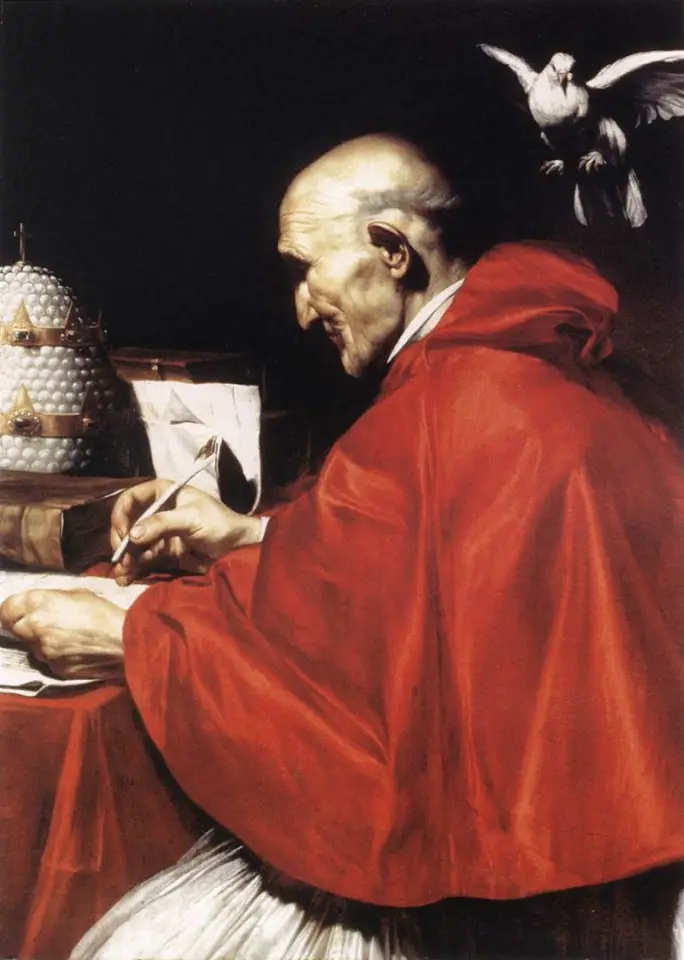
Positions
- Augustine
- Predestination is sovereign; grace is irresistible
- Gregory the Great
- The elect are those whom God knows will persevere in faith and good works; grace is not irresistible
- Church practice (according to Berkhof)
- Merits, works of mercy as satisfaction for sins, evangelical counsels, the surplus merits of the saints, the dependence of salvation on baptism
Key points
- Leo, Gregory, Bede and Alcuin followed Augustine but were less rigid on eternal reprobation
- Berkhof: in Augustine himself there are elements conflicting with absolute dependence on grace: grace as an infusion enabling meritorious works; faith justifies because it works through love. The Latin church gradually moved toward synergism and adopted the anthropology of the Greek church
- González: Gregory's main motive is not the heart's rest in God but a fear of uncertainty seeking security in the institution of the church
- Shelley: Gregory taught that the fall weakened but did not destroy free will; man cooperates with grace and merits by good works. Gregory made no new epoch but handed medieval Catholicism the common faith; without him its thinking cannot be traced
Outcome
A moderate Augustinianism prevailed, with a drift toward ritualism and merit; according to Pelikan, the dispute over nature and grace remained open in the Western tradition.
People
- Gregory the Great
- Leo the Great
- Bede the Venerable
- Alcuin of York
- Augustine
Terms
- evangelical counsels
- Non-obligatory requirements that bring greater reward; according to Berkhof, the distinction served the interests of monasticism.
Place
The West; Rome
Sources disagree
Berkhof: "two or three centuries" after Augustine (6th–9th centuries); González dates Gregory by his pontificate, 590–604; Pelikan – 6th–9th centuries.
Sources
- Jaroslav Pelikan – The Christian Tradition: A History of the Development of Doctrine, vol. 1 (Russian edition), p. 357–359
- Louis Berkhof – History of Christian Doctrines (Russian edition), p. 97–98, 152–153
- Justo L. González – A History of Christian Thought in One Volume (Abingdon, 2014), p. 189–190
- Alister McGrath – Reformation Thought (Russian edition: «Theological Thought of the Reformation»), p. 137–138
- Bruce L. Shelley – Church History in Plain Language (Russian edition), Ch. 17, sec. «Защитник ортодоксии»
Related entries
- Developed in: Medieval Anthropology: Boethius, Gregory the Great, Eriugena, Anselm and Original Righteousness as a Supernatural Gift (6th–13th centuries)
- Develops: The Semi-Pelagian Controversy and the Council of Orange (529) (5th century – 529)
In church history
- The pontificate of Gregory the Great and the mission of Augustine of Canterbury to England (590–604) (588 (title dispute) – pontificate 590–604 – mission to England 596/597–c. 599 – 607 (title "Universal Bishop"))
Data compiled: 2026-11-17