c. 140–144 · 2nd century
Marcion: Two Gods – the Creator of the Law and the Good God of the Gospel
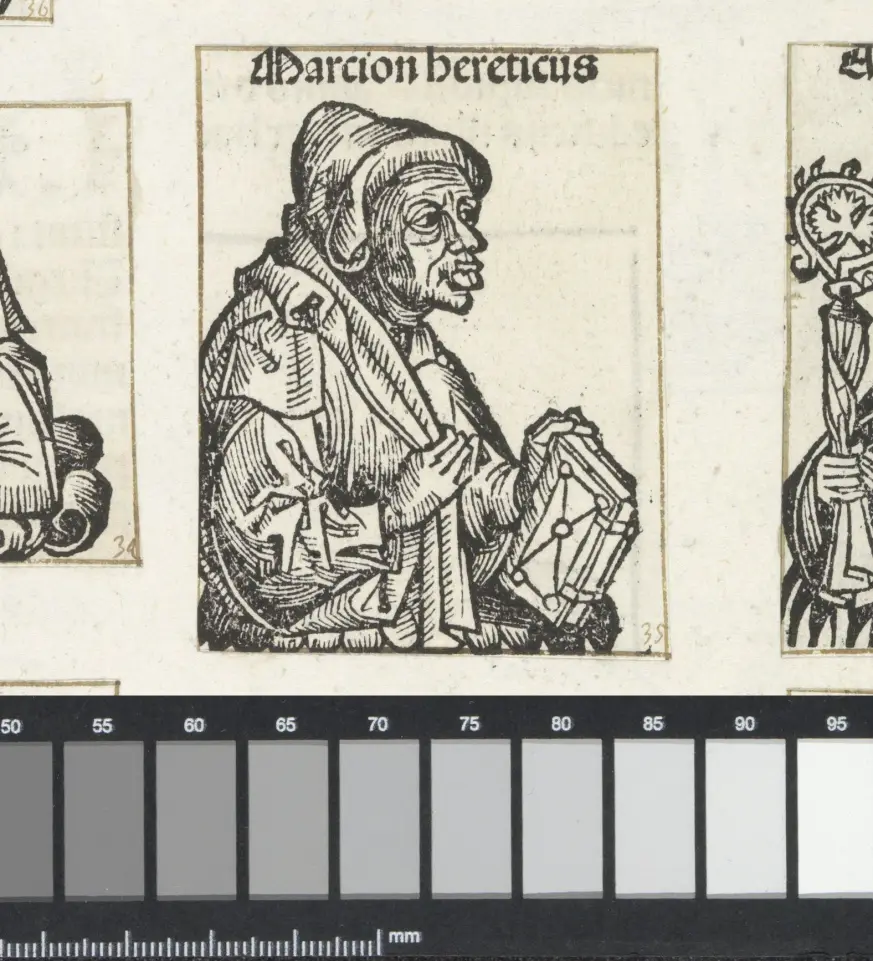
Marcion, a native of Sinope, came to Rome around 140 and, probably in 144, was expelled from the Roman church and founded his own. Marcion's "special and principal work," according to Tertullian (Against Marcion 1.19), was "the separation of the Law and the Gospel." The God of the Old Testament, the Creator of the world, is just, severe and warlike (according to different testimonies, "evil" or "just"; in Irenaeus, Against Heresies 1.27.2, "the author of evils"), while the Father of Jesus Christ is pure goodness, an "unknown" god who revealed himself in Christ in the fifteenth year of Tiberius (Against Marcion 1.19). Christ, according to Marcion, was not born and took only a seeming body. Pelikan writes that Marcion resolved the tension in the doctrine of God by sacrificing the unity of God for the sake of salvation.
Positions
- Marcion
- Two gods: the Creator, the God of the Law, and the good unknown God of the Gospel; Christ is not the Messiah of the prophecies
- Irenaeus, Tertullian
- Ditheism is unacceptable: it is unclear whose power sustains the universe; there is no difference between two gods and none
- Tertullian
- "God can be angry but not irritated" (Against Marcion 2.16); what is worthy of God belongs to the Father, what is unworthy to the Son, who united God and man (2.27)
Key points
- Marcion saw the key to the problem of the Testaments in the Epistle to the Galatians (Tertullian, Against Marcion 4.3; 5.2)
- Hall: Marcion did not reject the Old Testament but regarded it as a revelation of the Creator, to be understood literally; whether Marcion belongs among the Gnostics remains an open question
- González: unlike the Gnostics, Marcion did not claim secret knowledge and had no cosmogonic speculations; his teaching is an "exaggerated Paulinism"
Outcome
Ditheism was rejected by the catholic Church, but the Marcionite church survived for several centuries; Marcion raised the question of the authority of the Old Testament, which became the axis of the disputes (Pelikan).
People
- Marcion
- Cerdo
- Irenaeus of Lyons
- Tertullian
Terms
- Demiurge
- The maker of the world, a lesser, subordinate, possibly hostile god; for Marcion, the God of the Old Testament.
- unknown god
- The highest god of love, "alien" to this world.
Place
Sinope; Pontus; Rome
Sources disagree
Berkhof: c. 139 (arrival in Rome); Hall: c. 140, many followers by 150; Pelikan: c. 140, excommunication in Rome 144; González: expelled "probably in 144."
Sources
Primary sources
- Tertullian – Against Marcion, bk. I, ch. 19; bk. II, ch. 16, 27; bk. IV, ch. 3; bk. V, ch. 2
- Irenaeus of Lyons – Against Heresies, bk. I, ch. 27
Textbooks
- Stuart G. Hall – Doctrine and Practice in the Early Church (Russian edition), p. 29–30
- Jaroslav Pelikan – The Christian Tradition: A History of the Development of Doctrine, vol. 1 (Russian edition), p. 84–88
- Louis Berkhof – History of Christian Doctrines (Russian edition), p. 31–32
- Justo L. González – A History of Christian Thought in One Volume (Abingdon, 2014), p. 57–59
Related entries
- Developed in: Marcion's Canon: "Gospel" and "Apostle" against the Old Testament (c. 140–160)
In church history
Data compiled: 2026-11-17