139–144 · 2nd century
Marcion and the founding of the Marcionite church
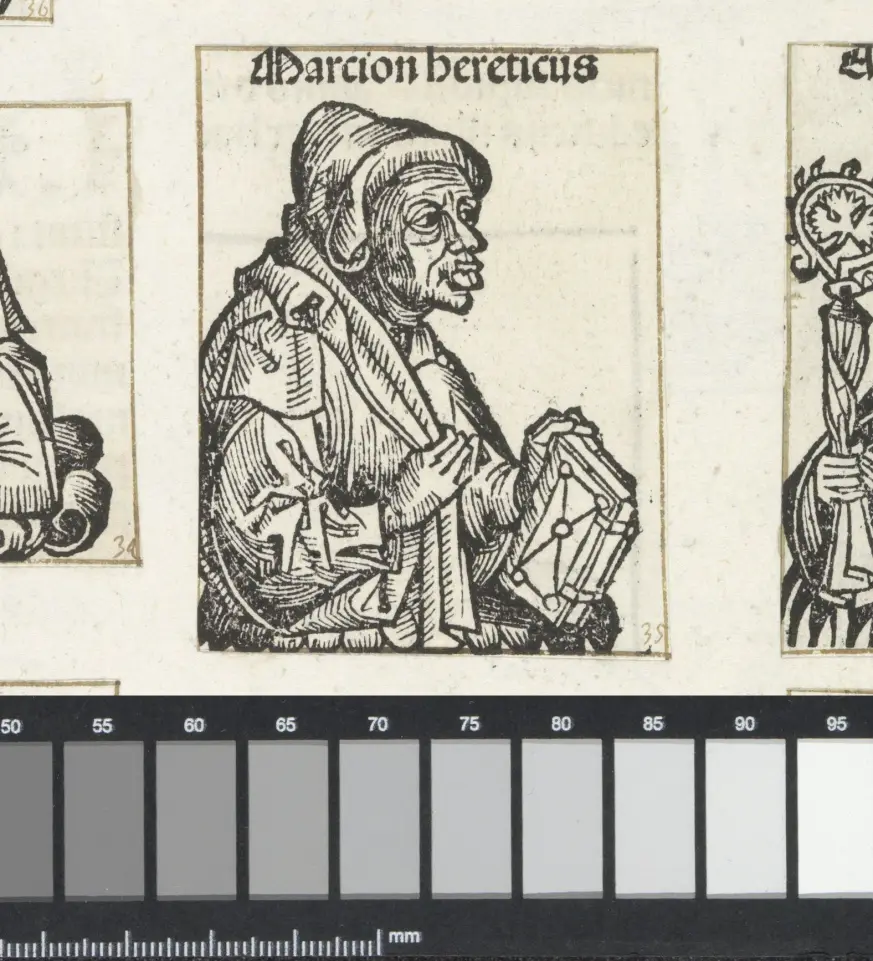
Marcion was a native of Sinope (Pontus) and a bishop's son. He arrived in Rome around 139–140 seeking to reform the Church according to the "pure Gospel of Paul." He contrasted the wrathful Creator-God of the Old Testament with the good, previously unknown God revealed in Christ.
Rejected by the Roman church, Marcion was excommunicated in 144. He founded his own church, which became a dangerous rival to orthodoxy for several centuries.
Marcion compiled the first known Christian canon: a purged Gospel of Luke and ten Pauline epistles (cf. Irenaeus, Against Heresies 1.27.2). This was a major spur to the whole Church's formation of the New Testament canon.
Marcion's christology was docetic. Christ appeared already grown in the 15th year of Tiberius, bypassing birth from the Virgin (Tertullian, Against Marcion 1.19; 4.7). His disciple Apelles later abandoned the two-gods doctrine while retaining docetism.
Key points
- Two gods: the stern Creator-God of the Old Testament and the good, previously unknown Father of Christ
- The first known Christian canon: a purged Gospel of Luke and ten Pauline epistles
- Excommunicated in Rome in 144; founded his own rival church
- Docetic christology: Christ appeared already grown, bypassing birth
- Chief opponent Tertullian (five books Against Marcion); his disciple Apelles revised the doctrine
- Shelley: Marcion, who came to Rome about 140, set the God of the Old Testament against the God of mercy; his churches reached Armenia and Egypt.
- Roetzel: Marcion is known only through his critics: born in Sinope, a wealthy shipowner who gave the Roman church 200,000 sesterces. The Roman elders condemned him, returned the money and excommunicated him permanently; he died around 160. According to Irenaeus (Against Heresies 3.3.4), Polycarp, on meeting Marcion, called him 'the first-born of Satan'; Roetzel links this to his rejecting the 'Old Testament' and inventing a myth of two gods. In 207 Tertullian feared that Marcion's gospel might fill the whole world; in the East Marcionite churches lasted into the fifth century. The Marcionites were perhaps the first to ordain women (Tertullian); baptism meant celibacy, and the Eucharist used water, not wine. The Pastoral Epistles (1 Tim. 6:20 'antitheses', 4:3, 2:11–15) may be an early polemic against Marcion and the Gnostics.
People
- Marcion
- Cerdo
- Tertullian
- Irenaeus of Lyons
- Apelles
- Polycarp of Smyrna
- Epiphanius of Salamis
- Theodoret of Cyrrhus
Place
Sinope (Pontus); Rome
Sources disagree
Arrival in Rome is dated variously from c. 139 to c. 140–150; the excommunication is usually placed in 144. Roetzel: around AD 150 Justin complained that Marcionite churches had spread throughout the Empire, so Marcion's mission began a decade or two earlier; Roetzel puts his death around 160.
Sources
Primary sources
- Tertullian – Against Marcion, bk. I, ch. 19; bk. IV, ch. 7
- Irenaeus of Lyons – Against Heresies, bk. I, ch. 27; bk. III, ch. 3
Textbooks
- Louis Berkhof – History of Christian Doctrines (Russian edition), p. 31–32
- Stuart G. Hall – Doctrine and Practice in the Early Church (Russian edition), p. 29–30
- J. North – A History of the Church (Russian edition), p. 44–45
- Jaroslav Pelikan – The Christian Tradition: A History of the Development of Doctrine, vol. 1 (Russian edition), p. 84–95
- Justo L. González – The Story of Christianity, vol. I (Russian edition), sec. «Маркион»
- Justo L. González – A History of Christian Thought in One Volume (Abingdon, 2014), p. 57–59, 62
- Tony Lane – Christian Thinkers (Russian edition), p. 22–23
- Bruce L. Shelley – Church History in Plain Language (Russian edition), Ch. 6, sec. «Перечень христианских книг»
- The Cambridge Companion to St Paul, ed. James D. G. Dunn (2003), p. 241–242, 242, 242–243, 245, 245–246, 243
More on the doctrine
- Marcion: Two Gods – the Creator of the Law and the Good God of the Gospel (c. 140–144)
- Marcion's Canon: "Gospel" and "Apostle" against the Old Testament (c. 140–160)
Data compiled: 2026-11-09