1274–1439 · 13th century
The Filioque at the Councils of Union: Lyons (1274) and Florence (1439)
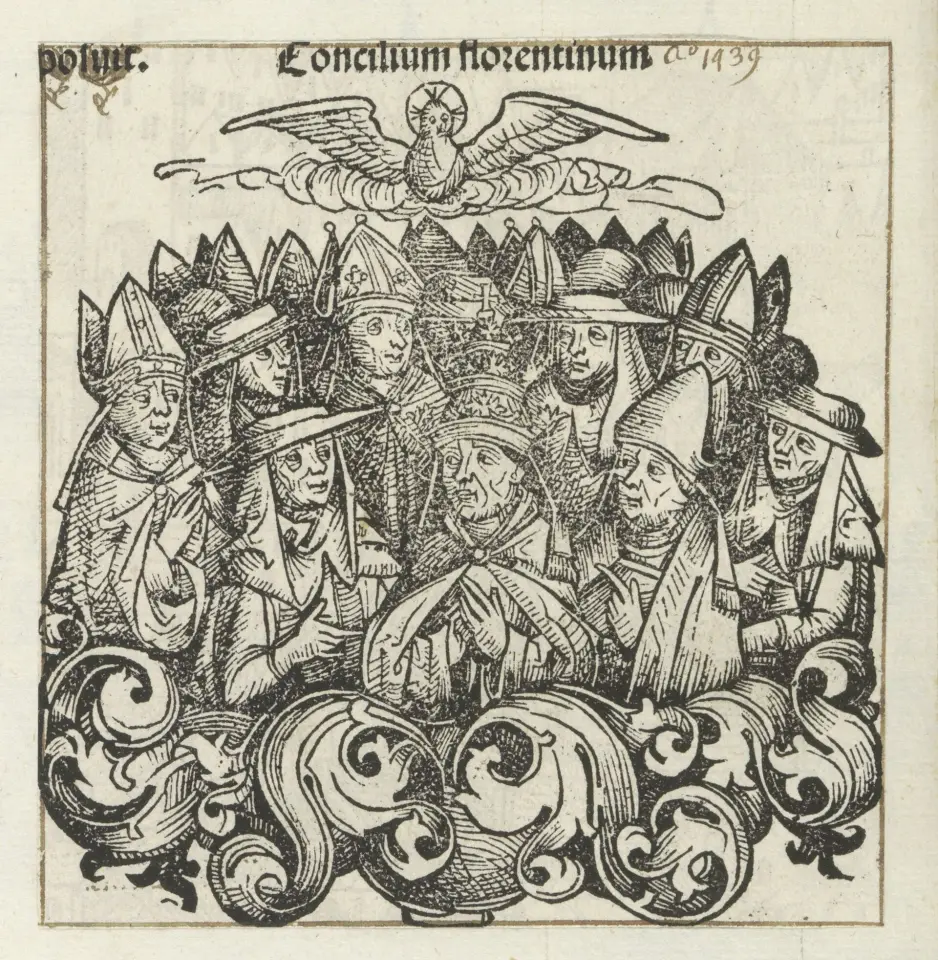
In late Byzantine polemic, Eastern critics insisted that the interpolation was illegitimate liturgically and juridically even if it could be accepted theologically, and that there are as many principles in the Godhead as there are hypostases from which the Spirit proceeds. The Latins rejected the charge of "two principles": the Council of Lyons (1274) anathematized both those who denied the Filioque and those who asserted two principles. The Council of Florence adopted the formula "from the Father through the Son," which Eastern opponents regarded as a Latin trick, and in the decree of 1439 the East, under pressure of the Turkish threat, accepted the filioque together with the doctrine of purgatory and recognition of the pope as head of the whole church. After the delegates returned, the Eastern churches rejected the decree.
Positions
- Eastern critics
- The addition to the creed is illegitimate; there are as many principles as there are hypostases from which the Spirit proceeds
- Latin apologists
- There is one principle and one procession; "through the Son" is equivalent to "from the Son"
- The West at Florence
- The Filioque, purgatory, papal supremacy
- The East
- Gave way in 1439 under Turkish pressure, then rejected the decree
Key points
- Lane: the Council of Florence met at Ferrara (1438–1439), Florence (1439–1442) and Rome (1443–1445); the decree allowed both leavened and unleavened bread
- Pelikan: the compromise did not resolve the theological problem, and the parties returned to their historical positions; the Eastern confessions of the 17th century repeated the rejection of the Filioque, in Kritopoulos the subject of the first and longest article
- Papanikolaou: Lossky (1903–1958) sharply criticizes the filioque, especially in Thomistic form, as an attempt to justify rationally how the one God is triune: “by the dogma of the Filioque, the God of the philosophers and savants is introduced into the heart of the Living God”
- Avvakumov: the number seven appears among Byzantines in the 13th century: the Greek delegation at Lyons II (1274) accepted the Western seven sacraments; the Latin list was part of the confession Credimus Sanctam Trinitatem (1267), used by unionists; in 1277 Bekkos rendered sacramenta as ἱεροπραξίαι
Outcome
The decree of union became a dead letter in the East; no military help followed, and Constantinople fell in 1453; the disagreement over the Filioque was fixed in the Eastern confessions of the 17th century.
People
- Metrophanes Kritopoulos
- Peter Mogila
- Dositheus of Jerusalem
Terms
- procession and sending – ekporevsis, ekpempsis
- The eternal procession and the economic sending of the Spirit.
- co-cause – ksynaition
- The Son as co-cause.
Place
Lyons, Ferrara, Florence, Rome
Sources disagree
Lyons – 1274, Florence – 1439 (Pelikan); Lane dates the council 1438–1445 and the decree 1439. The Eastern confessions – 17th century (Pelikan).
Sources
- Jaroslav Pelikan – The Christian Tradition, vol. 2: The Spirit of Eastern Christendom (600–1700) (Russian edition), p. 423–426, 444–446
- Tony Lane – Christian Thinkers (Russian edition), p. 141–142
- The Cambridge Companion to the Trinity, ed. Peter C. Phan (2011), p. 260
- The Oxford Handbook of Sacramental Theology, ed. Hans Boersma, Matthew Levering (2015), p. 310–311
In church history
Data compiled: 2026-11-17