1518 · 16th century
Luther: The Theology of the Cross against the Theology of Glory and the Break with Scholasticism
In September 1517 Luther took part in a disputation against scholastic theology (aimed at Gabriel Biel), and in March 1518, together with Karlstadt, he removed scholasticism from the curriculum of the Wittenberg faculty, replacing it with Augustine and the Bible. At the Heidelberg Disputation (1518) he contrasted the theology of glory, which seeks God in works, with the theology of the cross, which knows God only in suffering and on the cross; he counted both Thomism and nominalism as theology of glory. Luther distinguished a general, "legal" knowledge of God available to all from the "evangelical" knowledge of what God wants to do for our salvation. Philosophy as an introduction to theology was rejected; reason is both a "whore" and "a very useful instrument."
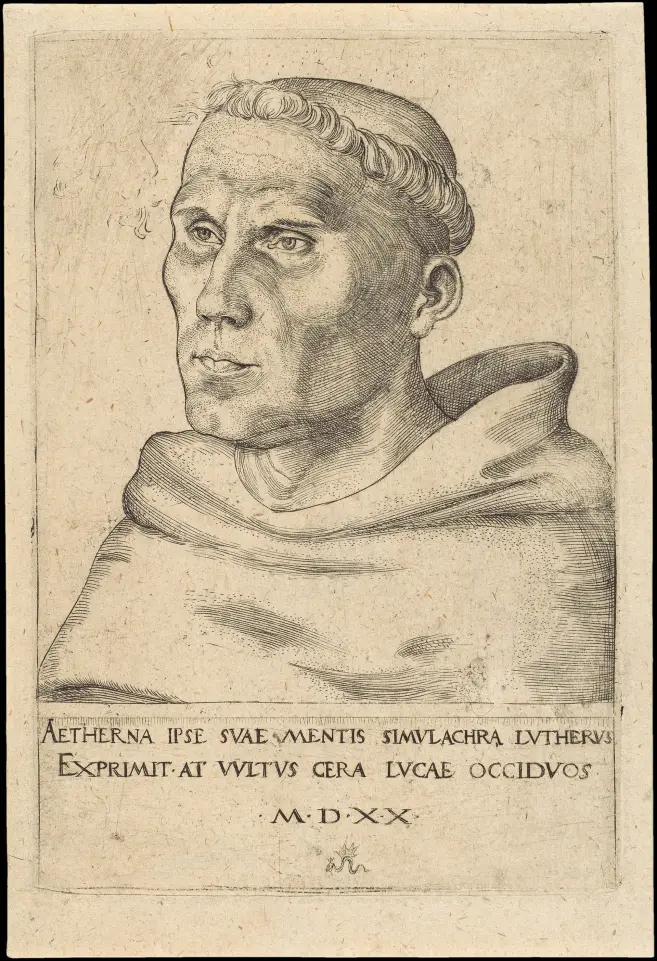
Positions
- The theology of glory
- God is seen in works; it prefers works to suffering, glory to the cross, strength to weakness
- The theology of the cross (Luther)
- God is known only in suffering and the cross; this is the only true theology
- Thomas and scholasticism
- Faith adds to the natural knowledge of God what reason could not discover
Key points
- González: following von Loewenich, in rejecting the theology of glory Luther rejects moralism and rationalism
- The starting point of theology is not reason or experience but God's action and Word; what matters is that God is "pro me"
- The negative theology of the mystics is still a theology of glory
- One must flee from the "absolute" God and know God through his "veils" – the Word
- McGrath: the Wittenberg reform was merely a reform of the curriculum of a second-rank university
- Hendrix: Luther used theologia crucis only five times, mostly at Heidelberg (1518); the “theology of glory” calls evil good, while the true theologian sees God at work in suffering and on the cross; God’s wrath is his “alien work” (Is 28:21) against sin
- Lugioyo: at the Heidelberg Disputation (1518) Luther centred theology on Incarnation and Cross, and in 1519 summed it up: “Crux sola est nostra theologia”. For Luther theology begins not with Christ’s divinity but his humanity – the revealed, incarnate God; his later Christology was built on this
- Shelley: the Cross is Christianity’s hidden mystery: it looked like God’s defeat, yet on it God conquered evil and sin. Luther called Catholic theology, thinking man can ascend to God, a “theology of glory” and made the transforming Cross its root
- McGinn: Luther rejected Dionysius for neglecting the Passion but valued Tauler and the Theologia Deutsch for passivity before God and Passion mysticism
Outcome
The program of Luther's theological method and a break with the scholastic method: the relation of philosophy and theology understood as that of law and gospel (González).
People
- Martin Luther
- Andreas Karlstadt
- Gabriel Biel
- Walther von Loewenich
Terms
- theology of the cross
- Knowledge of God in revelation, hidden in suffering and on the cross.
- theology of glory
- The attempt to see God in his works.
- legal and evangelical knowledge
- The general knowledge that God exists and is just, and the particular knowledge of his intentions for our salvation.
Place
Wittenberg; Heidelberg
Sources disagree
The Heidelberg Disputation – 1518 (González); McGrath: the disputation against scholasticism – September 1517, the faculty reform – March 1518; González places the statements on reason and twofold knowledge in 1518–1521.
Sources
- Justo L. González – A History of Christian Thought in One Volume (Abingdon, 2014), p. 286–287
- Justo L. González – A History of Christian Thought, vol. III: From the Protestant Reformation to the Twentieth Century (Abingdon, rev. ed. 1987), p. 41–47
- Alister McGrath – Reformation Thought (Russian edition: «Theological Thought of the Reformation»), p. 151
- The Cambridge Companion to Reformation Theology, ed. David Bagchi, David C. Steinmetz (2004), p. 56
- The Oxford Handbook of Christology, ed. Francesca Aran Murphy (2015), p. 331
- Bruce L. Shelley – Church History in Plain Language (Russian edition), Ch. 24, врезка «Богословие Креста»
- The Oxford Handbook of Mystical Theology, ed. Edward Howells, Mark A. McIntosh (2020), Ch. 4, sec. «Protestant Mysticism»
Related entries
- Rejects: Duns Scotus, Ockham and Nominalism: The Breakdown of the Medieval Synthesis of Faith and Reason (14th–15th centuries)
- Rejects: The Via Moderna and the Schola Augustiniana Moderna: The Dispute over Meriting the First Grace (14th–15th centuries)
- Developed in: Melanchthon, Loci Communes: The First Systematization of Protestant Teaching (1521 (editions to 1555))
In church history
- The Heidelberg Disputation (April 1518)
- Genealogies of Christian Mystical Theology: from Origen to the Quietist Controversy (3rd–17th centuries)
Data compiled: 2026-11-17