1521 (editions to 1555) · 16th century
Melanchthon, Loci Communes: The First Systematization of Protestant Teaching
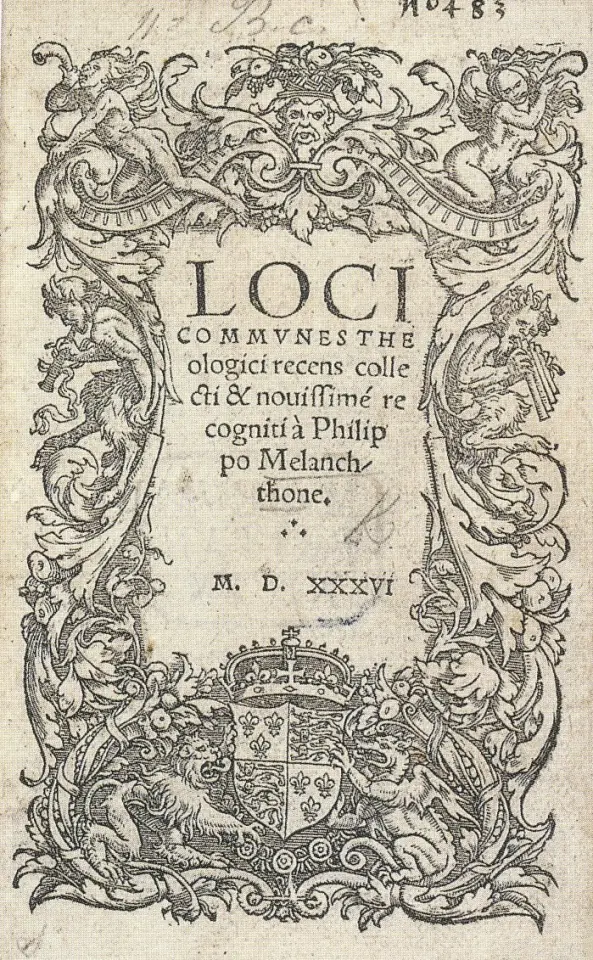
The humanist Greek scholar Melanchthon, who came to Wittenberg in 1518, published in 1521 the Loci communes rerum theologicarum – the first systematization of Protestant teaching. The aim of theology is practical: "to know Christ is to know his benefits," not to reason, as the scholastics did, about the natures and modes of the incarnation; the main thing is to know the power of sin, the law and grace. It is better to adore the mysteries of the Godhead than to investigate them. The 1555 edition, by contrast, opens with extensive sections on God, the Trinity and creation, recognizes the pagan sages' knowledge of God as true though insufficient, and grants greater authority to the Fathers.
Positions
- The scholastics
- They reason about the Trinity, creation and the mode of the incarnation
- The 1521 Loci
- The virtues of the pagans are vices; reason is blinded by sin
- The 1555 Loci
- Plato, Aristotle and Cicero knew that there is a good God but did not know his intentions and the gospel
Key points
- González: Luther, exaggerating, said the book should be included in the canon
- "Apart from the canonical Scriptures there is no reliable literature in the Church"
- Lane: Platonism led the Fathers astray, Aristotle the scholastics; later Melanchthon encouraged the study of Aristotle
- The editions of 1521, 1535 and 1555 are the key to Melanchthon's development
- Morgan: Melanchthon's Loci Communes (1521), the first Protestant dogmatics, was modelled on Romans.
Outcome
One of the foundations of Protestant systematic theology; the humanist shift of the later editions became one of the sources of the division into "Lutherans" and "Philippists" (González).
People
- Philip Melanchthon
- Martin Luther
Terms
- common places – Loci communes
- The title of the systematic work, the first Protestant systematic theology.
Place
Wittenberg
Sources disagree
First edition – 1521 (both books); Lane names the editions of 1521, 1535 and 1555; González compares the 1521 and 1555 editions.
Sources
- Justo L. González – A History of Christian Thought, vol. III: From the Protestant Reformation to the Twentieth Century (Abingdon, rev. ed. 1987), p. 107–110
- Tony Lane – Christian Thinkers (Russian edition), p. 161–162
- The Cambridge Companion to St Paul, ed. James D. G. Dunn (2003), p. 264
Related entries
- Develops: Luther: The Theology of the Cross against the Theology of Glory and the Break with Scholasticism (1518)
- Developed in: Protestant Orthodoxy and "Protestant Scholasticism": The Return of Aristotle (second half of the 16th – 17th century)
Data compiled: 2026-11-17