543–553 · 6th century
The Controversies over Origen and His Condemnation (543/553)
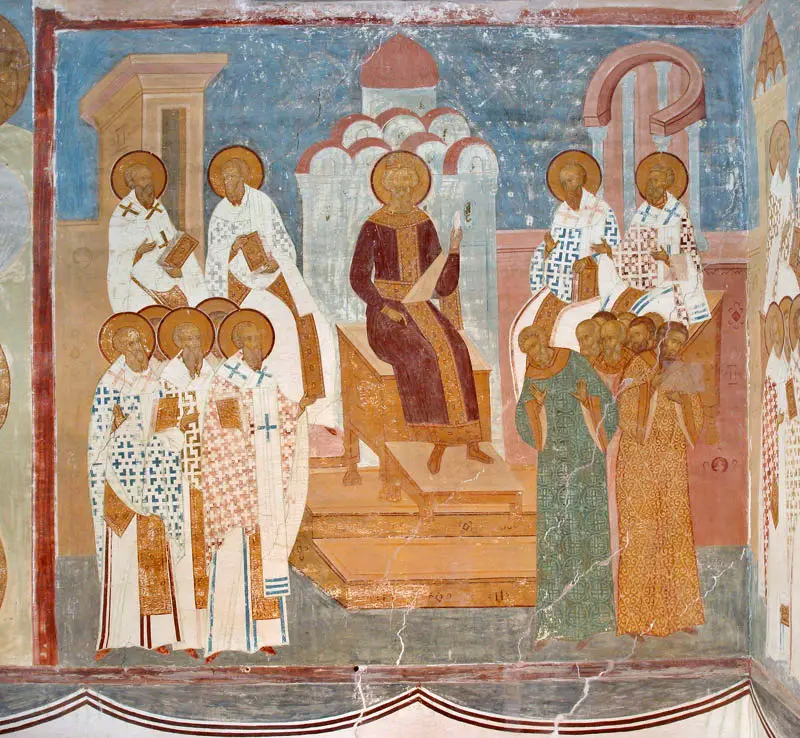
Controversies over Origen's orthodoxy never ceased from the time of his activity. Various synods condemned positions that he held or that were attributed to him; among the first opponents was Methodius of Olympus, and Jerome in 393, after studying Origen's system, turned from admirer to fierce opponent. In 543 Justinian issued an edict against the Origenists, and in 553 the council in Constantinople (the Fifth Ecumenical) approved the condemnation, issuing fifteen anathemas against the teaching of Origen and Evagrius. Lane considers both Origen's desire to be orthodox and the thoroughly Platonic character of his theology beyond dispute.
Positions
- Gregory Thaumaturgus, Eusebius of Caesarea, Dionysius the Great
- Defenders of Origen
- Methodius of Olympus; Jerome after 393
- Opponents of his teaching
- Justinian and the council of 553
- An edict against the Origenists and fifteen anathemas against Origen and Evagrius
Key points
- González: the disputed teachings – the eternity of the world, the preexistence of souls, future worlds, the salvation of the devil
- None of the great 4th-century fathers influenced by Origen defended his most daring speculations
- Lane: the stronger the Christians' hostility to philosophy, the more philosophical ideas they absorb; Origen remains the most influential father of Greek theology
Outcome
The teaching of Origen and Evagrius was condemned by a council; according to González, the breadth of his system made Origen a source of Eastern theology, and its daring the cause of repeated condemnations.
People
- Origen
- Evagrius Ponticus
- Methodius of Olympus
- Jerome
- Justinian I
Place
Constantinople
Sources disagree
Lane (on Evagrius): edict of 543, council of 553; González names only the council of 553; elsewhere Lane dates the condemnation only to the 6th century.
Sources
- Justo L. González – A History of Christian Thought in One Volume (Abingdon, 2014), p. 96–97
- Tony Lane – Christian Thinkers (Russian edition), p. 27, 30, 52, 74
Related entries
- Rejects: Origen, On First Principles: The First System of Theology (c. 220)
- Rejects: Origen: Eternal Creation, the Pre-existence of Minds and a Pre-mundane Fall – from Gregory of Nyssa to the Condemnation of 553 (3rd–6th centuries)
- Rejects: Origen: the "restoration of all things" (apokatastasis) and its condemnation (3rd century (condemnation – 6th century))
In church history
- The Three Chapters controversy and the Fifth Ecumenical Council (Second Constantinople, 553) (518 – 553 (council, 5 May – 2 June 553); acceptance in the West completed by the late 6th c.)
Data compiled: 2026-11-17