1738–1791 · 18th century
John Wesley: Prevenient Grace, Assurance and Christian Perfection; Whitefield and the Moravians
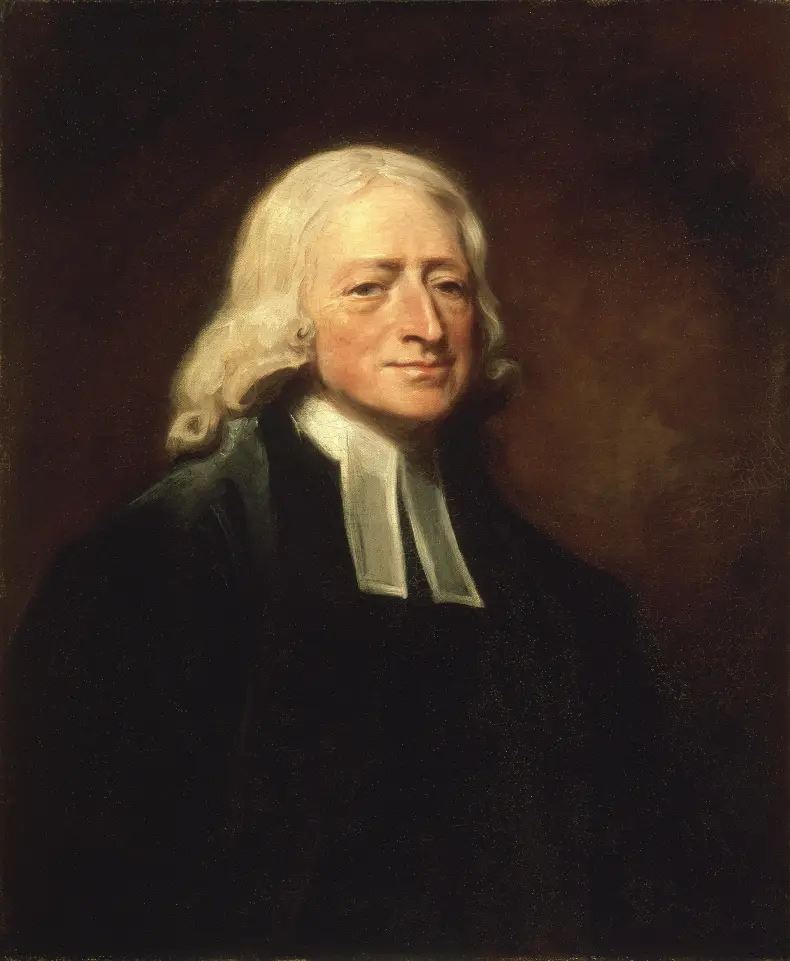
On 24 May 1738 in Aldersgate Street, listening to Luther's preface to the Epistle to the Romans, John Wesley felt that he trusted in Christ for salvation and received an assurance that Christ had taken away his sins (Journal, 24 May 1738); assurance – the witness of the Spirit – became, according to Lane, "the main doctrine of the Methodists". Accused of Arminianism, Wesley agreed, but asserted that neither he nor the Arminians denied original sin and justification by faith; the dispute, in his view, was in essence one – about predestination: election to eternal salvation is conditional and depends on faith. To avoid Pelagianism, he taught a universal prevenient grace that makes all able to receive the grace of faith. Sanctification is a process whose goal is entire sanctification, or Christian perfection; in place of the Calvinist perseverance of the saints there is assurance, which does not exclude the possibility of falling away.
Positions
- Calvinists (defenders of Dort)
- Unconditional predestination, irresistible grace, the perseverance of the saints guaranteeing both the present state and future continuance in it
- Wesley
- Election to salvation is conditional; unconditional election would entail unconditional reprobation (sermon 128, Free Grace, 8–9), which contradicts the witness of Scripture to the nature of God; unbelief is resistance to grace; assurance does not guarantee perseverance
- The Moravians (as presented by Wesley)
- There are no degrees of faith; there is no justifying faith without full assurance; on the way to faith one should "be still", not using the means of grace
- Whitefield
- A Methodist by every other mark, but a firm Calvinist in theology
Key points
- Wesley (sermon 43, The Scripture Way of Salvation, III.3): “exactly as we are justified by faith, so are we sanctified by faith” – in a single act God justifies and begins to sanctify
- Wesley: not all attain perfection in this life, but it should be preached
- Wesley disputed with the Moravians: there are degrees of faith and a justifying faith prior to full assurance
- González: Wesley’s account is a caricature of Moravian teaching. Whitefield’s success refutes the notion that Arminianism “preaches” better than strict Calvinism; his work led to the Welsh Calvinistic Methodist Church
- Berkhof: Wesleyan Arminianism is closer to Arminius himself than to the later Arminians: it acknowledges total depravity, and sufficient grace for everyone is a matter of free grace, not of justice
- Zinzendorf and the Moravians (from 1722) saw in Christ the sum of theology; their influence reached Wesley and, through Schleiermacher, nineteenth-century theology
- Shelley: Wesley rejected Calvinist predestination: God desires all to be saved, and people may accept or reject grace; Whitefield defended predestination, and despite friendship the disagreement split Methodists into Arminian and Calvinist camps
- Morgan: John Wesley's heart was 'strangely warmed' at Aldersgate (Journal, 24 May 1738), stimulated by reading Luther's Preface to Romans.
Outcome
Assurance and universal prevenient grace became central doctrines of Methodism; the teaching on Christian perfection remained a matter of dispute among Methodists; Arminian and Calvinist theology coexisted within Methodism. In time Methodism became a separate denomination, although Wesley did not want this.
People
- John Wesley
- Charles Wesley
- Peter Böhler
- Nikolaus Ludwig von Zinzendorf
- George Whitefield
Terms
- prevenient grace
- Grace that precedes turning to God and is given independently of any merits. For Arminius and Wesley, grace given to all that makes people able to receive the grace of faith, but not irresistible.
- Christian perfection
- Entire sanctification: not infallibility, but a state in which a person does not consciously break God's law and acts out of love.
- witness of the Spirit
- The witness of the Spirit to our spirit of forgiveness and adoption; the assurance that one is a child of God.
- means of grace
- Church, communion, fasting, prayer, reading Scripture – for Wesley, they ordinarily convey God's grace even to unbelievers.
Place
London (Aldersgate), Herrnhut (Saxony), England, Wales
Sources disagree
Aldersgate – 24 May 1738 (Lane, González); the Moravian pastor's question – 1736 (Lane); Wesley's dates – 1703–1791; Berkhof dates Wesleyan Arminianism to the mid-eighteenth century; the Moravians at Zinzendorf's estate – from 1722.
Sources
Primary sources
- Wesley – Journal, 24.05.1738
- Wesley – Sermons on Several Occasions, sermon 43; sermon 128
Textbooks
- Louis Berkhof – History of Christian Doctrines (Russian edition), p. 113–114
- Justo L. González – A History of Christian Thought in One Volume (Abingdon, 2014), p. 375–380
- Justo L. González – A History of Christian Thought, vol. III: From the Protestant Reformation to the Twentieth Century (Abingdon, rev. ed. 1987), p. 315–323
- Tony Lane – Christian Thinkers (Russian edition), p. 212–213
- Bruce L. Shelley – Church History in Plain Language (Russian edition), Ch. 34, sec. «В поля, навстречу миру»
- The Cambridge Companion to St Paul, ed. James D. G. Dunn (2003), p. 265
Related entries
- Develops: Arminius, the Remonstrance (1610) and the Synod of Dort (1618–1619) (1603–1619)
- Develops: The Experience of Conversion and Assurance of Salvation: the Puritans, the Westminster Confession, Pietism, Edwards and Finney (1584–1835)
In church history
Data compiled: 2026-11-17