2nd century · 2nd century
The Anti-Gnostic Fathers and Irenaeus: the Image of God, Freedom and the Fall as Interrupted Growth
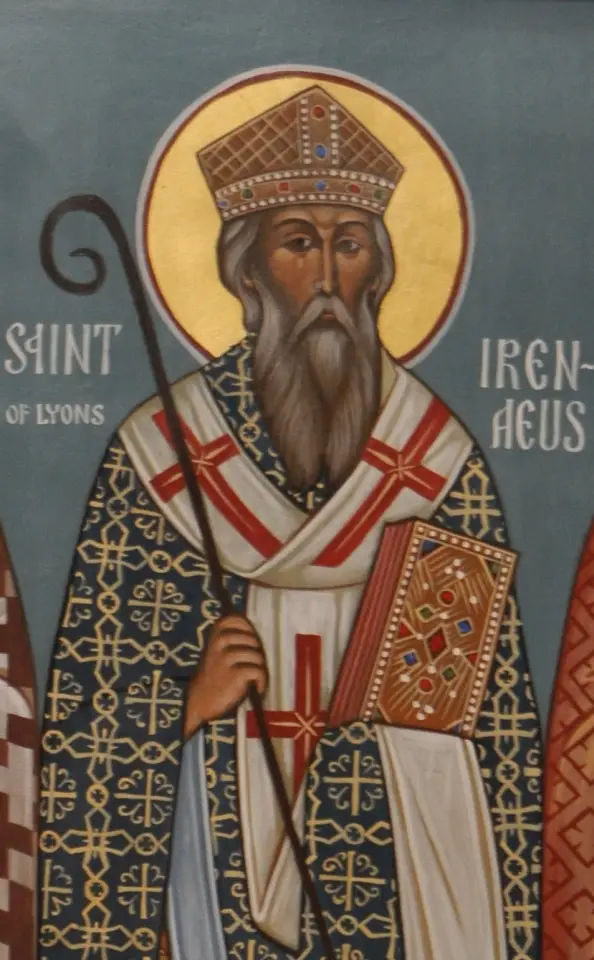
Against the Gnostics, the anti-Gnostic Fathers stressed that good and evil in humanity are not explained by nature: if evil were inherent in matter, the human being would not be a free moral being. Tatian (Address to the Greeks 7) taught that humans and angels were created free and that evil arose from the misuse of freedom. For Irenaeus, the image of God is the Son, in whom we were created, so the image is not something in us but a direction of growth: Adam and Eve were created "as children", able to grow (Demonstration 12, 14; Against Heresies 4.38.1). The image includes the body as well: God created not part of the human being but body and soul, and the image is complete when body, soul and spirit are present (Against Heresies 5.6.1). The fall, for Irenaeus, is not the loss of perfections once possessed but the interruption of due growth; the incarnation of the Word restored the image and likeness of God.
Positions
- Irenaeus
- The image of God includes the body; salvation is not the soul's escape from the body; the fall is interrupted growth, not the loss of original perfection
- Most thinkers after Origen (according to Hall)
- Rejected the idea that the body itself was created in the image of God (an example is Augustine)
- Tatian
- The Logos created the world not from pre-existing matter (Address to the Greeks 5); evil is the result of the misuse of freedom (7); the soul is not immortal by nature (13)
Key points
- Berkhof: humanity was created not immortal but able to attain immortality through obedience; sin is disobedience bringing death, and in Adam all humanity is subject to death. The connection of our sin with Adam's sin is not very clearly understood by these Fathers
- The angels were created mature (Demonstration 12); Satan's envy (ibid. 16) led to the temptation to hasten God's plan
- Since Adam's sin the Spirit has been lost and the image is imperfect; "to see God and to be like Him are one and the same"
- Sin and death are instruments of the devil, but God turns them to His own purposes: death limits the possibilities of sin (Against Heresies 3.23.6)
- González: Irenaeus's view stands in contrast to later Western theology
- Russell: Irenaeus distinguishes image from likeness: man was made “like the invisible Father through the visible Son” (Haer. 5.16.2); the image is intrinsic to createdness, while the likeness lies in rationality and is recovered through the Spirit. Both the Incarnation and the Passion restored the likeness, the tree of the cross remedying disobedience through a tree (5.16.3); its recovery is a gradual process possible only in a Trinitarian context (4.38.3). Origen, reading Genesis’ two accounts as two creations, taught a first spiritual creation and fall that sent souls down into bodies, which are to ascend again to communion with God; the dual creation and pre-existence of souls were rejected as heresy in the early 5th century, but the ascending half stayed influential (Evagrius). Augustine sees the divine image in the soul directly as that of the Trinity – memory, will and understanding (De Trin. 14.17.23)
Outcome
Anti-Gnostic anthropology affirmed human freedom and the goodness of the body; the incarnation was understood as the restoration of God's image and the perfecting of humanity in the flesh.
People
- Irenaeus of Lyons
- Tatian
Terms
- image and likeness of God
- For Irenaeus: the image is the Son; humanity is created after the image as a direction of growth; the image is complete when body, soul and spirit are present.
Place
Lyons, Rome, Syria
Sources disagree
Irenaeus – c. 170–202 (González), the work – c. 180 (Hall); Tatian disappears from history, perhaps around 180; Berkhof places the anti-Gnostic Fathers in the 2nd–3rd centuries without dates.
Sources
Primary sources
- Irenaeus of Lyons – Against Heresies, bk. III, ch. 23; bk. IV, ch. 38; bk. V, ch. 6, 16
- Irenaeus of Lyons – Demonstration of the Apostolic Preaching, ch. 12, 14, 16
- Tatian – Address to the Greeks, ch. 5, 7, 13
Textbooks
- Stuart G. Hall – Doctrine and Practice in the Early Church (Russian edition), p. 44–45
- Louis Berkhof – History of Christian Doctrines (Russian edition), p. 41
- Justo L. González – A History of Christian Thought in One Volume (Abingdon, 2014), p. 45–46, 68–69
- The Oxford Handbook of Christology, ed. Francesca Aran Murphy (2015), p. 204–205
Related entries
- Response to: Dualism against the Good Creator: Gnostics, Manichees, Paulicians, Bogomils, Cathars – and the Doctrine of Creation out of Nothing (2nd–13th centuries)
- Developed in: Irenaeus: recapitulation – Christ as the new Adam (c. 180)
Data compiled: 2026-11-17