2nd century · 1st century
Gnosticism: Gnostic Exegesis and the Church's Anti-Gnostic Response
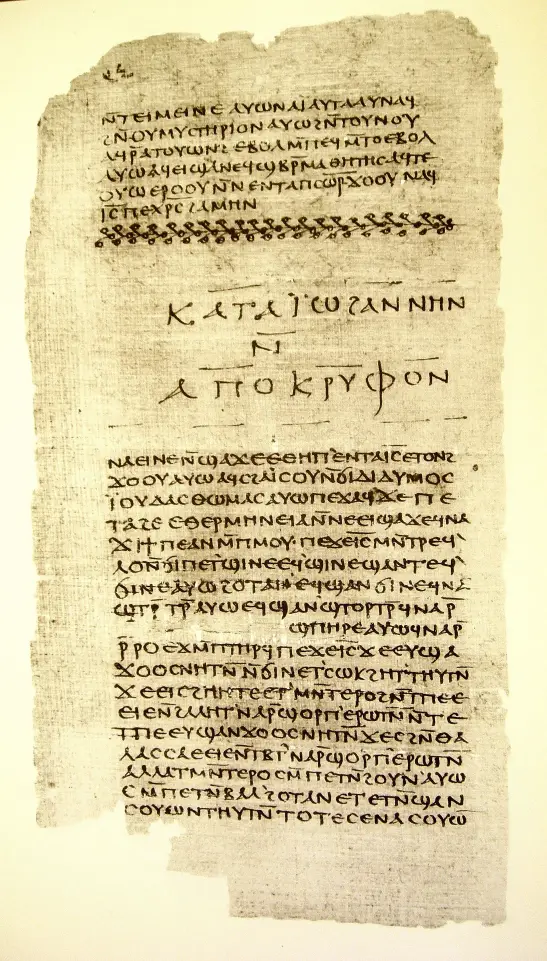
Berkhof describes Gnosticism as a speculative movement claiming a deeper knowledge of divine things, and also as popular and syncretistic. The Gnostics appealed to Scripture a great deal and interpreted it allegorically: Ptolemy in the Letter to Flora (preserved by Epiphanius, Panarion 33.3–7) divided the Law into three parts – “the legislation of Moses, of the elders, and of God himself”, and Heracleon of the school of Valentinus produced the first known commentary on the New Testament – an interpretation of the Gospel of John that neglects the historical sense. Irenaeus (Against Heresies), Hippolytus and Tertullian opposed them. According to Berkhof, in the struggle the Church learned to mark the limits of revelation and the relation of the Testaments and became conscious of Christianity as "doctrine."
Positions
- The Gnostics
- The highest God is distinct from the Creator; redemption of the spirit by knowledge; Christ is one of the aeons with a seeming body
- The Church (according to Berkhof); Clement and Origen (according to Pelikan)
- One God, the Creator, in both Testaments; the historical reality of Christ's birth, death and resurrection
Key points
- Assessments differ: Seeberg – “ethnicizing of Christianity”, Harnack – “acute Hellenizing”
- Berkhof: following Walther – “theft of Christian scraps”
- Hippolytus and Tertullian derive the heresies from Greek philosophy (in Hippolytus, Refutation of All Heresies 7.2, 7.17: Basilides’ system is derived from Aristotle, Marcion’s from Empedocles)
- Pelikan: "Origen was not a Gnostic because the Bible forbade him to be one"; Gnosticism is a distortion, but also an attempt to answer inescapable questions
- Roetzel: Gnostics leaned on Paul: 1 Cor. 2:6–3:3 (pneumatic, psychic, fleshly) for tripartite anthropology, Phil. 2:5–11 for the myth of the redeemer.
- Burns: Gnostics sometimes allegorized, but not their apocalypses, which demand assent to the literal truth of the revelation; the Gnostic–apocalyptic affinity lies not in “realized eschatology” but in the ultimate affirmation of revelatory authority
Outcome
According to Berkhof, the beginning of dogmatic development: one God in both Testaments, the uniqueness of Christ and his true humanity were affirmed; the anti-Gnostic Fathers laid the foundation of Western theology.
People
- Valentinus
- Basilides
- Ptolemy
- Heracleon
- Irenaeus of Lyons
- Hippolytus of Rome
- Tertullian
Terms
- Gnostics – gnostikoi
- Those claiming a deeper knowledge than simple believers.
- fullness – πλήρωμα
- "Fullness" – a term of Ephesians and Colossians; in Gnosticism, the fullness of divine reality formed by the Highest God and the aeons, to which the liberated soul returns.
Place
Lyons; Rome; Carthage
Sources disagree
Berkhof and Hall date only by century; Pelikan: 2nd–3rd centuries.
Sources
Primary sources
- Ptolemy – Letter to Flora, sec. 33.3–7
- Hippolytus of Rome – Refutation of All Heresies, bk. VII, ch. 2, 17
Textbooks
- Stuart G. Hall – Doctrine and Practice in the Early Church (Russian edition), p. 32–33
- Jaroslav Pelikan – The Christian Tradition: A History of the Development of Doctrine, vol. 1 (Russian edition), p. 109–113
- Louis Berkhof – History of Christian Doctrines (Russian edition), p. 26–27, 29–30, 40
- The Cambridge Companion to St Paul, ed. James D. G. Dunn (2003), p. 251
- The Oxford Handbook of Apocalyptic Literature, ed. John J. Collins (2014), p. 383, 386
Related entries
- Answered by: Irenaeus against the Gnostics: Open Apostolic Tradition, the Rule of Faith and the Four Gospels (c. 180)
In church history
Data compiled: 2026-11-17