16th – mid-19th century · 15th century
Adam's Federal Headship and New England Theology: from Cocceius to Edwards and Finney
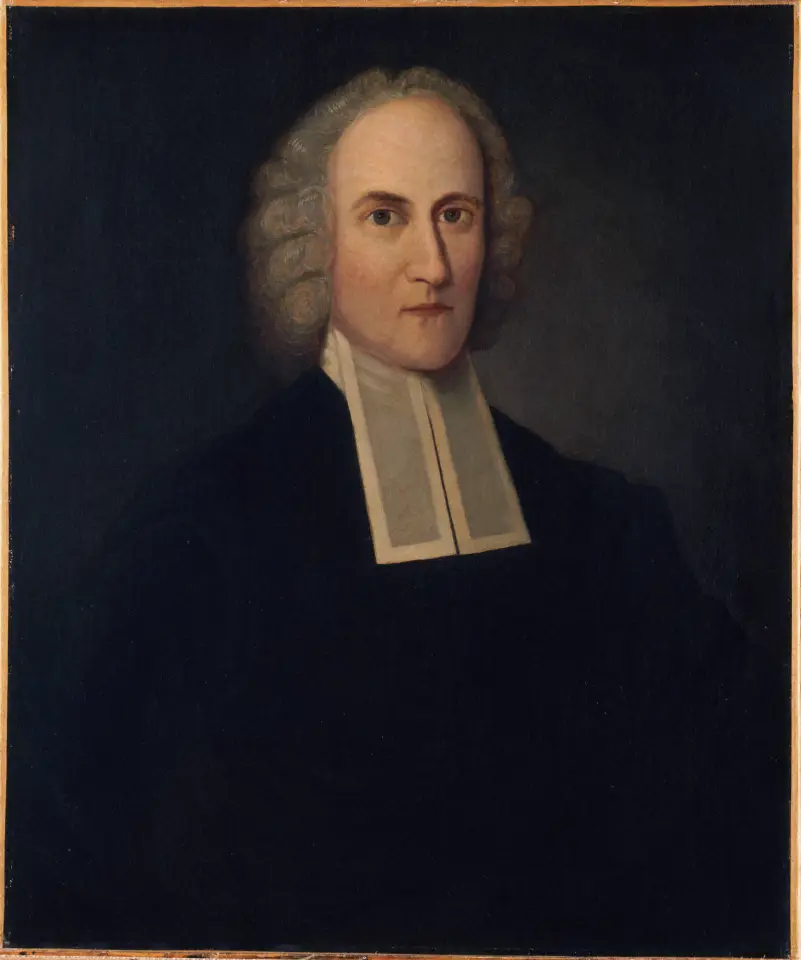
After the Reformation the idea of covenant developed in Bullinger, Polanus, Gomarus, Cloppenburg and Cocceius: Adam came to be understood not only as the natural but also as the federal head of humanity – its moral and legal representative, whose guilt is imputed to his descendants. Cocceius gave the classic exposition of federal theology: the covenant of works with Adam at creation and the covenant of grace after the fall. In New England Jonathan Edwards, in Freedom of the Will (1754) and the Defense of the Christian Doctrine of Original Sin, taught that fallen humanity is free to act as it chooses but is morally unable: what it lacks is not the ability but the desire to do good (Freedom of the Will, part I, sect. 4: moral inability "consists in the opposition or want of inclination"); he explained the transmission of sin realistically (Original Sin, part IV, ch. 3: Adam and his posterity are united "as the branches of a tree are united to the root", so as to constitute "one complex person"). Later New England theologians moved closer to Arminius, and Charles Finney denied original sin.
Positions
- The realist theory
- All sinned in Adam literally; in Edwards – as branches with the tree (Original Sin, part IV, ch. 3), so Adam's sin is ours and is imputed (also defended by H. B. Smith and Shedd)
- The federal theory
- Adam is the representative of humanity; all sinned in him as their representative, and guilt is imputed
- Woods, Tyler
- Mediate imputation (the theory of Placaeus)
- Hopkins, Emmons; Dwight, N. W. Taylor
- The former implied or asserted divine agency in connection with the appearance of evil; the latter reduced God's connection with sin to a minimum: sin is "necessarily incidental to the best system"
- Finney
- God governs the moral universe by moral laws in which choice is free; children are born with a will undamaged by sin; sin is inevitable but not necessary, since there is "physical sinfulness"
Key points
- Berkhof: the realist theory was set aside more in Reformed circles than in Lutheran ones. Edwards was accused of determinism, but he was right: freedom has its own laws consistent with certainty
- Cocceius: the covenant is the hermeneutical principle for interpreting Scripture, founded on an eternal covenant between Father and Son
- This developed positions already set out by Ursinus and later spread among the Puritans
- Lane: Edwards laid the foundations of “New England theology”, from which New Haven theology (Finney) grew; Finney “smuggled” Augustine’s doctrine in through the back door
- Muller: Bullinger was among the first Reformed with a covenant treatise; he and Calvin taught a gracious covenant given unilaterally yet spoke of human duty. The covenant is not in tension with predestination: Perkins joined double predestination with a unilateral covenant of grace, bilateral once bestowed. After 1560 Musculus and Ursinus briefly proposed a covenant in creation; it grew into two covenants – of works and of grace (Olevianus, Perkins, Rollock, Ball). In the seventeenth century Cocceius, Burman and Witsius represented it; early systematizers (Fenner, Rollock, Perkins) paired it with clear doctrines of predestination
- Shelley: the Puritans saw themselves as a new Israel, and the key to their view of the Bible was the covenant of grace with God; they believed in God’s sovereign election, yet that every personal believer in Christ could enter the covenant community
- Holifield: Bushnell’s Christian Nurture (1847) put infant baptism and the child’s later nurture at the center of his view of the church.
Outcome
The idea of covenant became the explanation of the transmission of sin in Reformed theology; realist, federal and mediate explanations coexisted within the Reformed tradition, while Finney moved away from Edwards's Calvinism toward the "New School" line.
People
- Heinrich Bullinger
- Polanus
- Franciscus Gomarus
- Cloppenburg
- Johannes Cocceius
- Zacharias Ursinus
- Jonathan Edwards
- Hopkins
- Emmons
- Timothy Dwight
- N. W. Taylor
- H. B. Smith
- Shedd
- Charles Finney
Terms
- federal head
- The moral and legal representative of all descendants.
- covenant of works
- For Cocceius, the covenant established by God with Adam at creation.
- moral inability
- For Edwards, the absence of desire, not of ability, to do good.
Place
The Netherlands, New England, Stockbridge, Princeton, Oberlin
Sources disagree
Berkhof dates the development of the covenant idea "after the Reformation" (16th–17th centuries) and gives no dates for New England theology; Cocceius – 1603–1669 (González); Edwards's Freedom of the Will – 1754, the Defense of Original Sin – at the end of his life (Edwards died in 1758); Finney – professor at Oberlin from 1835.
Sources
Primary sources
- Edwards – Freedom of the Will, pt. 1, sec. 4
- Edwards – The Great Christian Doctrine of Original Sin Defended, pt. 4, ch. 3
Textbooks
- Louis Berkhof – History of Christian Doctrines (Russian edition), p. 107, 114–115
- Justo L. González – A History of Christian Thought, vol. III: From the Protestant Reformation to the Twentieth Century (Abingdon, rev. ed. 1987), p. 292–293
- Tony Lane – Christian Thinkers (Russian edition), p. 187, 239–240
- The Cambridge Companion to Reformation Theology, ed. David Bagchi, David C. Steinmetz (2004), p. 144, 156–157, 156
- Bruce L. Shelley – Church History in Plain Language (Russian edition), Ch. 30, sec. «Люди Книги»
- The Oxford Handbook of Sacramental Theology, ed. Hans Boersma, Matthew Levering (2015), p. 469
Related entries
- Develops: The Reformers on Original Sin and Total Depravity: Luther and Calvin (1517–1559)
Data compiled: 2026-11-17