1524–1525 · 16th century
The Controversy over Free Will: Erasmus against Luther and Zwingli (On Free Will, The Bondage of the Will)
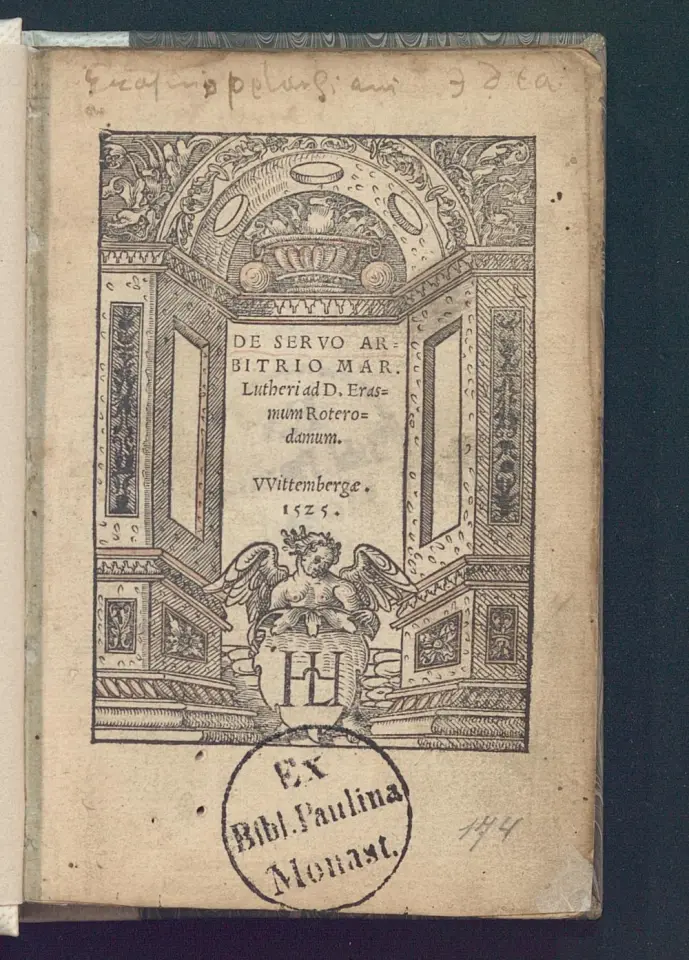
Under pressure from the pope and others (González names Henry VIII and Adrian VI), Erasmus in 1524 came out against Luther with the treatise On Free Will – on a question on which he clearly and sincerely differed from him. In 1525 Luther answered with The Bondage of the Will, which he considered one of his best works, affirming humanity's complete dependence on grace and predestination; in the same year Zwingli attacked Erasmian free will in his Commentary on True and False Religion. Both reformers held that Erasmus's teaching leads to an overly optimistic conception of human nature. McGrath sees here the moment when the divergence of humanism and the Reformation became obvious to all.
Positions
- Erasmus
- Free will is required by an understanding of the Christian life as virtue; educational methods can reform humanity; he approved Luther's desire for reform but did not accept a break with the papacy
- Luther
- To affirm free will is to deny sinfulness and means that one has not heard the Word in either law or gospel; complete dependence on grace
- Zwingli
- Education cannot reform sinful humanity; the intervention of Providence is needed; God, not humanity, is the main actor of reformation
- Lane (assessment)
- Luther went beyond Augustine (as did Bradwardine), attaching no importance to psychological freedom of the will and declaring that it does not exist even in morally neutral matters
Key points
- Zwingli's programme in Zurich (1519) was humanist and educational; a letter of 24 July 1520 reflects the admission of its failure
- Many humanists found the emphasis on human sinfulness and God's omnipotence unacceptable
- The relationship between Erasmus and Luther was permanently damaged; Erasmus remained on good terms with Melanchthon
- Erasmus drew ever further from the Protestants, but his moderation found no place in the Catholic camp either
- Erasmus’s writings were placed on Paul IV’s first Index of Forbidden Books
- Rummel: Erasmus’s Diatribe (1524) set passages for and against free will side by side; lacking an answer, he was ready to suspend judgment, and replaced the missing solution with the Church’s voice: Scripture’s teaching, the Apostles’ Creed and council decrees are beyond dispute. In On the Bondage of the Will Luther reproached Erasmus for wanting “to compare everything and affirm nothing”: “the Holy Spirit is no skeptic” (sect. 2); in the Hyperaspistes Erasmus explained his skepticism as refusing hasty definitions, excluding what Scripture reveals and the Church transmits. Erasmus’s cooling toward Luther after 1521 was read as timidity or pacifism, but epistemology explains it better: consensus as criterion of truth. Erasmus at first supported Luther, though from the start he had reservations about his confrontational style and assertive manner
- Hendrix: in On the Bondage of the Will (1525) Luther taught that before grace the will is enslaved to sin, and the Spirit frees and constantly holds it in faith; he compared the will to "a beast" ridden by God or Satan, which cannot choose to which rider it will run (sect. 24) and faulted Erasmus for repeating the nominalist argument
Outcome
An open break between humanism and the Reformation; according to González (HCT), a moderate position between Catholicism and Protestantism became difficult for four centuries.
People
- Erasmus of Rotterdam
- Martin Luther
- Huldrych Zwingli
- Philip Melanchthon
- Henry VIII
- Adrian VI
- Paul IV
Terms
- free will – liberum arbitrium
- The concept defended by Erasmus in 1524.
Place
Wittenberg, Zurich
Sources disagree
On Free Will – 1524, The Bondage of the Will – 1525 (Lane, McGrath); González (HCT) does not date the treatises ("after 1521"); in McGrath's text Zwingli's Commentary is dated "March 1515" – from the context a misprint for 1525.
Sources
Primary sources
- Luther – The Bondage of the Will, sec. 2, 24
Textbooks
- Justo L. González – A History of Christian Thought in One Volume (Abingdon, 2014), p. 281–282
- Alister McGrath – Reformation Thought (Russian edition: «Theological Thought of the Reformation»), p. 96, 179–181
- Tony Lane – Christian Thinkers (Russian edition), p. 151, 158–159
- The Cambridge Companion to Reformation Theology, ed. David Bagchi, David C. Steinmetz (2004), p. 42, 42–43, 43, 61–62
Related entries
- Develops: The Reformers on Original Sin and Total Depravity: Luther and Calvin (1517–1559)
In church history
- The Erasmus–Luther debate on free will (1524–1525)
Data compiled: 2026-11-17