1524–1525 · 16th century
The Erasmus–Luther debate on free will
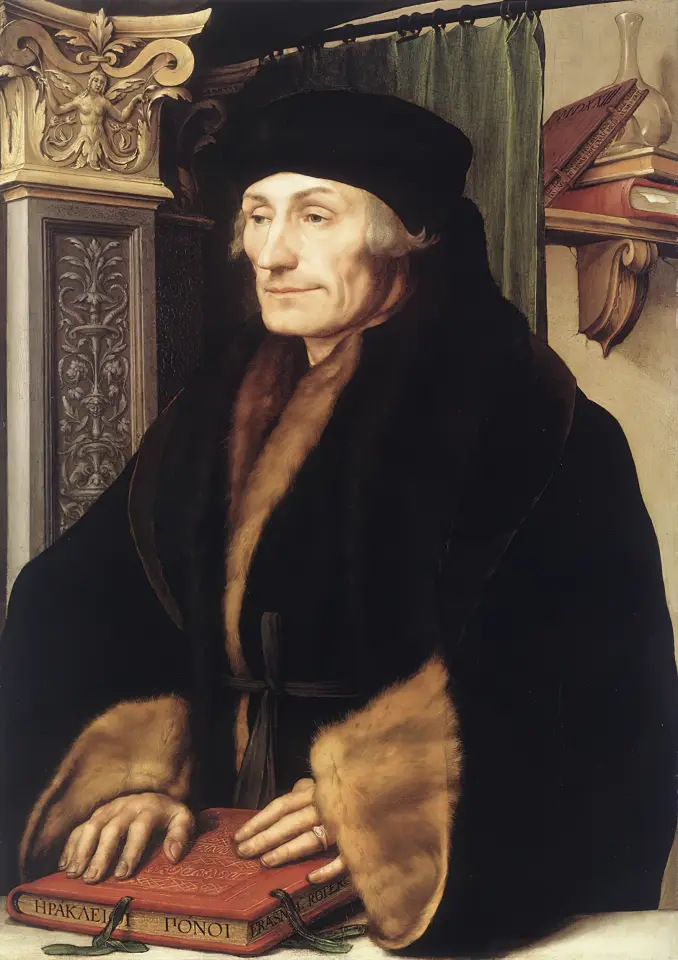
Under pressure from Henry VIII, Pope Adrian VI and others, Erasmus challenged Luther in 1524 in the treatise "On Free Will". Luther replied in 1525 with "On the Bondage of the Will". That same year Zwingli expressed views similar to Luther's in his "Commentary on True and False Religion". The debate concerned the role of the human being and of grace in salvation.
The debate publicly sealed the break between humanism and the Reformation. A moderate middle position became almost impossible, and the relationship between Erasmus and Luther was permanently damaged.
Key points
- Erasmus's challenge to Luther under pressure from Henry VIII and Adrian VI (1524)
- Luther's reply (1525) and Zwingli's similar position
- The break between humanism and the Reformation
- Melanchthon remained on friendly terms with both
People
- Erasmus of Rotterdam
- Martin Luther
- Huldrych Zwingli
- Philip Melanchthon
Place
Basel; Wittenberg; Zurich
Sources
- Justo L. González – A History of Christian Thought, vol. III: From the Protestant Reformation to the Twentieth Century (Abingdon, rev. ed. 1987), p. 28, 55
- Tony Lane – Christian Thinkers (Russian edition), p. 154–155, 161–162
- Justo L. González – The Story of Christianity, vol. II (Russian edition), Part 1, ch. 4
- Alister McGrath – Reformation Thought (Russian edition: «Theological Thought of the Reformation»), p. 96, 180–181
More on the doctrine
- The Controversy over Free Will: Erasmus against Luther and Zwingli (On Free Will, The Bondage of the Will) (1524–1525)
Data compiled: 2026-11-09